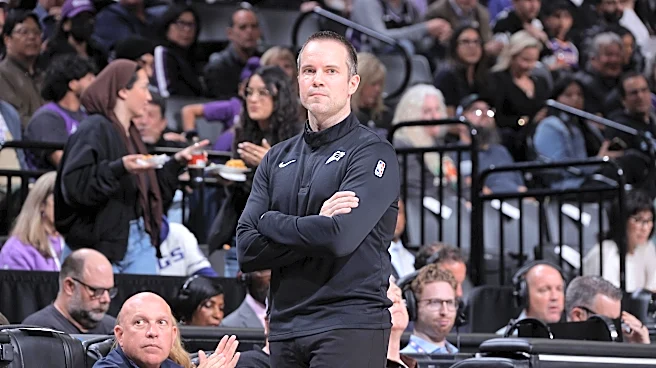


You can talk about all the things that make the 2026–27 Phoenix Suns interesting and intriguing, because they really are heading into next season. This is a team that didn’t make many major splashes, but instead focused on improving what they already had. Continuity and development will be the key factors defining success for Phoenix next season, and while we can talk about different rotations and the players they apply to, there may be no more important figure than second-year head coach Jordan
Ott.
He’s the captain, the one steering the ship, and he too provides continuity. For the first time since the 2022–23 season, the Phoenix Suns will have the same head coach in consecutive years. So continuity is checked. Development is where things get more interesting, because Ott’s personal growth will ultimately filter down to the team.
So what does development look like for Jordan Ott in Year 2?
There’s the surface-level answer, and it’s probably where most of the fan base sees the biggest opportunity. Don’t fall in love with certain lineups. Be willing to adjust based on the matchup. Too often at the back end of last season, when size was needed, we didn’t see Khaman Maluach or Rasheer Fleming get enough opportunities. Even with Mark Williams missing 16 of the final 20 games, Maluach still didn’t get much run.
You can defend that by looking at the analytics and seeing the impact Oso Ighodaro had. But when the team is getting outrebounded night after night, you start to care less about how Oso opens things up offensively and more about finding some defense and rebounding. Especially in games where the Suns fell apart in the fourth quarter.
Ott is the analytical type, and I think part of his development in Year 2 is learning to trust what his eyes are telling him night to night rather than leaning so heavily on the analytics. Part of coaching is feeling the game. It’s recognizing how guys are playing, sticking with someone a little longer than expected because of what you’re seeing, or giving a player an opportunity because you believe he can affect a specific matchup. That can’t always be dictated by numbers.
Granted, we don’t know what happens in practice or how Ott evaluates those performances, and that could have played a role in who ultimately saw the floor. But he left a lot of levers untouched last season, and part of his development is learning when and where to pull them.
Development for Ott also means expanding his system. The Suns have put him in a position to be successful because he doesn’t have to spend as much time teaching the basics as he did last year. The roster wasn’t flipped, so much of that foundation has already been downloaded and instilled. Now the question is how he builds on it schematically.
Ott wanted to generate extra possessions, and he did that last season. The Suns finished fourth in the NBA with 9.5 steals per game, fifth with 19.9 points off turnovers, and sixth with 16.4 second-chance points per game. So he clearly knows how to create extra opportunities. The next step is turning more of those opportunities into production in the paint, where Phoenix ranked 29th in the league at 43.1 points per game. Generate turnovers. Get easy buckets. That feels like a natural area of growth.
Lastly, I think second-half adjustments will be another key part of Ott’s development. He was too inconsistent in that area last season, and you can see it in the numbers. Phoenix ranked 16th in scoring in the first half of games, then fell all the way to 29th in second-half scoring. Effective head coaches can recognize what is happening, adjust, and counter the opposition’s actions. I thought Ott showed he was capable of that last season. It simply didn’t happen consistently enough. He’s entering only his second year as a head coach, and this is an area where growth could have a significant impact on winning.
Ott has been even-keeled and strategic, a player’s coach through and through. After an unbelievably rough season with Mike Budenholzer at the helm, he provided much-needed stability at the position. In many ways, he reflects the organization as a whole. The Suns have stabilized. Now they need to grow. The continuity is there. The next step is turning that continuity into development, and that development into wins.
That may ultimately be the biggest challenge of Year 2 for Jordan Ott. Last season was about establishing an identity, creating stability, and getting everyone moving in the same direction. This season is about evolving beyond that foundation. Better adjustments. More flexibility. A deeper understanding of when the numbers matter and when the game demands something different. The Suns are betting heavily on development this season, and that development has to include the guy standing on the sideline.