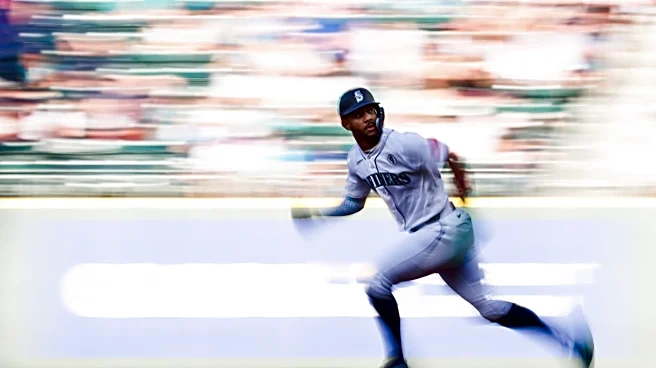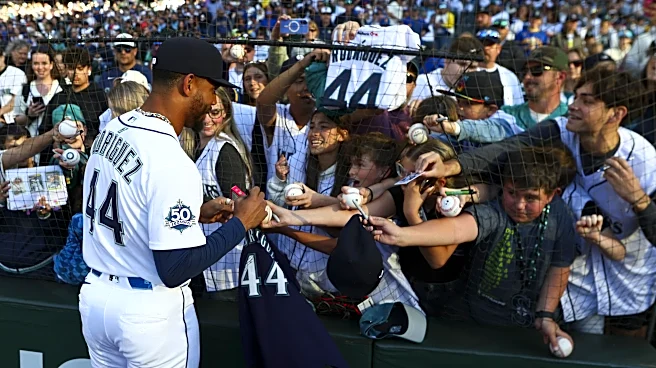




About this time last year I made the case for Julio Rodríguez as an All-Star. It was a pointed response to the discourse of the day: his latest slow start at the dish. I didn’t think it was a fair (or even accurate) characterization of his season to that point. At the time, Julio was seventh in bWAR and 17th in fWAR. He was having a better-than-average season at the plate, a great season on the bases, and a great season in the outfield. He was the best center fielder in the American League, regardless
of our expectations for more.
To appreciate Julio, I argued, one must appreciate him as an all-around player.
If you expected Julio to be the single greatest player in MLB history, you might be disappointed in his performance to this point in his career. But if you expected him to be great, if you expected him to be among the league’s best players, if you expected him to help the Mariners win games, that’s exactly what Julio is doing right now.
Since that day, Julio has been simply one of the 25 best hitters in baseball. You will find his name on the wRC+ leaderboard near James Wood, Vladimir Guerrero Jr., and the other great hitters in the majors. This isn’t Julio beating out long grounders to shortstop, either. His ISO is .229. His 35 homers rank 10th. He’s all of a sudden one of the top power hitters over the last calendar year, highlighted by 10 homers in May — the most he’s ever hit in a month.
The early-season handwringing over Julio’s early performance is now laid to rest. But as All-Star voting opens in 2026, a new dilemma takes its place.
Julio Rodríguez is not an All-Star in 2026. Not by the criteria I used last year, at least. He’s 62nd in bWAR; he’s 76th in fWAR. He isn’t a top 10 outfielder in the American League today. If the Mariners have an All-Star in 2026 by WAR, it’s Randy Arozarena, or perhaps Bryan Woo.
There’s still more than a month before the break — Julio in 2025 would earn his All-Star nod over this same stretch — and I wouldn’t put it past him to do so again. But through this date in 2025, Julio was worth about 50% more wins than he is today.
Where’s the WAR?
The difference between Julio then and now is defense. Not only has he not been good in the outfield, he’s actually been in kind of bad. By Outs Above Average from Baseball Savant, Julio’s -4 OAA makes him the worst qualified center fielder in baseball. This is surprising because, from 2022 through 2025, Julio was one of the five best.
It’s not weird for a player to get worse on defense over time, especially at a position like center field that requires lots of running. Sprint speed is typically the highest it’ll ever be the day a player debuts, and it’s the first tax the aging curve comes to collect.
But as I wrote in the offseason, Julio should expect a few more very good seasons in center if he were to follow the standard aging curve. He’s still just 25 after all. And really, the data that Savant publishes doesn’t suggest some sort of precipitous, age-related decline. His sprint speed is down hardly a skosk, and his overall jump in the outfield (how many feet he covers toward a batted ball in the first three seconds) is identical to last year.
It’s important to remember how Julio has typically gotten to the top of the fielding leaderboards. Between 2022 and 2025, no player made more one- and two-star plays, according to Baseball Savant. These are the easiest, non-routine plays an outfielder can make (routine plays being considered zero stars). Julio made 229 of 239 one- and two-star opportunities over those four seasons. That’s 96%. That’s extraordinary.
What’s limited Julio to the “next-best” tier in the outfield is he’s only been about average at making very difficult plays. In that same span, he caught 40% of his three-, four-, or five-star opportunities. Pete Crow-Armstrong caught 66%, and so he’s the best.

On one- and two-star plays this year, Julio is just 19 of 24. Another way to put it: He’s already missed as many of these plays as he did an all of 2024 and 2025 combined, in just 15% of the opportunities. It’s worth looking at the misses. The first four in the reel below are one-star plays, the fifth is a two-star play, and the final clip is a zero-star play (the rarest miss of all):
The first play: Julio ranges back and overruns the ball. He reaches with a pirouette, and it ticks off the end of his glove. It’s a bad route, which is rare to this point in his career.
The second play: Julio ranges back and to his right this time, slowing down and speeding up, measuring whether the ball is going to land in play, or bounce off the wall, or require a leap, and hey where is that wall by the way-, whoops, the ball is landed for a double. This is, frankly, not an easy play. It’s given one star, because he had plenty of time to cover that ground, which he did. But the wall made things tricky, and that’s not an easy to thing to model in a statistic like OAA. If anything, this is the type of play that you hold in your pocket when you use defensive metrics — they’re fantastic tools, but sample size is important. It’s also worth noting this play happened the same night as the first. Maybe he just wasn’t seeing the ball well in an outfield he rarely visits.
The third play: This one was awkward. He tracks straight back, gauging how close he is to the wall. He times his leap, realizes he’s off, and whiffs as collides with the wall. Whoops. In his defense, it was pouring — notice the water pooling on the warning track. Build a roof.
The fourth play: Julio simply doesn’t break in hard enough on a soft line drive. He’s caught in between, and chooses to play it on a hope, rather than dive. It was 45 degrees in Minneapolis on the final day of a road trip. Fine.
The fifth play: Julio starts back on a liner off the end of the bat, but the ball dips and changes trajectory. He crashes in and gives it a slide this time, but he soon realizes his only play is to knock it down. It’s a two-star play, the hardest of the makable plays.
The sixth play: Julio charges way in and slides, slides, slides right past the ball. I think he loses it in the roof, so I give it a pass, because that means the Mariners have a roof. But, yeah, zero-star play. That’s one you want every time.
There’s some themes here. Julio is clearly getting to these plays. This isn’t Angels’ Pujols chugging the bases, overmatched by the space in between. Julio is simply misreading the ball mid-route. Five are in away parks, one is with the roof closed at home. Each play is tricky. Makeable, but tricky. Again, these are the plays Julio has perfected the last four years. These are the plays that justify his very good defensive metrics… of the past.
What do I expect going forward? I think he’ll continue to be the same, great center fielder. None of these six plays scream “defense in decline” to me. If we get to the end of the year with these issues still around, maybe I’ll reconsider. But I just don’t think that’s likely.
I’ve often hoped to write the Analysts Guide to Julio Rodríguez’s Swing and Approach. But I quickly tap out after an hour looking at the data. He’s not a “consistent” hitter. Sometimes he’s hyper aggressive, swinging early and trying to shoot the gap through the right side of the infield. He’s never quite made enough contact for this to work. Sometimes he’s more patient, working counts while hunting a specific pitch — maybe the fastball in, maybe the hanging hook — but this approach is often undercut by his propensity to chase. He moves forward and back, left and right, up and down. He doesn’t want to talk about it.
But whatever this is, right now, it’s working. We got two of weeks of a slump to start the year (maybe he was cold), and since April 10, he has a 144 wRC+, .254 ISO, 13 homers and 13 doubles. This is clearly not the version of Julio we saw the first two months of last year, even if that slappier approach was technically working. He’s no longer going after the first pitch. He’s chasing fewer breaking balls out of the zone. He’s hammering anything over the middle of the plate — even the high stuff. And he’s getting the ball in the air and to the pull side.
If we want to think of his career as one long, continuous half-season, we can see that Julio has kept this pace (or more) for nearly a calendar year. I don’t see why that wouldn’t continue, and who knows, maybe we’ll get another transcendent final third.

It’s no longer early. The dream of a 10-win season Julio season in 2026 is likely dead, for those of us who care about WAR as a matter of legacy. But the spirit of that season is still very much alive. Despite the miscues, I’m as confident as ever in Julio’s ability to play center field. And at the plate, this is arguably the best, most reliable, most sustainable approach we’ve seen him hold in a long time. Maybe Julio is not quite an All-Star. I still think he will be.