
A few years ago, I retroactively looked at some of the Phillies’ offseason moves from years past and graded them on how well they eventually played out. As part of my Chaunkkah celebration involving the number eight, I will now look back on the 2008 offseason.
Heading into 2008, the Phillies were coming off their first postseason appearance since 1993, even if that appearance didn’t last very long. Still, the Phillies considered themselves to be championship contenders, and their moves under general
manager Pat Gillick were made with that mindset.
The big moves
- Signed third baseman Pedro Feliz as a free agent
- Signed outfielder Geoff Jenkins as a free agent
- Signed relief pitcher Chad Durbin as a free agent
- Signed outfielder So Taguchi as a free agent
- Re-signed relief pitcher J.C. Romero
- Sold third baseman Wes Helms to the Miami Marlins
- Traded Michael Bourn, Mike Costanzo, and Geoff Geary to the Houston Astros for Brad Lidge and Eric Bruntlett
How did it work out?
The foundation for the World Series champions was laid much earlier, but Gillick did a good job of rounding out the edges of the roster.
Helms had been a disappointment at third base in 2007, so the Phillies replaced him with Feliz. Feliz wasn’t a star, but he was a solid defender with just enough pop to make himself viable lower in the lineup. He would go on to get the game-winning RBI in game six of the World Series.
Geoff Jenkins was disappointing, as the former All-Star was supposed to be the left-handed side of a right field platoon with Jayson Werth. But Jenkins struggled and Werth thrived, so the job eventually went full time to Werth. So Taguchi was brought in as a bench piece, and his presence laid the groundwork for many more Japanese players to come to the Phillies. (Someday.)
Bringing back Romero was key, as he was an effective, durable left-handed setup man who pitched in 81 games that season. He was joined by Chad Durbin, who was effective in middle relief (although I never trusted him in a big spot.)
But the signature move of the offseason was the trade for Brad Lidge and Eric Bruntlett. The Phillies needed another starting pitcher and came to the conclusion that their best option was to turn starter-become-reliever Brett Myers back into a starter. To replace him as closer, Gillick worked with old friend Ed Wade to bring Lidge to Philadelphia.
This move shouldn’t have worked out. Bourn was a young, cost-controlled outfielder with plenty of speed and great defensive skills. And the Phillies traded him for a closer. And not just any closer; one who was coming off two inconsistent years and was rehabbing from an injury. (Bruntlett was mostly a throw-in. He was a fine defensive infielder who couldn’t do much with the bat but lives on in Phillies history thanks to his unassisted triple play.)
But as we know, the move did work out. Myers was inconsistent in his return to the rotation and was even demoted to the minors at one point. But he eventually got his act together and pitched well down the stretch. (Even if his most memorable moment from the postseason run came while he was at the plate.)
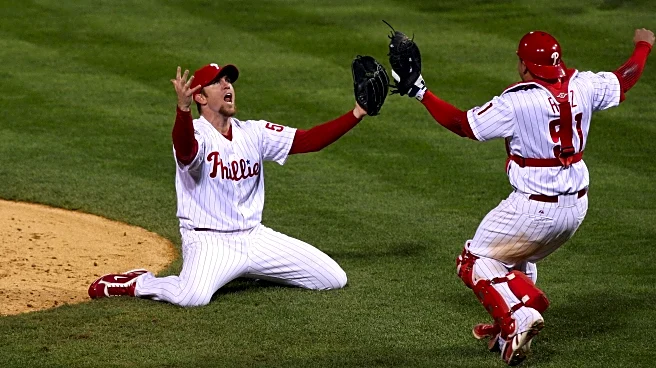
As for Lidge, he turned in perhaps the greatest season ever by a closer. He didn’t blow a save all year, and him falling to his knees after striking out Eric Hinske will forever be remembered by Phillies fans.
The trade looked somewhat worse the following season when Bourn developed into an All-Star and Lidge was awful. But as they say, flags fly forever, so no regrets.
Analysis and Grade
This wasn’t a perfect Howie Roseman style offseason where every single move hit, but the Phillies made a lot of good moves to supplement a great core, and it resulted in the franchise’s second World Series title. For that alone, the offseason receives an A grade.
Grade: A