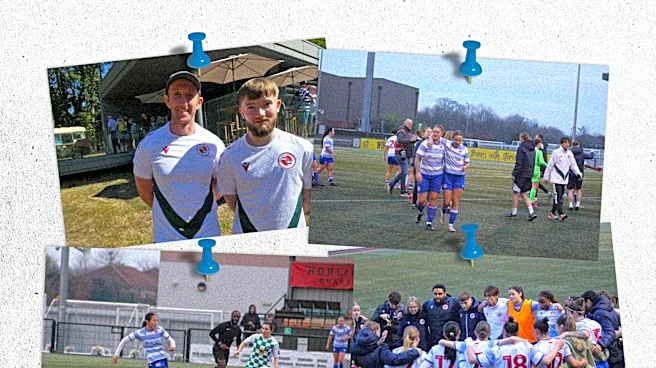








This time last year, the mood music was all about how Reading had survived – beating the odds and avoiding further relegation – with an eighth-place finish in a league of just 10 teams.
Fast-forward 12 months and there’s a new air of ‘what could have been?’, with the Royals finishing just six points short off automatic promotion through the top spot (taking four points from champions Wycombe Wanderers along the way), ending the season in fourth: behind Wycombe, Winchester City Flyers and AFC Portchester.
It’s been a ridiculously close contest for first place, with teams in the top half of the table taking points off each other. In winning the league, Wycombe lost one match and finished on fewer points than last season (with one additional team in the league in 2025/26). The top five sides (Southampton finishing below Reading on goal difference) were separated by just two league victories.
After having saved the Women’s team from extinction last season, huge credit must once again go to the Community Trust and the head of women’s and girl’s football Emma Hopkins. A fourth-place finish – within touching distance of the top sides – demonstrates that the upwards trajectory for the Women’s team is back on track and the Royals are on the right path.
A season of transformation
Bold decisions were made at the start of the season, which transformed the team from one of relegation survivors in 2024/2025 to genuine title-chasers in 2025/26. In July it was announced that Ed Jackson-Norris was to be the new first-team manager (taking over from Pedro Bruno), alongside his role as player development lead within the Community Trust.
In deciding to take the short journey from Maidenhead United Women, Jackson-Norris not only brought a wealth of knowledge and experience from a higher level (tier four), but also a trusted and valued coaching team. Max Scott and Ryan Robinson arrived as assistant manager and goalkeeping coach respectively, together with a flock of Magpie players, all of whom looking to be a part of Reading’s new and exciting challenge.
It turned out to be a 2025/2026 season which could also be split in two. Although the points tallies were similar in both sections – Reading racking up 19 points in the first half and 20 from the remaining 10 matches – other statistics told a different story.
As the team gelled, so did the confidence, belief and consistency in both performances and results. During the second half of the campaign, the Royals’ attacking prowess changed considerably – the team scoring 30 goals and conceding just nine, compared to 18 for and 12 against in the opening half of the season.
So it was perhaps not a surprise that, after another big change in personnel, and with the new squad still being narrowed down during pre-season friendlies and trials, it took a while to get the team settled, in tune and running on all cylinders. And probably a bit longer than the coaching team – and ever-optimistic fans – had hoped for.
During the the second match of the season, when Reading conceded an 85th-minute goal to lose 2-1 to newly promoted Beaconsfield Town, it felt like the Royals had ceded one of their limited lifelines a little too early.
However, with the exception of the nemesis of Winchester City Flyers (both of these matches coming too early in the season), the results in early games were still very good. In the league they beat Southampton and Sholing, at the same time as dispatching lower-tier opposition, with some ease, in both the FA Cup and League Cup.
Being Reading, there’s the club badge to factor in too and the reaction, expectation and responsibility that come with it.
Away from the pitch, it’s fair to say that, although sporting the same club emblem, both the Community Trust and Women’s team appear to be a side of the ‘Reading family’ which is often overlooked, ignored or undervalued by some fans – and possibly by some individuals within the hierarchy.
It’s a badge which not only represents a proud and rich history but also means something to so many, as the Community Trust knows only too well with the amazing charity work, support and projects they provide daily under the banner of Reading Football Club.
It’s evident on the pitch and during a matchday too, for better or for worse. When the new tier-five teams come up against Reading the feedback either seems to be one of misunderstood trepidation – fearing the Royals are still able to field a team of ex-WSL players – or, more often than not, the opponents very much look to raise their game accordingly.
The two matches against Wycombe Wanderers and the cup tie against Maidenhead United (more of that later) were perfect examples of the Reading badge’s effect being in full working action.
In the first match against Wycome, with local rivalry, history and bragging rights at stake – for players and fans alike (with ex-Reading assistant manager Shelley Strange now part of the Chairgirls’ coaching team), the match at the 1878 Stadium exuded an unexpected air of tension and nervousness from the home team.
With the Buckinghamshire team top of the table, comfortably ahead of the chasing pack, the normally free-scoring side (who ended the season with three players in the league’s top five goalscorers) failed to find the net across both meetings, meaning Reading not only became the first team to beat the Chairgirls, but also the first side not to concede a goal too – following up on the 0-0 away result with a 1-0 home victory back at Arbour Park.
These were results that appeared to be pivotal and acted as a springboard for the second half of the season, with the Royals gaining a new-found confidence, resilience and belief in themselves.
The lion, crown and hooped badge was clearly an issue too for the new Maidenhead United manager, and successor to Jackson-Norris.
After a narrow victory in the quarter-finals of the Combined Counties Cup (the match decided by an unfortunate late, freak goal), the Magpies’ boss took the opportunity to post on LinkedIn that his National League tier-four side had achieved their metric with victory over ‘the biggest club in Berkshire’ (or, alternatively, the fifth-tier Southern Region outfit).
Reading, however, had found an inner strength and were ready to handle whatever was thrown at them for the remainder of the campaign, dealing with any setbacks along the way. The squad had settled down to a more manageable number of around 20 players and there was a new-found sense of freedom and attacking style of play – but not at the expense of goals conceded.
With only two defeats in their last 12 matches, Reading finished the season top of the form table, with the 1-1 draw away to promotion rivals AFC Portchester demonstrating just how far they had come.
It was arguably one of the best performances of 2025/26, coming against a team who were at that time pushing to win the league (in the end probably undone by the sheer number of matches that had to be crammed in towards the end of the season). Jackson-Norris’ team were on the front foot from kick-off, deservedly taking the lead but firmly resolute and unfazed after conceding from the penalty spot just two minutes later.
It wasn’t a perfect run, with a couple of blips along the way, but Reading found a new way of winning – or not losing.
One of those blips occurred in a shock 1-0 defeat away to Sholing. It was a match for those who like their matchday metrics. The woodwork, last-ditch defending and some great goalkeeping combined to defy the stats, Reading’s 31 shots (worth an xG of five goals) failing to find the back of the net in a match which the computer said the home side had a ‘less than 1% chance of winning’.
Reading fans’ player of the season: Sophie Butler
Players’ and staff’s player of the season: Jazz King
Coaches’ player of the season: Poppy Whitburn
Golden boot: Nat Cowell (15 goals plus six assists)
PFA community champion: Nat Cowell
Off-pitch success and an odd end to the season
Under the leadership of Hopkins and Jackson-Norris, together with funding from the Community Trust, there’s a clear pathway, via the under-14s and under-16s teams, meaning young girls not only get the chance to play quality football, but also the opportunity to progress to the first team.
Four pathway academy players made their debuts for the first team: Sophie Butler staking her claim as the regular number one and Ellie Szekeres turning out to be the worst-kept (midfield prospect) secret, while Chloe Prangley and Lara Moore both stood out too.
There was further off-pitch success with Reading’s Community Day event in April. A crowd of more than 300 turned up to celebrate the day, join in the activities, meet the players before kick-off and raise money for the charity Breast Cancer Now, before watching the Royals defeat Woodley United 5-0.
That feat was made even more impressive when you factor in that the ‘home match’ event was held at Arbour Park, Slough.
It was an odd finish to what’s been a really enjoyable and progressive season. An entertaining but chaotic final home game saw the Royals lose 5-3 to AFC Portchester, with Jazz King carried off the pitch in what looked like a horrible injury.
Reading’s last match was called off by Fleet Town (for a second time) after they were unable to field a team. That meant the Royals would get all three points, similar to the ‘away walkover’ when Woodley United pulled out of their fixture early in the season.
Although the season ended in a bizarre, worrying (speedy recovery, Jazz!) and disappointing manner, there’s plenty to look forward to next season. With Rick Catania and Alec Lundberg tasked with progressing the Women’s game – both directors being on the sidelines, among the Reading fans for the 2-1 home win against Oxford City – for the first time in more than a few years, the future feels good.
With new open-day trials just around the corner, there should be less upheaval. The new-look 2026/27 squad will be built upon an already-great bunch of players who have been a joy to watch – win, lose or draw.
And of course, there’s the promised announcement, from the owners of the club, of good news to follow shortly.
See you next season!