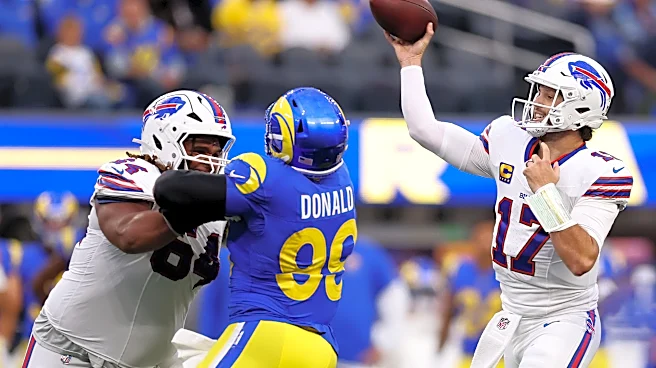





After the Buffalo Bills win over the Rams in Week 5 on Monday Night Football, Josh Allen mentioned he“fighting mechanically some stuff right now” has sent me on a mission to find out what those mechanical issues might be.
Before I begin, this was Allen’s direct quote on this topic at the during his postgame presser in Los Angelels:
“Just early on, didn’t feel like I was in a rhythm [early], wasn’t taking some of the underneath stuff. Fighting mechanically some stuff right now that I’m working on. But
I felt like in that second half I got into a rhythm. Guys made some plays. It’s awesome stuff.”
When speaking with media at UC Irvine on Wednesday, Allen, who will have a pre-planned session with his QB guru Chris Hess while the Bills stay in California, was asked a follow-up question on his mechanics comment, and said this:
“I think it’s every quarterback fights throughout the year. It could be as simple as one thing. Chris Hess is from this area. We had this on the books regardless. But it’s really good to have him out here, and maybe learn a thing or two, and try to find a way to tweak something and feel good.”
And what follows here is just a guess. It’s a guess based on something I noticed early this season from Allen throwing the football. And yes, it feels strange critiquing Allen, one of the most gifted throwers of the football in NFL history.
But here it goes.
I think Allen’s throwing mechanics issue pertains to his release point dropping too low, close to a sidearm delivery.
It hasn’t happened on every attempt, of course, yet there were a few misfires early this season in which it appeared Allen was releasing the football on the same vertical plane as his helmet or even lower.
Like here against the Lions, when he missed Khalil Shakir deep down the field.
I’ve slowed these All-22 videos to half speed, but I’ll admit it’s not especially easy to see how low Allen’s arm angle was on this throw:
I was walking through the concourse when that play occurred and randomly had the ideal vantage point for Allen’s arm angle. I remember being struck by how sidearm it was.
Check here, on a target for Keon Coleman down the field that fell incomplete against the Chargers in Week 3. This one is a lot easier to see:
That’s almost fully sidearm, right?
More recently, against the Patriots, on that strange drop by Joshua Palmer, on a throw that was well behind the receiver, Allen’s sidearm-ish delivery was very noticeable:
Watching that play live, I recall being surprised Allen, despite being under duress, wasn’t able to get the ball far enough down the field to hit a wide open Palmer in stride. That never happens.
Now, Allen is a freak of nature. This we know. And a sidearm delivery doesn’t automatically equate to an inaccurate toss.
Allen has shown he can throw a fastball for a strike from this lower arm angle, like the game-winning touchdown to Palmer against the Texans in Week 1:
Impressive.
But here’s a second layer of speculation — I don’t believe sidearm is Allen’s desired arm angle. I’m certainly not going to be pretend I’m a biomechanics expert. But it’s not something he’s regularly done throughout his career.
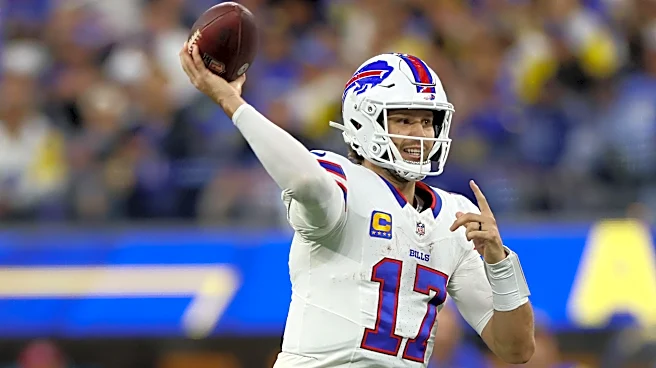
And I’ve seen the vast majority of his ridiculous displays of arm strength on throws in which he rotates his body and throws from a more natural three-quarters delivery in which his right hand releases the football at the top — or above — his helmet. There is more of a driving downward motion as opposed to a horizontal whip.
Like here in the second half against the Rams:
Or on the short over-the-middle completion to Shakir in overtime:
Allen’s hand was much higher than the early-season misfires or even the touchdown to Palmer in Houston. After halftime against the Rams, his delivery looked a lot more “downhill.”
Now, I must write that there are many contributing factors to a quarterback’s release point, particularly an improvisational savant like Allen.
Is he scrambling? Is he rushed inside the pocket? Is he rolling left? Right? Distance of the throw and touch needed on the throw matter too.
And, yes, it’s oftentimes easier to get rid of the football quicker with a sidearm delivery. Think of baseball infielders. We see a distinctive sidearm release all the time as they fire across the diamond or, more frequently, when they’re trying to turn a double play. No doubt you can get the ball out of your hands quicker throwing it sidearm.
Conversely, think of an outfielder crow-hopping before launching a rocket to a base in hopes of nailing a runner trying to advance. They typically release the ball with a three-quarters or fully over-the-top delivery.
The force from the front leg planting into the ground coupled with body rotation transfers energy through the kinetic chain up the body and ultimately into the throwing arm. And while a sidearm release can generate plenty of velocity, the higher the release point, the more empathically a thrower can “pull” his trunk downward right before release to increase the speed of the ball leaving his hand.
A quarterback like Allen whose natural motion is more three-quarters or over-the-top almost assuredly doesn’t transfer that energy as efficiently when dropping the arm angle closer to sidearm. And he likely cannot create as much velocity when doing so compared to when he’s releasing the ball from higher on the vertical plane.
This importantly impacts accuracy too. Allen is more accustomed to throwing from a higher release point. A dip near sidearm could very well impact the timing and coordination of his release.
Writing on this reminded me of Allen’s touchdown to Jake Kumerow back in 2020 in Denver, when the Bills clinched their first AFC East title in 25 years. You know, the one Allen called the hardest he’s ever thrown a football in his life.
Watch how close to over-the-top this release was on this throw. A visual clue to discern between sidearm and three-quarters or over over-the-top if you can’t see the arm because of how fast it’s moving — watch the head. If it moves downward right before the release, it’s the more fundamentally sound three-quarters or over-the-top delivery. If the head doesn’t dip, it’s sidearm.
The head dip is a clear sign of the aforementioned body pulling down motion.
You’ll see Allen’s helmet move downward on that throw against the Broncos:
So that’s where I land on this niche topic — I believe Allen is working on maintaining a higher release point for velocity and ball-placement purposes, which are quite important for an NFL quarterback.
And sure, Allen can make accurate throws while dropping his arm angle close to sidearm. And in some instances, he might have to use that delivery.
But I think he’s at his best — and taps into all of his arm strength and accuracy — when his release point stays higher.