


Now that the ball has been tipped and the madness has begun, we turn our attention to the many draft prospects the Mavericks will start evaluating at the end of April. Moving over to the South Region, this is one of the more interesting parts of the bracket when you look at it through a draft lens. Florida sits at the top as the one seed, but the real story here is the cluster of NBA talent spread throughout the middle of the region. There’s a strong mix of high-upside guards and versatile forwards,
with several guys who are firmly in the lottery conversation and a few others trying to play their way into it. This is the kind of region where a couple of big games can completely reshape how teams view certain prospects. Let’s get into it.
Kingsten Flemings (G, Houston)
Perhaps no freshman guard has changed his team’s identity more than Flemings, who has given Houston a level of offensive dynamism it hasn’t consistently had in recent years. Averaging around 16 points and 5 assists on strong efficiency, including a 42-point breakout performance, Flemings has established himself as a true lead guard prospect and a firm lottery candidate. He has the handle, pace, and shot creation of a modern primary, and on a Houston team that traditionally suppresses guard numbers, his production stands out even more.
With Darius Acuff rising and starting to generate real buzz as a potential first point guard off the board, Flemings enters March with something tangible to prove. A deep run where he consistently controls games, making advanced reads, limiting turnovers, and creating efficient offense against loaded defenses, would allow him to reassert himself as PG1 in the class and push firmly into the top-5 conversation. This is as much about ownership of the position as it is production, especially with other guards building momentum late. At the same time, tournament defenses will test his decision-making and ability to handle pressure, and any dip in efficiency or control could open the door for others to pass him. In a class where the guard hierarchy is still fluid, perception can shift quickly based on a few high-leverage games. If he thrives, he solidifies himself as a true lead guard; if he struggles, he risks being viewed more as a secondary creator than a primary engine.
First round game: Houston vs 15-seed Idaho
Bennett Stirtz (G, Iowa)
Stritz has quietly put together one of the most complete freshman guard seasons in the country, operating as the engine behind Iowa’s offense. Now averaging around 20 points and 5 assists on near 50% shooting and high-30s from three, Stirtz has built his profile on polish, pace, and decision-making rather than overwhelming athleticism, landing him firmly in the first-round conversation.
March becomes a proving ground for whether his skill-based game truly translates against high-level athletes and defensive pressure. If Stirtz can lead Iowa to an upset while controlling tempo, generating efficient offense, and minimizing mistakes, it would validate what scouts already see in his feel and pick-and-roll command. That kind of performance, where he looks like the most composed and effective player on the floor, could solidify him as a true first-round guard. At the same time, this setting will test his physical limitations, particularly his ability to create separation and finish against length. If he struggles to get to his spots or becomes a defensive target, it reinforces concerns about his athletic ceiling at the next level. Because his value is rooted in efficiency and control, any disruption to that rhythm becomes magnified. This tournament will ultimately answer whether his game scales to NBA-caliber athleticism.
First round game: Iowa vs 8-seed Clemson
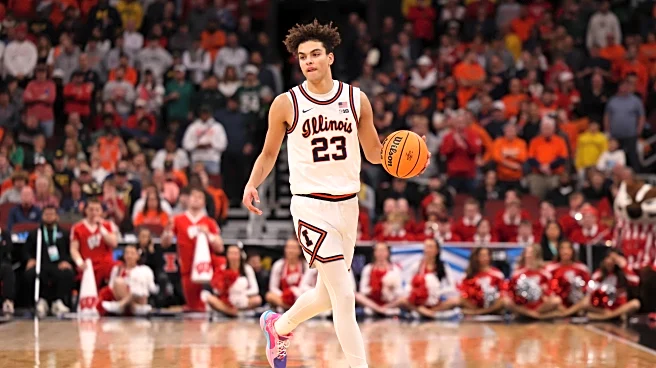
Keaton Wagler (G, Illinois)
Wagler has been one of the biggest risers on draft boards since the start of the season, averaging nearly 18 points, 5 rebounds, and 4 assists as the engine of Illinois’ offense. At 6’6, he offers size, shot creation, and playmaking, but what separates him is his ability to generate efficient offense at all three levels without forcing the issue, positioning him firmly in the lottery conversation.
This tournament is about proving he can scale that efficiency against elite defenses. If Wagler runs Illinois’ offense deep into March while continuing to make advanced reads, limit turnovers, and maintain efficiency against heavy scouting, it solidifies him as a true primary guard at the NBA level. Scouts want to see how he responds when defenses load up on him and force him into difficult decisions, and a strong run could push him firmly into the top-5 conversation. However, because his value is built on control and decision-making, any cracks in that foundation will stand out. If he struggles with shot selection, gets sped up, or becomes turnover-prone, it raises questions about whether he can consistently operate as a lead initiator. The margin for error is smaller for players like Wagler, whose game is rooted in precision rather than explosiveness. A clean, efficient tournament run elevates him; a shaky one introduces real doubt.
First round game: Illinois vs 14-seed Penn
Thomas Haugh (F, Florida)
Haugh has emerged as one of the most dependable “glue guy” forwards in the country, doing a little bit of everything for a winning Florida team. Known for his high motor, defensive intensity, and off-ball impact, Haugh projects as a 3-and-D forward with strong rebounding and positional versatility, drawing comparisons to Cameron Johnson or Dean Wade with more athletic pop. He thrives in transition, makes quick decisions, and consistently impacts the game without needing the ball, placing him in the mid–late first round range.
March presents an opportunity for Haugh to expand his offensive profile. If he can take on more responsibility attacking closeouts, creating in late-clock situations, and scoring efficiently against set defenses, it would elevate him from a high-floor role player into someone teams trust in bigger moments. A deep run where he consistently impacts winning on both ends could push him further up boards as a plug-and-play playoff piece. At the same time, if his role remains primarily off-ball and he doesn’t show flashes of self-creation, it reinforces the idea that he’s more of a complementary piece than a driver. That isn’t a negative, but it does cap his ceiling relative to other prospects in his range. Scouts will be watching for any signs that he can create his own offense when needed. This tournament will help define whether he’s simply a high-level role player or something more.
First round game: Florida vs 16-seed Prairie View A&M
Caleb Wilson (F, UNC)
Wilson made a statement in the early part of the season, averaging nearly 20 points and 9 rebounds on elite efficiency, while also contributing as a passer. Wilson has firmly planted himself in the top-5 conversation all year. At 6’10 with mobility, touch, and two-way instincts, he looks the part of a modern NBA forward.
Because of injury, Wilson enters March in a uniquely vulnerable position where he has little opportunity to raise his stock while others continue to build theirs. With Darius Acuff, Kingston Flemings, and Keaton Wagler all capable of making deep runs, the spotlight shifts away from him at the worst possible time. In a draft cycle driven heavily by late-season exposure, strong tournament performances from those guards could make it easier for teams to justify sliding Wilson down boards. The concern isn’t that his talent has changed, but that others may answer key questions in real time while he cannot. For a player who has been comfortably in the top 5 all season, this is one of those rare situations where his stock can only move in one direction if others shine. If multiple guards dominate on the biggest stage, Wilson could find himself pushed out of the top tier despite doing nothing wrong on the court.
First round game: North Carolina vs 11-seed VCU (out, hand)