
Interview recorded April 2022
Zaid grew up in the Bedford-Stuyvesant neighborhood, in the New York City borough of Brooklyn.
“It’s a Dutch name, I grew up there a long time ago,” Abdul-Aziz said with a laugh.
He played prep basketball at John Jay, and never thought too much of himself as a player.
“You know something I really didn’t have much of a high school career because I didn’t think I was that good,” he said. “So even though I was playing very well, I never had a big head or anything, I just thought I was an average player.”
Zaid was introduced to Iowa State University by fellow Brooklyn native and Class of 2018 Iowa State Hall of Famer, the late Hank Whitney.

“I would say it was Hank Whitney,” Abdul-Aziz said. “Whitney was the guy who played about 10 years before me at Iowa State. He set up a game with me and him to see if I had any skills. I pretty much dominated Hank Whitney and he called Iowa State.”
“About a week or two later they offered me a scholarship,” he adds. “When I got the scholarship, I asked Hank ‘What’s a scholarship?’, I didn’t know what it was. He said ‘A scholarship is when they pay you to go to school and they pay you to play for the team.’ That first semester, they put me on probation to see to see if I could do the work and I did.”
During Zaid’s adventure at Iowa State, he settled on a major in which he could change the world. After basketball, Abdul-Aziz worked as a chemical dependency professional.
“I wanted to go back to my community and make a difference,” he said. “So I studied sociology and I graduated in that. So and then I became a master’s level counselor in the state of Washington.”
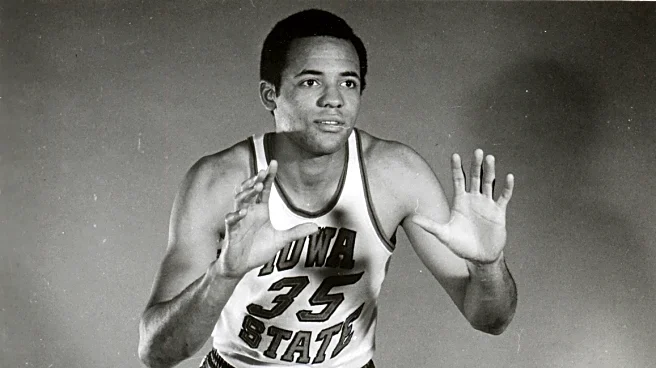
Zaid wore No. 35 at Iowa State and professionally because he wanted to play until he was 35 years old.
Something Cyclone fans and college basketball fans might not know, is that a temporary collegiate-level dunking ban is attributed to moves made by Abdul-Aziz.
“We were playing at Oklahoma State and I got the ball off the glass and I flew it down to a guy by the name Raúl Duarte of Peru,” Abdul-Aziz said. “He went in kind of clumsily and he laid the ball up but he missed it. I come screaming down the court, I grabbed the ball out of the cylinder and I dunked it. So Henry Iba, the legendary coach from Oklahoma State. He goes, ‘Ref! That’s goaltending!’ It was goaltending. The ref said, ‘Sit down, Iba!,’ he said, ‘I’m not gonna sit down!’”

“The ref gave him a technical,” he adds. “So he yells at the ref and says, ‘You know, I’m on the rules committee. Next year, we’re gonna ban the dunk. You watch and see we’re gonna ban it!’ That’s what happened. They banned it that year and I think they banned it for eight or nine years.”
Zaid’s 41 points against the University of Southern California on Dec. 20, 1966, are tied for the sixth most points in a single Cyclone men’s basketball game to this day.

Someone that made a massive difference in Zaid’s adventure at Iowa State was Dorothy Erskine. Erskine, a 1935 Iowa State College graduate, a 1984 “Cy’s Favorite Alum” and Plaza of Heroines member, had a familial bond with Abdul-Aziz.
“I couldn’t have made it through Ames without my mom. I call her, my mom of Ames her name was Dorothy Erskine. She worked at Beardshear I think. When I wanted to go back home and leave, Ames I said Mrs. Erskine, I’m going back to Brooklyn.”

“She said, ‘No, you’re not, you’re coming over for meatloaf, you’re coming over for meatloaf and mashed potatoes,’” he adds. “She said ‘I made you a pumpkin pie.’ If it wasn’t for Mrs. Erskine, I would have went back to Brooklyn. But every step of the way she backed me and helped if it wasn’t for her, I would’ve never made it.”
Zaid averaged a double-double throughout his Cyclone career, 18 points per game and 13 rebounds per game in the 1965-1966 season, 24.8 ppg and 13.4 rpg in the 1966-1967 season and 24.2 ppg and 14.6 rpg in his senior season of 1967-1968.
“Not so many people have ever done that,” he said. “I take a lot of pride in that. Especially the rebounding because that’s what I really love to do.”
Zaid was nicknamed the Kangaroo, and below is one of his first cards during his NBA career which reflects the moniker.

“If you saw one of my early basketball cards, ‘number 35 Don Smith the kangaroo”‘ because I could, you know, I could hop like a kangaroo,” Abdul-Aziz reflects. “There’s a Philadelphia 76ers game when I was with the Milwaukee Bucks, you’ll see me, I’m hopping like a kangaroo. I’m getting all these rebounds and if you look at me, you would think I was a kangaroo the way I’m hopping and jumping!”
Below is a video of him tallying nine boards in a 1969 game against the Detroit Pistons.
LINK
In Zaid’s opinion, rebounding was second nature to his basketball archetype.
“To be honest with you, I was a prodigy,” he shares. “I was just given a natural ability and I really didn’t have to practice that much.”
Zaid’s memories from 1968 NBA Draft, which was held a couple of days before his 22nd birthday, involve how it’s not like how the draft is now, that he didn’t want to head to the team that drafted him and that he met an inaugural inductee to the Rock and Roll Hall of Fame in the elevator.

“It wasn’t like it is now,” he said. “The only thing I could remember is, I didn’t wanna go to Cincinnati Royals. I wanted to go to the Knicks. Me and my lawyer, we traveled to Cincinnati to do the signing and everything, but it wasn’t a big thing like it is today. I signed the contract and I got on an elevator, guess who was on the elevator? James Brown, the singer. I’ll never forget that. I said, ‘Hey, James, how you doing?’ He said ‘I’m fine man, how are you doing?’ He was just a tiny guy. He was like 5’2”-5’3”. He was staying at that hotel where I did the signing. Cincinnati, didn’t treat me very nice. I hardly played. They put me on the bench and they would put me in if we were 22 points up. Well, we were 20 points down. Because the head coach was a good friend of the center Connie Dierking. So they didn’t give me a chance.”

Zaid had a chance to play on the 1968 Olympic team, coached by Oklahoma State’s Henry Iba, but, an English exam and events around the country made him not go for it.
“Well if I wouldn’t have opted out, I couldn’t have taken the senior English exam because, you know, when I was going to school I would just scribble,” he shares. “The scribble was, it was good. I knew what I was scribbling but sometimes I was getting to the point where I couldn’t make it out. So I knew that if I went to the Olympic team, I would never come back to Ames again because here I am a young guy with money. So I decided to stay there and take my senior English exam. There was another reason which was a lot of stuff was going on in the country and people wanted me to take sides with different issues, and, but I just thought I’d be practical. I just said it the way I saw it. So what happened? I passed my senior English exam!”
This portion of the interview with Zaid focuses more on learning more about him, both on and off the court. It’s very likely this portion of the interview will teach you something new about the Cyclone legend.

The first pair of fun facts about Zaid involve both his music tastes while a student at Iowa State and his pre-Iowa State music days.
“I was a doo-wop guy,” Abdul-Aziz said. “I loved The Temptations, The Four Tops, Diana Ross and the Supremes. One group that I loved so much was the Beatles, cause I love the lyrics. I love the way they sang and they were really, really talented. But, my main thing was doo-wop, Stevie Wonder and people like that. I realized a long time ago there’s only two types of music: Good and bad. I found good music. If I heard good music, I would know right away. And if I didn’t have good music, it wouldn’t resonate with me, for sure.”
“Did you know I was a doo-wop singer?,” Zaid asked. “We had a group called The Teenagers and we used to do a lot of singing and, and what was amazing about it was that there was another group called The Teenagers who were Frankie Lymon and The Teenagers. We used to do a lot of singing and, on Friday night, Saturday night and I played the flute.”

Zaid appeared in 109 of his 505 career games with the Bucks, a town he was very fond of both as a player and a member of the community.
“Milwaukee was just a great team,” he said. “I played for them and, Milwaukee was like a university town, and I just loved playing for the Bucks. I moved my mother down from New York to be with me. That was one thing I was happy I did. I got closer to my mom.”
Zaid’s mother, Juanita, was beloved in the Brew City.
“She was a real fan,” he said. “She could play really good basketball, believe it or not. She was just a wonderful woman. Everybody loved her in Milwaukee and cause, you know, sometimes Kareem [Abdul-Jabbar] will come over to my place for dinner, she cooked dinner or lunch or whatever. So it was like a family, a family type of thing for all of us. My favorite meal of meatballs and spaghetti. I love spaghetti.”
Abdul-Aziz found himself wearing a Seattle Supersonics shade of green when he was traded for Lucius Allen and Bob Boozer in 1970.
“I got traded for two all-stars pretty much,” Abdul-Aziz said. “I was just like a piece of meat that was being used to make them happy for other people. But that’s ok. I played with Oscar Robertson, and he saw what was going on with me, they wouldn’t play me. He did the forward for my book. The Great Oscar Robertson says that said that ‘Zaid Abdul-Aziz or Don Smith, as I knew him back then was a great player who just wasn’t given a chance’, which was a big thing that the great Oscar Robertson would say that I was a great player.”
Zaid tallied 4,065 rebounds in the NBA, and noted his ability as one of his proudest accolades.
“One thing I’m very, very proud of is that I got 27 rebounds against the (Capital) Bullets,” he said. “I was kind of sad because there was one thing I always wanted to do, as a, as a player, I wanted to get 30 rebounds and I missed that by three. If you look at it 27 is really 30 you know. I had over, 25 rebounds 25 times.”

“Something that’s really touching to me. I mentioned my mom and everything who was living in Brooklyn,” he adds. “We went to New York, we played the Knicks in Madison Square Garden. I had my career high on Willis Reed. I had 37 points and I think 13 or 14 rebounds and I picked up the most valuable player of the game as we beat the Knicks, with Walt Fraser, uh, Bill Bradley and that team, I think they won the championship that year. So that’s a memory I had that my mom and my nephew came to the game. They saw me have that game, and I think I was 13 for 15 from the field or something like that.”
Zaid reverted to the faith of Islam in 1973, something he details heavily in his book Darkness to Sunlight.
“It’s the probably the most fastest growing religion in the world. There’s over 1.2 billion Muslims in the world,” he shares. “If you took Indonesia, if you took Malaysia, that’s all Muslim. So, Islam, it has no color variable to it. There’s no color. If you’re Muslim, you’re Muslim.”
Abdul-Aziz’s book can be found on eBay, or Amazon, or perhaps a local library. Zaid’s process in both writing the book and writing in general are very relatable. (Note how this interview was recorded in April 2022)
“I’ve always wanted to write a book but like most people, you, you get to the first chapter and you try to put everything in there, you can’t move, you get a writer’s block. So I learned how to deal with the writer’s block,” he said.
“It took me three and a half years to write it,” he adds. “When I wrote it, I wrote it in the, Northgate Mall. I need a background music. I can’t write if there’s no music or some something going on in the back. So the music I was listening to helped me just the background noise help me. I know that sounds strange, though.”
“It starts in my childhood, it starts, you know, and it just keeps moving. I get to Iowa and then it just goes on and on and on. Some of the things I went through in my life. I was so happy to have Amazon pick my book as a success,” he said.
In the late 1970s, Zaid saw that his time in the National Basketball Association was coming to an end. After 10 years in the league, Abdul-Aziz retired in 1978 at the age of 32.

“I was kind of burnt out at that time because I always had to make myself better to get a job. Yeah. And I just got tired of chasing the, you know, chasing that professional level. I just got tired,” he said. “I missed two rings. I could have had a ring with the Bucks. I could have had the rings with the Sonics, so I didn’t get it and I was right there. It’s kind of sad when you look at it.”
Zaid is proud of his efforts in the NBA and he played among some of the best big men to ever play in the NBA.
“I don’t have any regrets. I did the best that I could do. People talk about one guy, I’m not a very tall player, you know. I am tall, I’m tall. I’m 6’8”. Right. But, I play bigger than that. That’s like Charles Barkley. Charles Barkley is only 6’5”. Some people say he’s only 6’4”, you know,” he said. “Well, I played, we played bigger than that and that’s what I’m proud of that. You know, I had to guard Wilt Chamberlin and I had to guard Kareem and I held my own with those guys. It was, they dominated me and we probably had the same stat line. I had 25 points and 12 rebounds. They had that. I’m proud of that. I was able to hold my own with the greats and then Oscar saying I was a great player. What else can I say?”
Zaid has two anecdotes regarding the late Bill Russell, and how sometimes players that become coaches don’t find success.
“I played against Bill Russell one game and he became my coach cause he came to the Sonics,” Abdul-Aziz said. “He was a better player sometimes when you coach, it’s hard to, communicate what you’re trying to do to a team. That’s why when Bird was a coach. He wasn’t very good. And then, Magic Johnson, he was a coach too and he wasn’t very good. So sometimes it’s hard to do that.”
In 1998, Zaid was inducted into the Iowa State Hall of Fame.
“To see my jersey go up was just amazing,” he said. “My family was there, my kids were there, it was just an amazing event.”
To this day, Abdul-Aziz still watches the Cyclones play basketball and is a big fan of his former team and head coach T.J. Otzelberger.