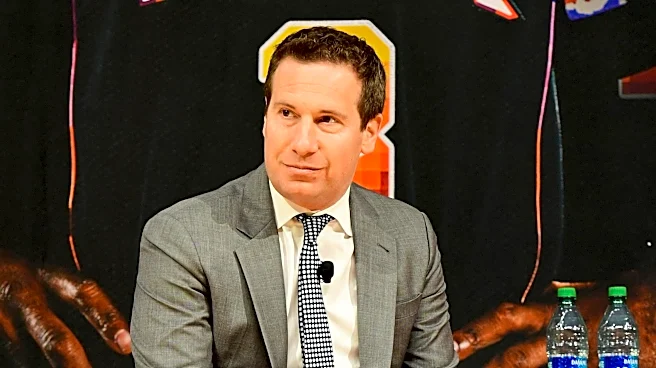



Reports continue to trickle in about how United Wholesale Mortgage, the mortgage-lending firm led by Phoenix Suns and Phoenix Mercury owner Mat Ishbia, has been taking a financial bath this year. Through the first two quarters, the company has reported a combined $622 million in losses, $170 million in the first quarter andanother $452 million in the second. That is what I would classify as “not good.”
I’m no financial analyst, and I’m blessed to be married to an accountant who helps me with my own
finances, so I’m probably the last person you should ask about how markets and financial structures work. But I do know that losing $622 million isn’t a good thing. And when you hear a number like that, as someone who is not only a fan of the Phoenix Suns basketball but also of what Mat Ishbia has done with the organization, you can’t help but get a little worried.
Ishbia has shown a level of care for the fan base. He has rejuvenated the overall experience and placed a real emphasis on making it better to be a Suns fan. This isn’t a Robert Sarver situation, where we were hoping he would eventually sell the team because of the continual frugality. This isn’t a Michael Bidwill situation either, where it feels like the organization is constantly avoiding opportunities to improve the fan experience or the product on the field, while the people at the top operate as if they know better than everyone else. The same strategies continue to lead to failure, and if you challenge that narrative, somehow you’re made to feel like you’re the idiot.
That hasn’t been the experience with Ishbia. He came in, spent big in an effort to win, failed, and adjusted. All the while, he has continued doing everything around the fringes to improve the environment and ecosystem surrounding the Phoenix Suns.
We saw that once again on Tuesday with the announcement that the Suns are installing the largest video board outside any NBA arena. It’s something that will add to the fan experience for people walking into the arena and could eventually become part of postseason watch parties. And if we’re blessed enough to get to June, I’m sure Ishbia will have a plan involving misters and whatever else he can do to make that environment as tolerable as possible. Which, under the relentless power of the Phoenix sun, is going to be a challenge.
All of that being said, when you hear that the business that helped put Ishbia in a position to own the Suns is going through financial challenges, it’s understandable that some concern begins to creep in. How do I know people are concerned? Because I keep getting asked the same question by members of the fan base and by friends. How concerned am I?
Again, I’m no expert. I’m probably not the right person to ask about this stuff, but I still have an opinion and a blog, so I’m going to put it out there.
I’m not concerned one bit.
Why? Because I don’t see the two situations as directly related, and I understand that billionaires live very different lives and play very different financial games than I do.
I’ll start by reminding everyone that Ishbia is worth billions of dollars, not millions. Yeah, “illion” with a “b.” To be a billionaire, you have to be worth more than $999 million, and Ishbia has multiples of that. Forbes currently has his net worth at $6.2 billion.
If there’s one thing we’ve learned about Ishbia, it’s that he’s willing to take calculated risks, and sometimes those risks don’t pay off. Look at Kevin Durant and Bradley Beal. He has shown this behavior before, where he’s willing to take a chance on something and, if it hits, it hits big. If it misses, it doesn’t necessarily miss big. It misses loud.
That’s what happened with the Phoenix Suns two seasons ago when they didn’t even make the Play-In. It was a loud miss, and at the time, it felt like something the organization might not be able to recover from. I can’t tell you how many columns I wrote or how many hours I spent during that stretch with a haze of depression around me as it pertained to the state of the Suns. I thought there were no outs. And yet, the team showed us there are always outs.
The same could be said for this current situation. From my understanding, Ishbia took a gamble that interest rates would drop, and they didn’t. It cost him and his company money. Real money. More money than I can comprehend. More money than I will accrue in my lifetime. But again, billionaires play different games. That’s a gamble he can afford to take, and while it hasn’t worked out strategically in the short term, there’s still a chance it ultimately pays off in the long term.
Take into account that all of this is happening while Ishbia is also buying up and buying out what remains of the Sarver ownership group, a group that wanted so desperately to get a big payday on the way out that they ended up suing him. Ishbia is now in line to control 99% of the Suns. Joe Pompliano notes in the Substack he published today, that, “just because UWM’s stock price is dropping doesn’t mean Ishbia will have to sell the Suns. He has taken enough cash out of the business over the years that he could buy the entire team outright if he wanted to.”
Remember, the team sold for $4.0 billion when he bought it in 2022. So if he ever did find himself in some kind of financial crisis where he needed liquidity, he could sell off portions of the Suns for massive amounts of money. Why? Because owning a professional sports franchise puts you in a position to continually profit as valuations continue to skyrocket.
Look at the Lakers, who recently sold for $12.5 billion. Think about how the Utah Jazz sold for $1.6 billion only six years ago, and I understand there is a massive difference in the marketable footprint of those two franchises. The Celtics sold last year for $6.1 billion. Inflation and rising prices are everywhere you look, from gas to groceries to concert tickets, and the same thing is happening with sports franchise valuations.
In many cases, that cost eventually gets passed on to the consumer, and I’m sure the same can be said for the Phoenix Suns. I’m not a season ticket holder, but it seems like every year when prices come out, there are complaints about 8% increases in some areas and as much as 15% in others. I understand that frustration. At the same time, Ishbia isn’t passing everything on to the customer without giving anything back. He has created cheaper options for fans, added more bells and whistles around the arena, made the team more accessible locally for free, and continued investing in the overall experience. So when you look at the price on your ticket, you’re getting more than a basketball game. You’re getting a broader family experience.
I’m not worried about the business Ishbia runs and whether its current struggles will affect his ability to own and operate the Phoenix Suns. Granted, I do worry about the housing market, which, if The Big Short taught me anything, is a pretty important piece of the economy. If that market were to collapse again like it did in 2008, then yes, that could have a much larger impact on Ishbia. But if 2008 taught us anything else, it’s that big businesses and corporations usually find a way to be okay. The government bails them out, and those of us who can’t play billionaire games watch while they do.
The bottom line is that I understand why people are asking the question, but I don’t think Mat Ishbia’s current business struggles should automatically be viewed as a warning sign for the Phoenix Suns. The numbers at UWM are significant, and they’re worth monitoring, but so is the bigger picture. Ishbia has enormous wealth, substantial assets, and ownership in a franchise that has only become more valuable.
Until there is a legitimate reason to connect UWM’s financial performance to the way the Suns are being operated, I’m not going to manufacture a crisis where one doesn’t appear to exist.