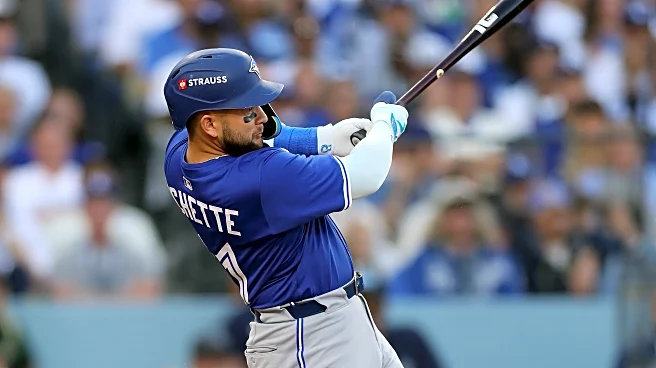


It’s been widely reported that the Phillies are interested in Bo Bichette and met with him on Monday, according to Jon Heyman of the New York Post. Maybe he signed with them (or someone else) by the time you read this.
There are good reasons to like Bichette as a player. He hit .311 with an .840 OPS last season and is two months shy of turning 28. He is younger than Alec Bohm and Bryson Stott and those free agents don’t exist generally. Bichette has an incredibly fun swing to right center field that
is entertaining for any fan.
He has the kind of approach Dombrowski covets in a right-handed hitter with his athletic swing and power to all fields. Dombrowski has signed two different players who fit a similar loose description: Nick Castellanos and Trea Turner.
Those two paragraphs might be underselling Bichette, but hopefully still tell you that he was a very good baseball player last season and has (mostly) had a great career.
However, there are real questions about paying Bo Bichette on a long-term deal and his fit on the Phillies roster.
The goal of this piece is not to provide some massive hot take about what the Phillies should do here. This is all about asking important questions and making key points on Bichette as a player and the potential future with him in Philadelphia.
Clunky defensive fit
By Outs Above Average, Bo Bichette was not only tied with JP Crawford for being the worst defensive shortstop in baseball, but he was one of the worst defensive players in the entire league. He will not play shortstop with the Phillies or for any team thats looking to sign him but it’s not like that absolves questions.
Bichette is not a great overall athlete. His sprint speed ranks in the 21st percentile and his arm would be in the bottom third of the league for third basemen (although arm strength doesn’t really matter there). Some of his range issues would go away at third but it only goes so far. He will have to learn a position he’s never played in his professional career, while not carrying enough athleticism to help make up for early mistakes.
It won’t be as bad from both a performance and overall value standpoint than at shortstop, but it’s still enough of a short-term question to ask. He is not exactly replacing a Gold Glover either, so the Phillies should be fine defensively in 2026.
The bigger and harder-to-answer questions will come in the long term. The Phillies committed five years to Kyle Schwarber earlier this off-season and Bichette is a declining athlete (more on this later). Assuming he signs for 5+ years, we may see a very clunky defensive fit long term that is impossible to ignore without the same offensive output from either player.
Declining Athleticism
Bichette is about to turn 28 so he is not super close to declining on the average aging curve but there are some questions with how he ages. His sprint speed declined from roughly league average to the 21st percentile in the sport, his arm is not the same, and his bat speed saw a slight dip.
The bat speed could’ve been purposeful (more on this later). Bichette had a higher max exit velocity last season than in 2024 and he cut his strikeout and whiff rates down a few ticks.
The other two are harder to explain. We don’t have as much knowledge on why his sprint speed went down or why his arm is weaker. They could be intentional changes or because of a history with certain knee and calf injuries (although none of them were major). Maybe not.
But often, in broad analyses of players, we like to assume that everyone’s aging curve is the same. Every player declines at the same age and every player peaks at the same age. That isn’t always the case.
Here is a great way to put it, Trea Turner and Kyle Schwarber played some of the best baseball in their careers at 32 years old. Nick Castellanos was barely above replacement level in his age 32 season.
There are many factors that go into the aging curve like how much of an outlier they are as athletes. Turner’s combination of speed and power, Schwarber’s bat speed. Those are good traits to bet on aging. Bichette doesn’t have those athletic traits and is already declining as an athlete.
Let’s Talk Bat Speed
I’ve spent this piece asking critical questions about Bichette as a long-term fit on this team and player overall. This section is about defending one of the criticisms he might face.
Bat speed on Baseball Savant is a perfectly fine metric but there are more ways to talk about bat speed. It talks about the average bat speed from the top 90% of a player’s competitive swings.
Bichette’s bat speed was 69.1 mph last season, which ranked in the 12th percentile across all qualified major league hitters. However, his case is unique because of the kind of hitter he is. He prioritizes contact more, which generally correlates with players who have worse bat speeds.
Two other key metrics are important for having this discussion. Bichette’s max exit velocity (max EV) was 112.3 mph last season, which was comfortably above the league average. His 90th percentile exit velocity ranked in the 69th percentile (nice). These show that his average bat speed does not match the raw power he presents.
Bichette also hit .448 with a .655 slug against pitches above 97 mph, which shows that he has no issues catching up with velocity.
When it comes to evaluating someone’s true bat speed, max EV, 90th percentile exit EV, and how the hitter performs against high-end velocity are important points of information.
I’m not going to predict Bichette will age poorly and that a long-term deal is a disaster. Bichette may get a six-plus-year deal and look great the entire time. That is certainly possible!
However, there are real red flags with him that are hard to ignore and it is worth pointing them out and understanding that this is far from a slam-dunk decision.