
When Tom Thibodeau was relieved of his duties after the Knicks’ unceremonious exit at the hands of the Indiana Pacers in May, there were a few prevailing grievances that led to the coach’s downfall.
One of them was a stubbornness to lineup construction. Thibodeau’s defense always required a rim protector, preventing him from ever considering a small-ball lineup despite the options presented. He played a tight rotation and stuck with his chosen starting lineup through thick and thin, only experimenting
due to injuries or desperation.
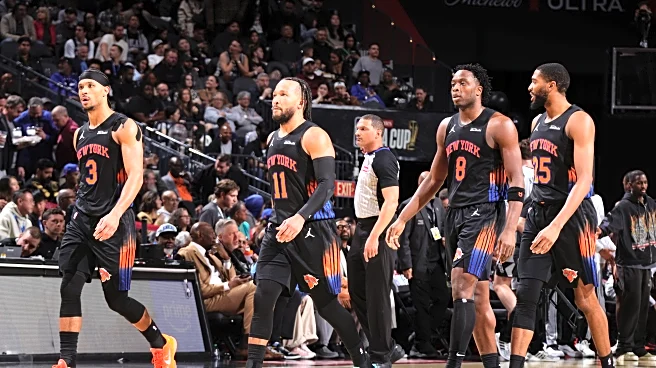
The lineup of Jalen Brunson, Mikal Bridges, Josh Hart, OG Anunoby, and Karl-Anthony Towns started out looking like one of the best starting five’s in the NBA, but heavily regressed after New Year’s for a myriad of reasons. The defense was sub-standard with two flat-out bad defenders and the five-out spacing that the team envisioned fell apart with Hart’s shooting struggles.
The differences in net rating were drastic.
Pre-New Year: +6.6 (561 min)
Post-New Year: -1.4 (156 min)
Postseason: -6.2 (335 min)
Having bad lineups happens, but when they’re played to this extent? It’s alarming. It took until Game 3 of the Eastern Conference Final for a change to be finally made. The Knicks used a grand total of 13 starting lineups in 100 games.
Enter Mike Brown, who was hired, in part, for more lineup versatility. He opened the season planning to have Mitchell Robinson start over Hart, but the frequent unavailability of the load-managing big man forced some different lineups, which included Ariel Hukporti, Deuce McBride, and Landry Shamet.
Eventually, Hart, who got off to a brutal start to the season, was put back in the starting lineup when OG Anunoby went down with an injury. Instead of reverting to a lineup with Robinson or McBride, however, Hart stayed in the starting lineup for the December 5th bludgeoning of the Jazz when Anunoby returned.
It started out great. The lineup had an exceptional +21.5 net rating in 77 minutes across 10 games through mid-December. It was being used in proper doses and wasn’t being leaned on for nearly 20 minutes a night.
A big reason for the big turnaround was an elite 106.4 defensive rating. Despite two negative defenders on the court, the lineup worked and the offense was supercharged by Hart’s newfound shooting stroke.
And then, suddenly, it fell apart. Since December 20, that lineup has played 106 minutes across nine games and has a putrid -8.4 net rating. All of a sudden, that elite offense had fallen apart and opposing offenses began exploiting the defensive shortcomings of Brunson and Towns.
This, coupled with the team’s overall struggles (which may be in the rearview mirror…), has caused some discussion on whether Mike Brown should embrace a different lineup. After all, he’s already used more starting lineups (16) than Thibs used last year in half the games.
But is it so simple? There are four realistic candidates for a fifth starter around the team’s top four. Assuming no Giannis-level trade occurs before the deadline, the Knicks will have the next 2.5 months to figure out which of the four gels the best between Deuce McBride, Landry Shamet, Josh Hart, and Mitchell Robinson.
The case for Deuce McBride
The most criminally underpaid player in basketball, Deuce has been a reliable 3-and-D asset for the Knicks since he emerged into the rotation 25 months ago after the team traded away Immanuel Quickley. There have been some inconsistent stretches (and a few injuries), but the 25-year-old has taken another leap in his spot-up shooting and is probably the team’s best point-of-attack defender.
If you want a true five-out lineup, this is the choice. Everyone in this lineup can shoot, even if OG is struggling mightily from above-the-break. It’s a dream for Mike Brown. It also gives you someone to stick on a star guard like Tyrese Maxey or Donovan Mitchell, allowing Bridges to do what he does best off the ball.
What do the numbers say about this lineup? Well, similar to the current starters, it’s gotten significantly worse as the season has progressed:
Pre-December 20: +12.3 net (26 min)
Post-December 20: -7.1 net (66 min)
What’s interesting about these lineups is that Deuce is helping the offense go into hyperspeed. Even since 12/20, when the team has looked much worse on both sides of the ball, this lineup has a blistering 130.5 offensive rating. It’s just the defense that’s the problem because, personally, I don’t think a 137.6 defensive rating is good.
As you’ll see with Shamet, it just seems to be a common trend in Brunson and Towns’ lineups. Whether it’s possible for them to be co-stars is a story for another day. If you want to maximize the offense, it’d be smart to go with a lineup that has a 127 ORtg in 92 minutes.
The case for Landry Shamet
It’s going to be sad when the Knicks won’t be able to retain Landry Shamet this offseason. They snagged him late in the offseason the last two years and have gotten quality bench minutes out of the journeyman wing. His spot-up shooting ability has fully returned after concerns it disappeared in Washington, as he’s shoot 41% from downtown in 72 total games as a Knick. Some of this team’s best runs have come with him on the court.
So why not give him a shot to start? He has started six games this season due to injuries, but hasn’t since he hurt his shoulder in Orlando in November. Since then, he’s had an up-and-down role as a reliable shooter who can hold his own defensively and provides needed hustle.
The problem is that Shamet with the starters is the worst performing of these lineups, at -5.8 on the season in 57 minutes. It’s also not a “whole team struggling” problem, as it was negative when he went down in November.
Shamet’s two most-used lineups aside from the starters have something in common: no Brunson or Towns.
McBride-Clarkson-Shamet-Anunoby-Towns: +30 net (23 min)
Brunson-McBride-Shamet-Anunoby-Robinson: +59.2 net (23 min)
He plays well with McBride and Anunoby, which makes sense, but the other pieces are free-flowing. It doesn’t appear that he’s a good fit for the starters, especially considering he’s kinda like Deuce in his strengths, just slightly worse while being bigger. Still, if Deuce is ever out, it’s worth considering.
The case for Mitchell Robinson
The lineup that the Knicks came into the season hoping to use hasn’t been used nearly as much as it should, but that’s due to injuries. Mike Brown and the training staff came into 2025-26 with a clear plan to limit Robinson’s workload to maximize him for the playoffs. That means no back-to-backs, no 30+ minute games, etc.
But at some point, the Knicks will probably encounter a matchup where they just cannot take Big Mitch off the court. If he isn’t ready to play that workload, they’re crippling themselves. By that nature, it seems likely that Mitch will continue to increase his in-game workload as the season goes on.
Unlike the other three lineups, the starters with Mitch have been a significant positive, posting an elite +12.4 net rating in 51 minutes behind stellar defense.
However, once again, that number is dragged down by the team’s recent slump. The lineup has only played 16 minutes together since mid-December and has gotten eviscerated on both ends of the floor. It really just seems like a team-wide issue, as there are multiple lineups with different strengths and weaknesses, all struggling concurrently.
So, again, it’s a story for another time with the whole Brunson-Towns tandem, but what does Mitch provide that the others don’t? How about game-breaking rebounding?
In the lineup’s brief time together, they’re killing teams with a 53.3% overall rebounding share and a ludicrous 37.1% offensive rebounding rate. It’s a common theme with Robinson, whose second-most used lineup (w/Brunson/McBride/Hart/Bridges) has a near-50% offensive rebound rate.
The possession battle with the double big is a tremendous advantage, especially on days that the Knicks are making shots. That’s an unstoppable offense and should mask defensive issues. It also provides a real rim protector and should help with the team’s struggles defending the pick-and-pop and drive-and-kicks.
The case to stay with Josh Hart
If the Knicks hadn’t just won four in a row, the calls to make a drastic change would be louder. Now that they’ve stabilized, is that the best course of action?
The last four games have featured Thibs-ian levels of starter usage, with the starting five playing a staggering 58 minutes in that span. No other combination featuring the Big Four has more than two minutes. The lineup hasn’t been dominant by any stretch, but has been +2.3, the best stretch in a good bit.
The biggest problem with Hart last season was both his unwillingness to shoot and his poor efficiency when he did. This year? He’s one of 21 qualified players to be shooting 40% from deep on at least four attempts a game. Only one other Knick (Deuce) can say they’re in that club. When Josh is firing from distance, it’s going in.
Plus, this lineup provides something that the other ones can’t attest to: secondary playmaking.
Josh Hart is the Knicks’ third-best playmaker. The top two, Brunson and Kolek, are both small point guards and should rarely share the floor. Without Hart, the Knicks rely too much on Brunson initiating the action on every single play, whether it’s iso ball or finding an open shooter through a drive to the rim. Hart can alleviate some of that as a willing passer who only shoots when he knows he can make it.
There’s no perfect solution for the Knicks right now, as they try to balance an inconsistent bench and inconsistent shooting and defense. This upcoming stretch will tell them a lot about how things will go as the playoffs draw nearer, and it’s worth experimenting when you can.