
The Orioles have showed an aggressive, win-now mentality this offseason. But they’ve always got an eye on the future, too. And they’re pulling out all the stops to try to garner an extra 2027 draft pick
through the Prospect Promotion Incentive system.
As a refresher, PPI, created in 2022, was designed to encourage teams to call up their best prospects earlier rather than bury them in the minors to manipulate their service time. This PPI FAQ covers all the ins and outs, but very basically, a team earns a draft pick if a highly-rated rookie stays on the roster all season and then wins the Rookie of the Year Award. (It also applies if that player finishes in the top 3 of the MVP or Cy Young voting within his first three years, but for the purposes of this article, we’ll just focus on the ROY thing.)
For a player to be PPI eligible, he has to have rookie status and must be ranked as a top-100 prospect on at least two of the three main prospect lists — MLB Pipeline, Baseball America, and ESPN — before the season. The Orioles have reaped the benefits of PPI before, earning a 2024 draft pick when Gunnar Henderson won AL Rookie of the Year in 2023. The O’s used that extra pick, #32 overall, to draft infielder Griff O’Ferrall.
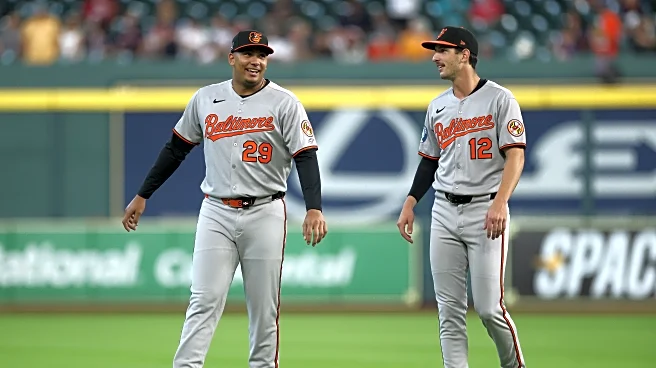
Next year, the Orioles will be trying to hit PPI paydirt again. And to make it possible, they kept two top prospects in the minors until mid-August this year, preserving their rookie status for 2026, even as O’s fans were clamoring for their arrival long before then. Now the Birds are hoping their slow-playing of Samuel Basallo and Dylan Beavers will pay off.
The more heavily touted of the duo, of course, is Basallo, who currently ranks as the Orioles’ best prospect and #7 in baseball, per MLB Pipeline. The 2021 amateur signing from the Dominican was a steady force throughout his ascent up the Orioles’ organizational ladder, showing elite power and plate discipline at all levels. The O’s are betting big on Basallo, having already signed him to an eight-year extension. He’s rightly considered a front-runner to win AL Rookie of the Year.
Then there’s the Beavers, the dark-horse candidate. A year ago at this time, coming off an unremarkable 2024 campaign at Double-A, few would have expected Beavers to one day be a legitimate Rookie of the Year candidate. He wasn’t a bust, exactly, but the former first round pick wasn’t particularly making a name for himself (other than already having the delightful name of Beavers). But Beavers looked like a whole new player in ’25, boosting his OPS by more than 180 points, fueled by a fantastic .420 OBP in 94 games for Norfolk.
As Basallo and Beavers tore up Triple-A this year, the hype continued to grow. By the end of July, Beavers was hitting .304 with a .916 OPS for the Tides. Basallo was rocking a .273/.385/.599 line. Orioles fans, fatigued by the Birds’ woeful performance, were desperate for the infusion of energy and excitement that the two prospects would bring. Many wanted Basallo and Beavers called up as soon as possible. But the Orioles had other plans.
Even when the Orioles cycled through six catchers in the first four months, they didn’t call up Basallo. Even after the trade deadline, when the O’s jettisoned outfielders Cedric Mullins and Ramón Laureano, plus occasional outfielder Ryan O’Hearn, they didn’t call up Beavers.
Though they never directly stated it, the O’s clearly didn’t want to promote Basallo or Beavers early enough for their rookie eligibility to expire in 2025. A player loses rookie eligibility if he spends 45 or more days on a big league roster. And — what do you know? — on Aug. 16, when only 44 days were left in the season, the O’s called up Beavers. The next day, they promoted Basallo.
Both prospects played nearly every day for the Orioles for the rest of the season. Beavers had 137 plate appearances and Basallo 118. So they both got some valuable major league experience. But the question remains, should the Birds have called them up weeks earlier, nullifying their rookie status but giving them even more experience heading into a 2026 season in which the club hopes to be competitive? Or was it worth it for the O’s to keep Basallo and Beavers in the minors as long as they did, rolling the dice that one of them might win Rookie of the Year and garner the O’s a draft pick?
For Basallo, waiting until Aug. 17 was easy to justify. He was just 20 years old for most of the season — he didn’t turn 21 until four days before his debut — and he clearly had things he still needed to learn at Triple-A, particularly his spotty defense behind the plate. So it made sense for the Orioles to slow-play his promotion and let him keep his rookie status for 2026.
For Beavers, it was a riskier gamble. The now-24-year-old had nothing left to prove in the minors and could have been called up weeks earlier to fill a glaring hole in the Orioles’ outfield. Consider that in one mid-August game, the Orioles rolled out a starting outfield of Greg Allen, Jordyn Adams, and Jeremiah Jackson. Two games later, it was Dylan Carlson, Daniel Johnson, and Ryan Noda. That’s five players who had no business being in the majors, plus Jackson, a converted infielder who was miscast as an outfielder. Yet these were the kinds of lineups the O’s were regularly rolling out as they steadfastly refused to call up Beavers.
Adding to the frustration of Beavers’ non-promotion was that he wasn’t even a top-100 ranked prospect at the time, meaning he wouldn’t be PPI-eligible in 2026 even if he retained his rookie status. If the O’s were angling for an extra draft pick, Beavers didn’t seem to be the rookie to do it with. But the Orioles were banking on the hope that Beavers’ breakout 2025 would get him added to the top-100 rankings.
By golly, they were right. When the three prospect sources updated their rankings at the end of the 2025 season, all of them had added Beavers to their list. He currently ranks #80 on Baseball America, #83 on MLB Pipeline, and #94 on ESPN. Assuming he doesn’t fall out of the top 100 when those sites release their 2026 preseason rankings, Beavers will be PPI-eligible after all.
So the Orioles have two PPI-eligible rookies heading in 2026. Now for the hard part: to earn the O’s an extra pick, one of them will actually need to win AL Rookie of the Year.
It’s going to be a tall order. Basallo is the better candidate of the two, but he’ll need to improve greatly on his 2025 MLB performance, in which he batted just .165 with a .559 OPS. He’ll also be bouncing between different positions, backing up Adley Rutschman behind the plate while also making starts at DH and 1B.
Beavers, meanwhile, isn’t as highly regarded a prospect as some other young AL stars who could debut in 2026, despite his solid big league performance in 2025. As of now it’s not even clear if he’ll have everyday playing time. Taylor Ward figures to start most days in left and Colton Cowser in center. That leaves right field, where Tyler O’Neill is making $16.5 million this year and will get playing time accordingly, if healthy (which for Tyler is a big if). Beavers will probably ride the bench at least against lefties and maybe more often than that.
In the end, whether Beavers or Basallo wins Rookie of the Year or not, their careers probably won’t be ruined by the Orioles’ choice to keep them in the minors a few extra weeks. But for O’s fans who had to suffer through those Greg Allen, Daniel Johnson, and Ryan Noda outfields for a while, it sure felt like an eternity.