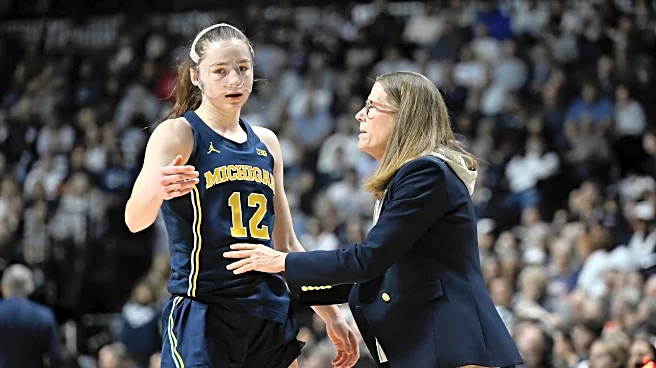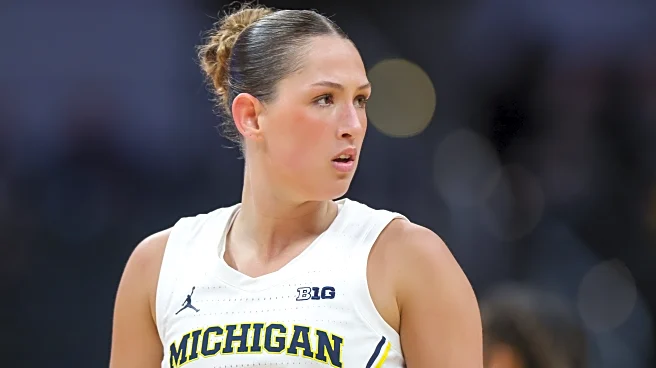

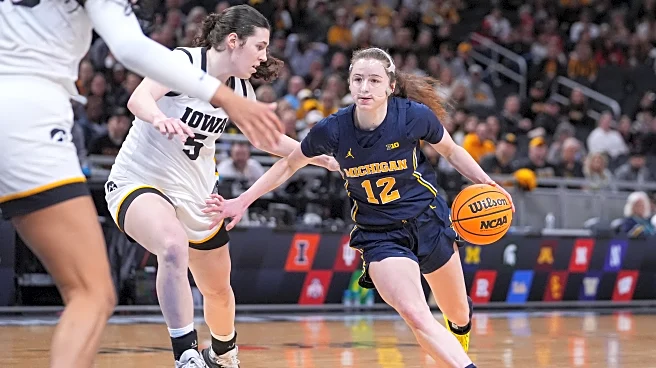

The opening weekend for No. 2 seed Michigan women’s basketball junior forward Ashley Sofilkanich in the NCAA Tournament feels a little different this year.
First and foremost, it’s her first appearance in March Madness after transferring from Bucknell at the start of the season.
But it’s also an opportunity for Sofilkanich, as part of the heavily-favored Wolverines, to capture an ever-elusive first career win against No. 15 Holy Cross on Friday at 5:30 p.m. to open the first round.
Sofilkanich began
her college career at Bucknell, which, like the Crusaders, competes in the Patriot League. However, the Bison fell to Holy Cross all five times in Sofilkanich’s time facing the Crusaders, losing in the Patriot League tournament to end the 2023-24 season.
Her freshman year, she was named to the Patriot League All-Rookie, All-Defensive, and third teams while starting 28 of 31 games and averaging 12.5 points and 6.3 rebounds per game. She led the Bison in rebounds while finishing second in points, and second in blocks conference-wide.
Her sophomore year, Sofilkanich broke out in her Player of the Year season and was also named to the All-Patriot League first team and All-Defensive teams. She led the conference with 19.7 points, 2.3 blocks, 10 double-doubles, 220 field goals made, and 569 points in 31.8 minutes per game.
Now at Michigan, Sofilkanich filled a gaping hole from the get-go in the Wolverines’ frontcourt. Michigan primarily played five guards in the 2024-25 season, despite playing inside-out basketball in previous years.
“Last year we played five guards because we needed a true post presence,” head coach Kim Barnes Arico said. “We felt like Ashley could certainly be that for us. A back-to-the-basket player, someone with great touch, someone that was the Player of the Year in her league, could really score the basketball and could rebound the basketball, two key things for us that were going to be important. So that was something that was really important for us in the portal.”
Since arriving in Ann Arbor, Sofilkanich has started every game, averaging 8.1 points and 4.1 rebounds in just 17.9 minutes per game while shooting an efficient 57.1 percent. With her on-court time trimmed nearly in half compared to her time at Bucknell, Sofilkanich’s had to adapt to a different role.
“It is interesting, obviously at Bucknell a lot of their offense went through Ash, and now here it’s, she’s maybe not the first or second option, so it is like, ‘Oh, wow, like the Player of the Year is the third option here, right, fourth option here,’ ” Holy Cross head coach Candice Green said. “So, yeah, that kind of just speaks to how good Michigan is, right.”
The Wolverines are amid a historic season for the program, earning the highest-ever NCAA Tournament at No. 2 in the Fort Worth Region 3. They finished tied for second in conference play, setting records for Big Ten wins (15) and regular-season wins (24). With 25 wins, including one in the quarterfinals of the Big Ten Tournament, Michigan has tied the second-most wins in program history behind the 2017 WNIT championship team.
With sophomores AP All-American third-team guard Olivia Olson, All-Big Ten first team guard Syla Swords, All-Big Ten honorable mention guard Mila Holloway contributing significant scoring numbers, there’s less action flowing directly through Sofilkanich this season while some of the country’s best forwards match up against her. Simultaneously, she’s taken the brunt of the defensive load on those same players, guarding AP All-American first teamers Sarah Strong and Lauren Betts in matchups with No. 1 seeds Connecticut and UCLA as a major leap from Patriot League play.
“I really struggled in the beginning of the year with playing post defense here,” Sofilkanich said. “I mean, it’s such a different level of basketball compared to the Patriot League, where I might have been, like, the tallest player on the court. So having to play against Lauren Betts or Serah Williams or even, Sarah Strong, I just think it’s like giving me such a different perspective, and my coaches have really pushed me and, like, made me know that, like, I am capable of guarding these people, like I am at the same level as them, even if I might not think it myself. I think it’s just such a learning experience, and I think it’s gonna help me so much in the Tournament.”
Jumping to the Power Five from a mid-major is always a leap, with players typically transitioning from being the leading scorer with the ball always in their hands. Combined with adjusting to a new coach, new teammates, new system, new atmosphere and new school in a new place, it’s a lot of change to manage while also competing against a higher talent level. Bucknell ran a slower-paced offense than Michigan and played just five total Power Five schools in Sofilkanich’s career, all matchups losses. There’s a component of imposter syndrome involved with the leap as well, adding another barrier to overcome while being expected to produce at similar levels.
“It’s just a weird feeling, because I know I did win conference player of the year last year, but then it’s just a whole different mindset and a whole different talent level coming here to the Big Ten,” Sofilkanich said. “But yeah, I think my confidence is definitely growing. I mean, my teammates put a lot of confidence in me as well, and I feel like it shows in the games when we have a lot of people, me included scoring double digits, and those are the games we really pull away from these teams, because they don’t really know who to guard. You can’t face-guard two people if you have three other people on the floor scoring.”
Sofilkanich’s paint presence adds another dimension to the Wolverines offense that makes them nearly impossible to stop. With Michigan’s heavy defense pressure catalyzing transition offense, Sofilkanich’s rim-running enables efficient looks. Backdoor feeds inside from downhill drives open up her finishes around the rim, and the Wolverines’ unselfish play — characterized by their team goal of 20 assists per game — further reinforces that. But overall, Sofilkanich has grown throughout the season, building confidence and poise and more consistent play forged in the fire of Big Ten conference play.
“Her development is insane,” North Carolina State guard Zoe Brooks said about her high school teammate at Saint John Vianney. “She could do so much things that she couldn’t do years ago. So I think Michigan was a very good jump for her. I mean, she was at Bucknell, and she was just completely dominant. So I think that she’s adjusting well here at Michigan.”
Potentially playing against three of her former high school teammates — Meg Cahalan and Janie Bachmann at Holy Cross in the first round and Brooks and the No. 7 seed Wolfpack in the second round — Sofilkanich’s development is on full display. Competing for one of the nation’s premier high school programs, Sofilkanich selected that school to be challenged. She played behind Cahalan until her senior year, taking those three years coming off the bench to develop both as a person and player. Sofilkanich credits her high school experience as a major reason supporting her jump from the Patriot League to the Big Ten, recognizing that playing behind and against the best built talent and character through adversity.
Now playing against the Patriot League instead of representing it, Sofilkanich finally has her opportunity to capture the long-awaited win against the Crusaders. So while for many No. 2 vs. No. 15 seed matchups, the favorite capturing a win doesn’t represent much more, for the former Patriot League Player of the Year, it would be something special to beat her long-time foe while sharing college basketball’s biggest stage with two old friends.