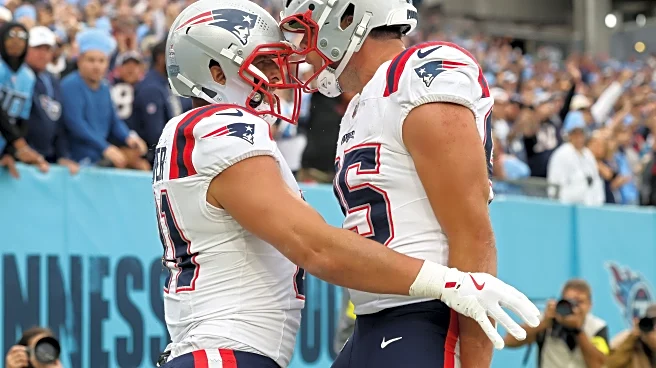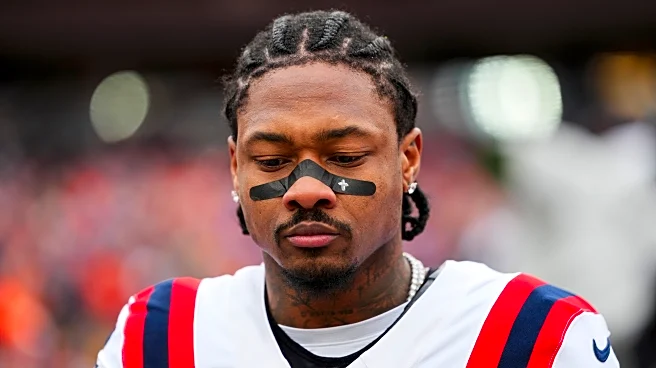

Even though he finished the season as their most productive pass catcher, the New England Patriots informed veteran wide receiver Stefon Diggs that he will be released after the start of the 2026 NFL league year next Wednesday. One year removed from joining forces via a three-year, $63.5 million contract, the two sides will be headed their separate ways.
It appears there have been multiple contributing factors behind that decision, including Diggs’ age as well as his contract and legal situations.
Regardless of the team’s motivation, however, the bottom line remains the same: a player who finished 2025 with 99 combined regular season and playoff catches as well as 1,123 yards and four touchdowns is no longer with the club moving forward.
What does that mean for the Patriots, though? Let’s break down the move from a big-picture perspective.
A gamble
As noted above, there are several reasons why parting ways with Diggs after only one season makes sense for the Patriots. That does not make the move any less risky, though.
The 32-year-old, after all, was a highly-productive player and Drake Maye’s most relied-upon weapon. He finished as the team leader in targets, catches and yards and was one of the most valuable receivers in football last year: his combined EPA of 65.3 ranked fourth among all NFL wideouts in 2025 and was leaps and bounds above the next-best pass catcher on New England’s roster (TE Hunter Henry; 34.3).
Whether that kind of production and impact was worth the $26.5 million salary cap number he was about to carry is up for debate. Still, replacing it will not be easy and in turn put additional pressure on Maye to distribute the ball and build chemistry with a receiving corps now looking quite a bit different.
Depth chart shaken up
Even though the move has yet to be made official, we are no longer counting Diggs as part of the Patriots’ wide receiver group. As a consequence, said group now looks like this:
Wide receiver (7): Kayshon Boutte (9), Mack Hollins (13), Kyle Williams (18), DeMario Douglas (3), Efton Chism III (86), Jeremiah Webb (29), John Jiles (83)
The Patriots currently have seven wideouts signed, including five who finished the 2025 season on the active roster. Among those, Kayshon Boutte, Mack Hollins and Kyle Williams currently project as the starters, with the latter possibly the top in-house candidate to replace what Diggs brought to the table: while primarily used as a vertical X-receiver during his 2025 rookie season, Williams could also play more of an interior and Z-role akin to the one held by Diggs.
Nonetheless, the Patriots adding to their wide receiver group in the coming weeks should be expected. Boutte, Hollins, Williams and DeMario Douglas have all had flashes last year, but none are proven volume targets or go-to receivers in the mold of Diggs.
First domino to fall
Speaking to reporters at the NFL Scouting Combine last week, both head coach Mike Vrabel and executive vice president of player personnel Eliot Wolf pointed at offensive playmaking as an area of need.
“We’ll have to go back and understand that to put yourself in those positions and ultimately win a championship, you’re going to have to beat good defenses, whether that’s at home or on the road or whatever that is,” Vrabel said at the time. “The consistency of it, the ability to create some X-plays — it’s hard to drive the ball 10 or 12 plays and you have to be better, improve the details and improve the execution. We’re all involved in it. From the coaching to the playing, it’s on us all. And that’ll be our challenge going forward.”
How the Patriots will try to meet that challenge will be seen. In a vacuum, however, releasing Diggs does not make the job any easier.
While no longer the player he was during his heyday with the Vikings and especially the Bills, particularly coming off a torn ACL, his presence and connection with Drake Maye still opened things up for other players on the team. With him now out of the equation, somebody else will have to become that No. 1-type operator, be it an internal promotion, a free agency pickup or a trade or draft acquisition.
Regardless, Diggs getting cut has to only be the first shoe to drop. Anything else would make the move even more of a gamble than already mentioned.
Leadership void
There are off-field concerns regarding Diggs — he was arraigned and pled not guilty to several charges last month stemming from an incident in December, when he allegedly assaulted his personal chef following an argument — but he was by all accounts a popular player and tone-setter in the Patriots’ locker room in 2025. He took it upon himself to help lead the wide receiver room, and was responsible for the team’s “We all we got, we all we need” rallying cry while also helping shape the “Road Warriors” mentality they rode to a Super Bowl berth.
That aspect of Diggs’ tenure in New England will not be easily replaced. Mack Hollins is one candidate to take over that leadership role given his experience and personality, but he alone might not be able to fill the void.
Salary cap savings
When the Patriots and Diggs reached an agreement on that aforementioned three-year, $63.5 million contract last offseason, it became clear quickly that the structure of the pact gave the team a relatively easy out after each season. It did not take long for them to take advantage, and it is not hard to see why.
Despite his production, Diggs was carrying a salary cap number of $26.5 million into the 2026 season. Of that number, $5.7 million consisting of his signing bonus proration ($4M) and parts of his salary ($1.7M) were initially fully guaranteed. On Friday, March 13, an extra $6 million of his salary would have been added to that group of guarantees. The timing of the upcoming move therefore is not coincidental.
As for the cap impact itself, it creates net savings of $15.795 million. That number accounts for a $9.7 million dead cap charge — two remaining signing bonus installments ($8M) plus his guaranteed salary for 2026 ($1.7M) — as well as another player taking his spot on the Top 51 list counted against the cap in the offseason.
In total, the Patriots are now $57.08 million under the NFL’s salary cap, according to cap expert Miguel Benzan.