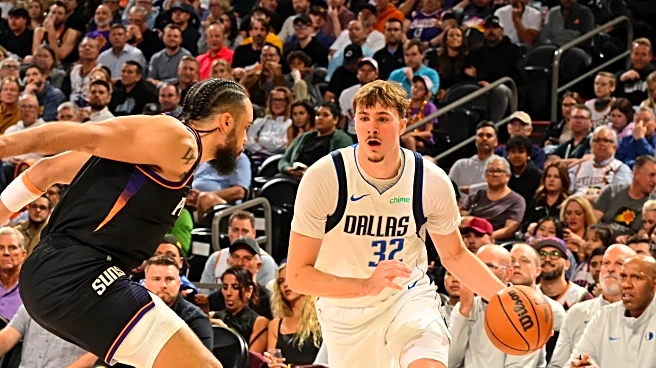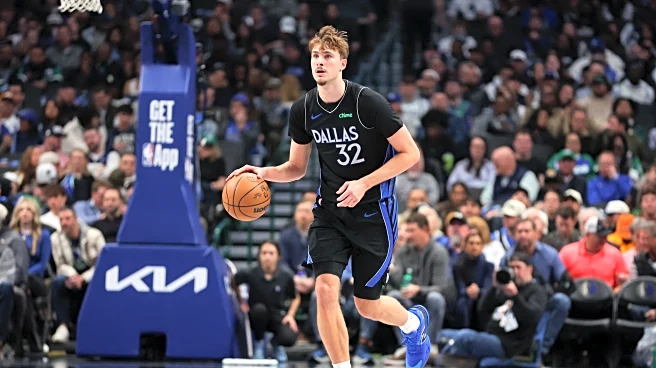

The Dallas Mavericks’ rookie star and number one overall pick Cooper Flagg just played the 41st game of his young career on Monday against the New York Knicks. His inaugural season has been a little interesting. Head coach Jason Kidd experimented with Flagg at point guard to open the season, a tough situation for any young player. The Mavericks’ odd lineups made it even tougher for the first year forward.
Kidd eventually pivoted away from that experiment and put Flagg at the forward spot, and things
improved drastically. Flagg won Western Conference rookie of the month in both November and December, and looks to be in a tight race with Kon Knueppel for Rookie of the Year.
With half of his first season in the books, I wanted to look back at the last ten years of number one overall picks and see how Flagg compares. I compiled each number one pick’s basic counting stats—field goal percentage, 3-point percentage, points, rebounds, assists, steals, blocks, and 3-pointers made. Slash stats are points/rebounds/assists per game. All stats are through a player’s first 41 games of their career, regardless of whether those first 41 games came in their rookie year or in later seasons.
2025: Cooper Flagg
48% FG, 29% 3P, 18.8/6.3/4.1, 1.3 steals, .8 blocks
Totals: 770 points, 257 rebounds, 170 assists, 52 steals, 32 blocks, 4o 3PM
Flagg didn’t land into the perfect situation. The Mavericks are still reeling from the Luka Doncic trade, left in an odd purgatory. The roster is built poorly, expensive, yet far from being a contender for much of anything besides the play-in tournament. Worse still, the best player on that awkwardly fit roster, Anthony Davis, is consistently injured. Yet the Mavericks haven’t made any moves toward rebuilding the team around Flagg.
Head coach Jason Kidd went full mad scientist and experimented with Flagg at point guard early in the season. With Davis in and out of the lineup, there’s been no consistent rotation. Trade rumors and the detritus from the Doncic trade still linger over the franchise.
Flagg’s first 41 games in the NBA haven’t been ideal. But he’s put up numbers just as good or better than several of the number one overall picks listed below.
2015: Karl-Anthony Towns
52% FG, 33% 3P, 15.6/9.5/1.2, .6 steals, 1.7 blocks
Totals: 638 points, 391 rebounds, 50 assists, 26 steals, 69 blocks, 11 3PM
Towns was a good scorer the first half of his rookie season, but really stood out on defense. He’s one of the better rebounders on this list, and is second only to Victor Wembanyama in blocks.
Flagg edges Towns in scoring and is a better playmaker early on, and has better on ball defense. He’s also a much better shooter (40 3pm through 41 games compared to Towns’ 11) than the self-proclaimed “best shooting big man in NBA history.”
2016: Ben Simmons
51% FG, 0% 3P, 16.6/8/7.2, 1.9 steals, .9 blocks
Totals: 679 points, 328 rebounds, 296 assists, 77 steals, 38 blocks, 0 3PM
Simmons’ career has derailed to a point where he is now a professional competitive fisherman (no really, he is), so it’s easy to forget what a stat-stuffing phenom he was early on. Simmons did a little of everything on the basketball court, except shoot 3’s.
The Sixers had a more coherent vision for their team when Simmons was drafted than the Mavericks currently do with Flagg on board. Simmons also missed his first season in the league, giving him a full calendar year of development that Flagg hasn’t had.
2017: Markelle Fultz
43% FG, 23% 3P, 8.2/3.1/3.4, 1 steal, .2 blocks
Totals: 337 points, 129 rebounds, 138 assists, 39 steals, 9 blocks, 8 3PM
Fultz didn’t get to his 41st career game until his third season in the league. Even with the extra time in the NBA to develop, his stats are unremarkable. Due to all his injuries and issues with his jump shot, it’s impressive that Fultz has been able to carve out a career that’s going on eight years in the league. It speaks to his mental toughness, despite whatever went wrong early on his career.
Needless to say, Flagg definitively had a better first half-year than Fultz.
2018: DeAndre Ayton
60% FG, 0% 3P, 16.7/6.8/2.2, .8 steals, .9 blocks
Totals: 686 points, 439 rebounds, 90 assists, 31 steals, 37 blocks, 0 3PM
Ayton was a good scorer the first half of his rookie season, but didn’t do much else. For a big man, his rebounding and block numbers are low. On the other hand, 2.2 assists per game is pretty good for a rookie center. Ayton’s stats through 41 games as a rookie are decent, but considering who was drafted after him (remember Luka Doncic?), you’d probably want more out of your number one pick.
Flagg has been asked to do more than Ayton was in his rookie year, and the play on the court, as well as the stats, shows it.
2019: Zion Williamson
59% FG, 36% 3P, 23.1/6.8/2.2, .8 steals, .4 blocks
Totals: 946 points, 278 rebounds, 89 assists, 33 steals, 18 blocks, 8 3PM
Williamson didn’t get to his 41st game until his second season, but unlike Fultz, he took advantage of that extra development time. He’s the highest scorer on this list, and looked unstoppable with the ball in his hands those first few years. When he was healthy, of course. Williamson didn’t do a lot, else, however, with low numbers in every other category.
It’s a question that can spark some debate—would you rather have an electric scorer like Williamson, or a better all-around player like Flagg?
2020: Anthony Edwards
39% FG, 32% 3P, 16.8/4.2/2.5, 1 steal, .4 blocks
Totals: 689 points, 171 rebounds, 101 assists, 39 steals, 15 blocks, 86 3PM
Flagg has similar numbers to Edwards, which should be encouraging to Mavericks fans. Obviously they have different games, but a half-season of numbers similar to a multi-time all-star and All-NBA player is what you like to see.
2021: Cade Cunningham
40% FG, 33% 3P, 10.4/5.5/5.2, 1.3 steals, .7 blocks
Totals: 648 points, 224 rebounds, 215 assists, 54 steals, 28 blocks, 84 3PM
Cunningham grinded out a messy situation as a rookie and put up some solid stats. His assist numbers are low for a point guard, but remember, the Detroit Pistons had absolutely no one to hit shots at that point. He’s second only to Simmons in steals on this list.
There’s some comparison here to Flagg’s rookie year. The Piston’s poorly built roster and a front office in flux sounds familiar to Mavericks fans. Hopefully things turn around for Dallas and Flagg like they did for Detroit and Cunningham.
2022: Paolo Banchero
44% FG, 32% 3P, 20.8/6.4/3.8 1 steal, .5 blocks
Totals: 852 points, 261 rebounds, 154 assists, 42 steals, 20 blocks, 56 3PM
Banchero showed flashes of greatness early, and as is tradition in Orlando, without any shooting to space the floor for him. That’s tough for a rookie. Banchero took a leap in his sophomore year, making his first all-star game. He’s failed to build on that second-year bump, however, and hasn’t upped his game since.
Banchero’s first 41 games are a pretty good comp for Flagg. Hopefully the Mavericks rookie can level up the same way Banchero did next year.
2023: Victor Wembanyama
47% FG, 30% 3P, 20.6/10.1/3.1 1.1 steals, 3.1 blocks
Totals: 843 points, 415 rebounds, 126 assists, 45 steals, 128 blocks, 61 3PM
Wembanyama is the third leading scorer on this list. When you add in the tremendous amount of rebounds and blocks, along with the surprising number of assists, it’s easy to see why the Spurs’ phenom is considered an alien. If Wembanyama can stay healthy, he’ll be a force in the West for years.
Flagg beats out Wembanyama in assists and 3-pointers, but I give Wemby the edge here. He’s just too dynamic on both sides of the ball in those first 41 games.
2024: Zaccharie Risacher
41% FG, 30% 3P, 11/3.5/1.2, .8 steals, .5 blocks
Totals: 451 points, 143 rebounds, 49 assists, 34 steals, 21 blocks, 52 3PM
Risacher’s first season was not what you want to see out of a number one overall pick. Only Fultz had worse counting stats, and as mentioned above, Fultz’s first few seasons were a disaster. But Fultz has overcome all his early issues and carved out a decent career in the NBA. Maybe Risacher can do the same.
Flagg easily surpassed Risacher’s production, but as we’ve seen above, every rookie’s situation needs to be taken into context. Risacher can still turn into a good rotation player.