

Note: I know I said last week that play breakdowns would return, but as I sit here writing this at 3 A.M., my full-time job has demanded a little more of my free time than usual. Rather than rush through them to meet the deadline for this article, I’m going to put together a separate article next week breaking down some of the more interesting plays from the first two games.
People, what a difference a week makes.
Seven days after the Chicago Bears opened their season by scoring 59 points and piling
up 552 yards against the Carolina Panthers, they returned home to Soldier Field and gave us just about the exact opposite.
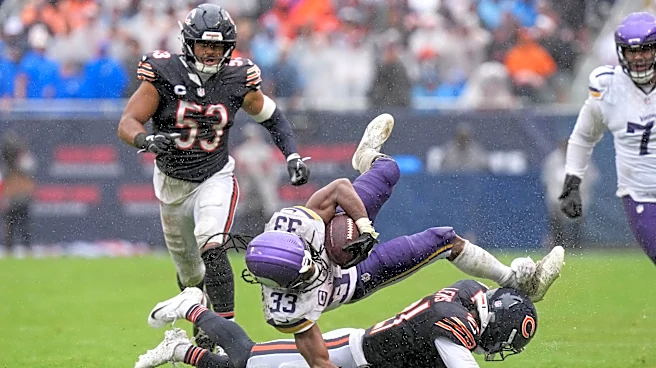
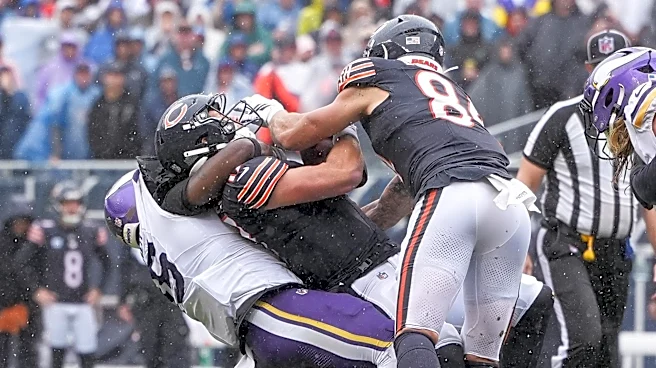
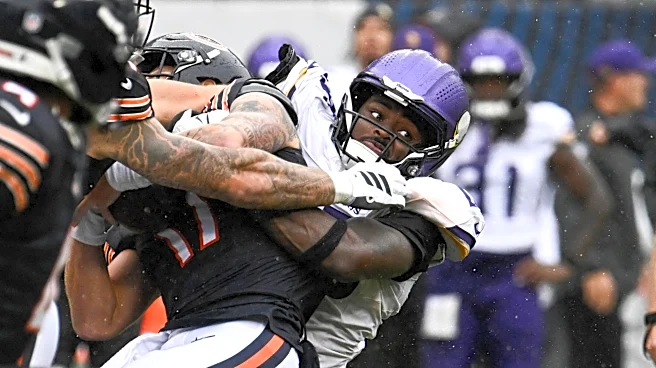
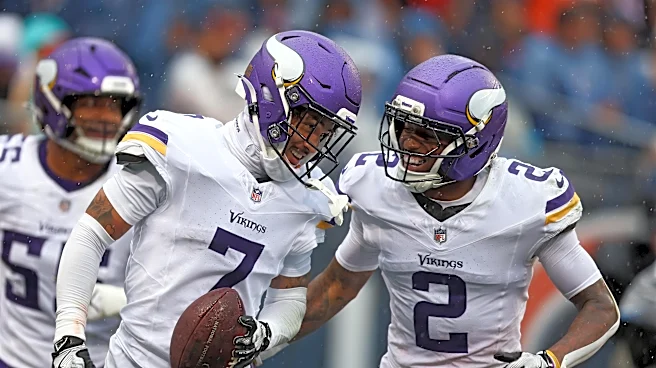
In a rainy, sloppy game that featured very little offense from either side, the Bears fell to the Minnesota Vikings 9-3, dropping to 1-1 on the season.
The frustrating part is that Chicago had plenty of opportunities to win it.
The Bears actually outgained Minnesota 297-246, held the ball for more than five additional minutes and picked up 17 first downs compared to just 11 for the Vikings. Unfortunately, they also turned the ball over twice, committed eight penalties for 58 yards and finished 0-for-3 in the red zone.
All three of those red-zone trips came in the second half, with Chicago reaching the Minnesota 1, 5 and 12-yard lines without scoring a single point.
That’s certainly one way to follow up a 59-point performance.
For as rough as things looked offensively, the Bears defense deserves plenty of credit for keeping them in the game. After surrendering 37 points in Week 1, Dennis Allen’s group held Minnesota to just 246 total yards and didn’t allow a touchdown all afternoon.
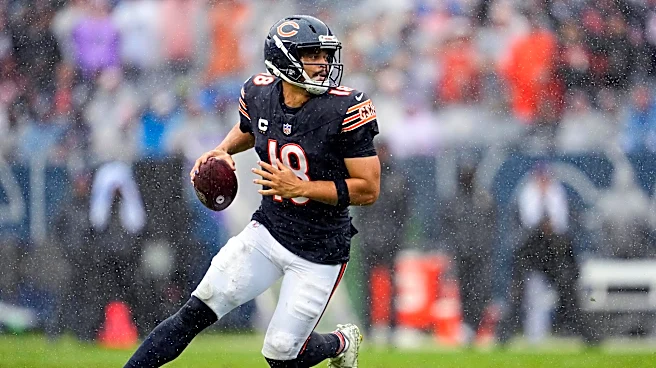
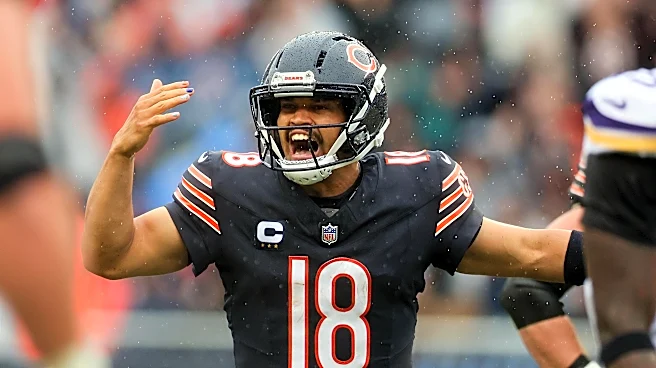
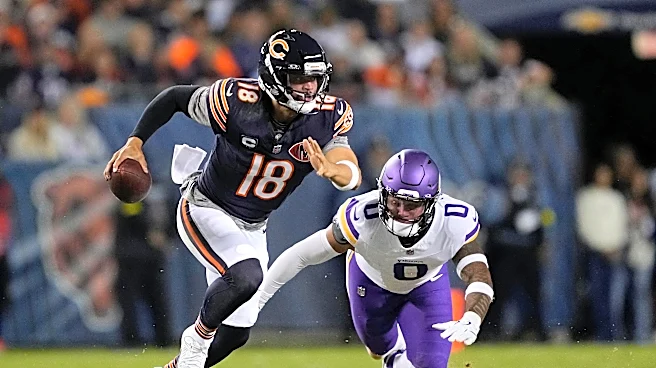
For Caleb Williams, it was a much different afternoon than the one we saw in Carolina.
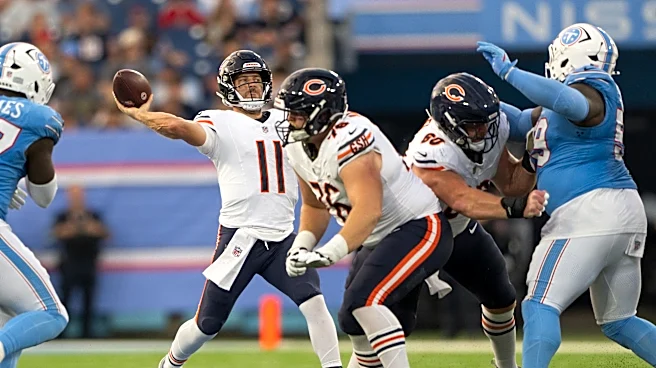
Williams completed 15 of 26 passes for 138 yards with no touchdowns and one interception, finishing with a 56.2 passer rating. He added another 42 yards on five carries, but Chicago struggled to consistently find answers against Brian Flores’ aggressive defense.
The box score, however, doesn’t tell the entire story of Williams’ afternoon.
Despite everything Minnesota threw at him, his accuracy remained remarkably consistent. Williams finished with an 82.6% On Target rate, and while the explosive plays weren’t there, he generally avoided making a difficult situation worse. Against a defense constantly changing the picture before and after the snap, Williams remained patient, took what was available and largely avoided forcing the football into danger.
That showed up in my grading as well. Williams still managed to finish with a positive overall game grade, thanks largely to consistently accurate throws and smart decisions. Even with Minnesota applying pressure throughout the afternoon, he had just one throw graded worse than “Bad.”
And applying pressure might be underselling what Flores was doing.
The Vikings blitzed Williams on 27 of his 33 dropbacks, good for an 81.8% blitz rate. According to Next Gen Stats, that would rank as the third-highest single-game blitz rate by a defense since at least 2018. Around The NFL shared the Next Gen Stats breakdown here.
So while the final numbers certainly weren’t pretty, there was more good underneath the surface than the 56.2 passer rating would have you believe.
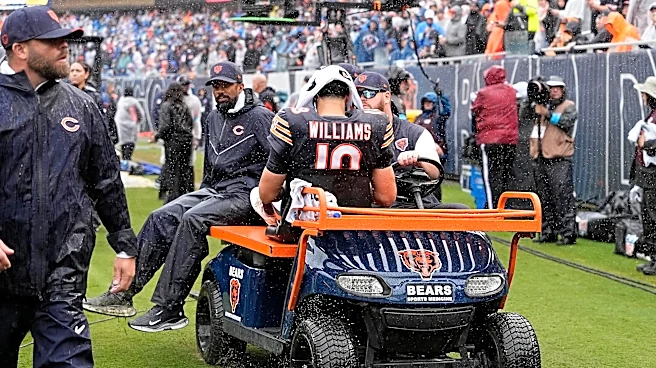
Unfortunately, the biggest story involving Williams came midway through the fourth quarter when he went down with a right hamstring injury while scrambling on first-and-goal from the Minnesota 6.
Tyson Bagent took over and eventually gave Chicago one final chance, driving the Bears to the Minnesota 12 with 10 seconds remaining before Dallas Turner sacked him on the final play of the game.
The good news is that Williams appears to have avoided a significant injury. Ben Johnson announced Monday that his quarterback is considered week-to-week with a hamstring pull. Ian Rapoport shared Johnson’s update Monday morning.
Now that we’ve got that depressing little recap out of the way, let’s get into Caleb’s Week 2 performance.
For more information including scoring key, game-by-game grading sheets, weekly grading scorecards, and an overall look at his 2026 season, you can view Caleb’s entire season workbook here.
Benchmarks
Stat Formatting Key: (Last Season totals are underlined, Week 1 totals in Italics, and this week’s stats appear in regular text.)
C/A: 330/568 (58.1%) | 19.4/33.4 (58.1%) | 15/26 57.7%
Yards: 3942 | 231.9 | 138
Touchdowns: 31 | 1.8 | 0
Turnovers: 8 | 0.5 | 1
QB at Fault Sacks: 13 | 0.8 | 0
aDOT: 8.9 | 4.0
Passer Rating: 90.1 | 56.3
True Passer Rating: 125.8 | 53.2
Time to Throw: 3.19s | 3.49s
Time to Pressure: 2.56s | 2.56s
Pressure Rate: 41.46% | 41.67%
On-Target Rate: 84.0% | 82.6%
Poor Play Rate / Big Play Rate: 4.7% PPR / 11.6% BRP | 5.4% PPR / 2.7% BRP
EPA per dropback: +0.54 | +0.05
ANY/A: 9.7 | 2.5
Game Scorecard

The full grading sheet for each play can be foundhere.
Game Notes
Note: Last year, I included PFF grades in these breakdowns. With PFF continuing to expand its use of AI across its platform, and with my confidence in how accurately its grades reflect quarterback performance declining, I’ve decided to move away from them this season. In their place, I’ll be using PFN’s Impact Score, which will be notated as PFN on grading sheets moving forward.
- NFL Passer Rating / True Passer Rating / PFN Impact Score:56.2 / 53.2 / 69.9
- The NFL’s average passer rating through Week 2 sits at 96.4, putting Williams’ 56.2 comfortably below the league average. His 5.3 YPA, zero touchdowns and one interception all worked against him in a metric heavily influenced by traditional box-score production.
- A 53.2 TPR represents a poor game in my model, where 100 serves as the baseline for “Average.”
- That’s a complete reversal from Week 1. The 53.2 would be Williams’ lowest TPR of any 2025 start by more than 25 points, with his previous low coming against Philadelphia in week 13. One major factor was an ADoT of roughly 4.0 yards, a massive drop from his 10.4-yard mark in Week 1.
- On the PFN scale, where 75 represents an average qualifying starter and 90 is elite territory, Williams finished Week 2 with a 69.9 Impact Score, ranking 25th of 30 qualifying quarterbacks.
- Despite the rough Week 2 showing, Williams still ranks 10th overall among quarterbacks this season with an 80.5 Impact Score.
- On-Target Throws:2026 Average: 84.0% | Week 2: 82.6%
- Reminder: Completion percentage ≠ On-Target Percentage. I only chart aimed passes, meaning throwaways, spikes and passes deflected at the line are excluded. Drops can still be credited as on-target.
- Short-Level Passing (Behind LOS–9 yards): 15/17 | 88.2% On-Target
- Deep-Level Passing (10–20+ yards): 4/6 | 66.7% On-Target
- The accuracy has remained remarkably consistent through two games. Williams has now posted an On-Target rate above 80% in both starts, already surpassing the one such performance he had all of 2025.
- The short-range accuracy has been particularly encouraging at 90.9% on the season so far. This was an area where he struggled throughout 2025.
- Poor Play Rate / Big Play Rate:5.4% PPR / 2.7% BPR
- The interception and one poorly aimed pass late in the second half were the primary blemishes on an otherwise relatively mistake-free afternoon.
- As always, turnovers are double-graded in my system. Williams received the automatic -1.00 turnover grade, along with a separate contextual grade of “Below Average” on the throw itself. On tape, it appears Williams expected Luther Burden III to settle into the zone while Burden continued working with the quarterback. The pass was high, but still catchable with effort in Burden ended up settling.
- Williams’ lone “Great” or better play came on his scramble and sack avoidance before finding Kalif Raymond for eight yards, setting Chicago up at the Minnesota 1-yard line.
- The interception and one poorly aimed pass late in the second half were the primary blemishes on an otherwise relatively mistake-free afternoon.
- Time to Throw: 3.49 seconds
- Using my charting, Williams averaged 3.49 seconds to throw in Week 2. Minnesota’s aggressive pass rush and defensive structure forced him to extend plays more often than usual, but his mobility and ability to escape pressure helped keep several snaps alive. Given how frequently Minnesota generated pressure and sent extra rushers, a less mobile quarterback likely takes several more sacks in the same circumstances.
- EPA per Dropback:+0.05
- That’s a steep drop from Week 1’s +0.54, which isn’t particularly surprising considering Chicago managed just three points. What is somewhat surprising is that Williams remained above zero in EPA/dropback despite the offense’s struggles, meaning his passing efficiency was still slightly positive on a play-by-play basis.
- It’s another example of why the underlying numbers paint a slightly better picture than the 56.2 passer rating. Williams wasn’t particularly productive, but the afternoon wasn’t quite as damaging on a snap-to-snap basis as the traditional box score suggests.
- Under Pressure: 41.7% in Week 2 | 47.1% through two games
- Pressure has been a constant through the first two weeks. PFF has Williams pressured on an NFL-high 47.1% of his dropbacks this season, including roughly 41.7% against Minnesota.
- The encouraging part is that those pressures aren’t turning into sacks at nearly the rate they did early in Williams’ career. His 15.2% pressure-to-sack rate currently ranks 11th among qualifying quarterbacks on the year. That’s higher than his excellent 9.6% mark in 2025, which ranked third in the NFL, but still well removed from the sack problems that defined his rookie season.
Summary
Williams finishes Week 2 with final grades of 1st Half (-0.40) / 2nd Half (1.95) / Game (1.55), earning an “Average” game grade against Minnesota.
The traditional numbers certainly weren’t impressive, but I came away more encouraged by Williams’ performance than his 56.2 passer rating and53.2 TPR would suggest. His accuracy remained consistent, he largely avoided forcing the issue against an extremely aggressive and confusing defense, and he finished with just one throw graded worse than “Bad.” It wasn’t the type of afternoon we saw in Carolina, but there was still some good quarterback play underneath an ugly offensive team performance.
Of the five quarterbacks I’ll be grading throughout this season, Williams finished third in Week 2. For a look at how all five quarterbacks graded side-by-side, you can see that here.
The question now becomes who I’ll actually be grading next week.
Williams is officially week-to-week with his hamstring injury, and the quarterback situation became even murkier Tuesday with Tyson Bagent entering the concussion protocol. That potentially leaves Caleb Williams, Bagent or even Case Keenum as Chicago’s starter against Philadelphia.
Whoever gets the call Monday night will get the same treatment here. If it’s Williams, we’ll get another data point in his continued development. If the injury keeps him sidelined, I’ll shift the grading over to whoever Ben Johnson puts under center.
Until then, Bear Down!
Gary Baugher Jr. is a second year contributor to WCG, bringing football insight backed by over 16 years of experience in organized football and more than 30 years as a passionate fan of the game. You can follow him on Twitter at @iamcogs.