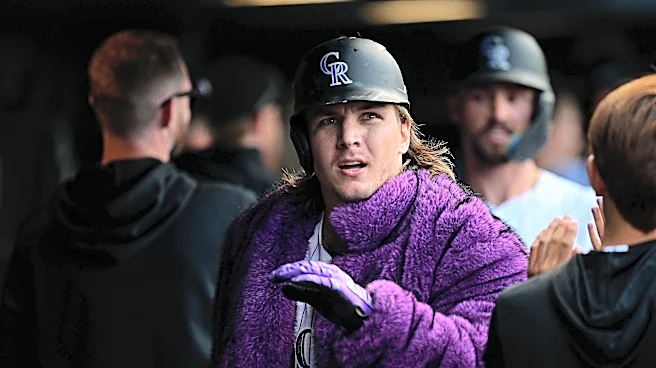

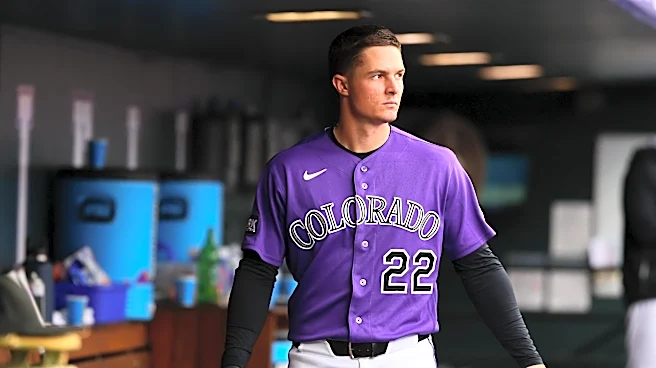
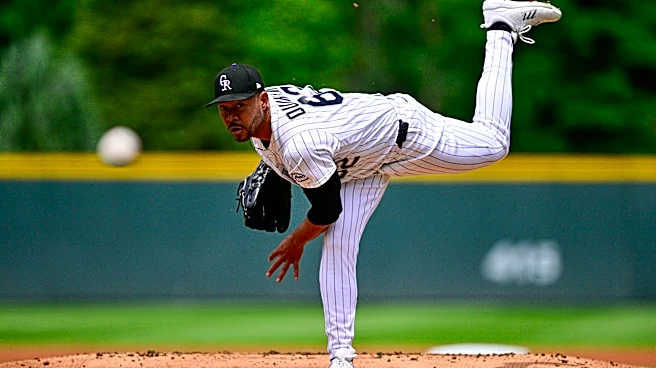
Hunter Goodman has been good. Again.
That is the place to start.
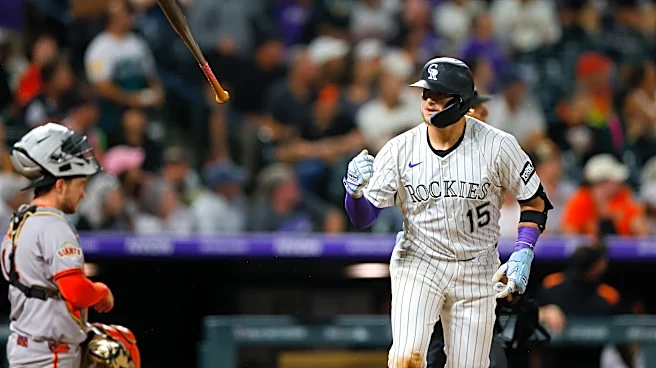
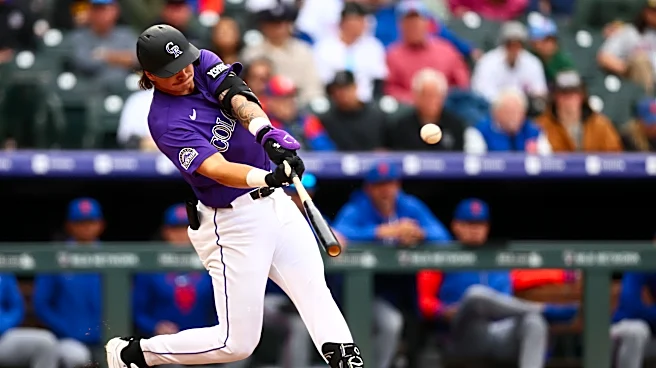
Goodman hit 31 home runs last season, became an All-Star, and won a Silver Slugger. And he has been productive in 2026, hitting .247/.310/.513 with an .823 OPS and 11 home runs through May 15th.
The interesting part is not that Goodman is producing. It is the extreme, occasionally odd shape of how he is doing it.
The power indicators are extreme. So are the access concerns. His production has been better on the road than at Coors Field.
And he is not just a right-handed power bat exploiting left-handed pitching.
Then there is the ABS piece, where Goodman’s relationship with the strike zone appears to change depending on whether he is wearing the gear or holding the bat.
The production is real. So are the caution lights.
In 2026, Goodman ranks in the 91st percentile in average exit velocity, 85th percentile in barrel rate, 92nd percentile in hard-hit rate, and 90th percentile in bat speed. When he gets to the baseball, there is impact in the bat. The shape has also moved in an even more power-friendly direction: 39.6% fly balls, 52.7% pull rate.
This is an extreme power profile.
But here is another extreme: 3rd percentile chase rate, 4th percentile whiff rate.
That is where the access question gets sharper. Power hitters are going to miss. Aaron Judge whiffs, too. The difference is whether those misses come while hunting damage in the zone or chasing damage out of it. Judge’s 2026 chase rate is 25.2%, below the MLB average of 28.5%. Goodman’s chase rate is 43.6%.
Their chase-contact rates are fairly similar — 45.7% for Judge, 49.7% for Goodman — but Goodman is putting himself in those chase situations much more often, contributing to an eye-catching 1st percentile strikeout rate and 25th percentile walk rate that holds the entire profile back.

Right now, Goodman is more Oneil Cruz and less Judge: overwhelming impact, real production, and massive plate discipline caution lights.
Still, it is working.
The home/road split is its own (odd) extreme
There were hints last year that Goodman’s power did not need Coors Field. In 2025, he hit more home runs on the road than at home, 18 to 13, even though the full profile still behaved like a normal Rockies hitter profile.
Goodman hit .307/.356/.526 with an .882 OPS at home and .248/.288/.515 with an .803 OPS on the road. The power traveled. The production still lived mostly at home.
This year, the whole thing has flipped.
In 2026, Goodman has hit .200/.278/.415 with a .693 OPS at home and .281/.333/.584 with a .917 OPS on the road. He has three home runs at Coors and eight away from it.
That is not just road power: That is a Rockies hitter doing the Rockies thing backward.
And because, apparently, the profile needed one more oddity, Goodman’s day/night split has been extreme, too: a .571 OPS in day games and a .962 OPS at night.
The platoon split is not extreme
Goodman is a right-handed power bat, so one might think the damage is coming mostly against left-handed pitching — the reverse Mickey Moniak.
Except that is not exactly the case, either.

His 2026 platoon splits are almost perfectly neutral: .244/.311/.512 with an .823 OPS against lefties and .248/.309/.513 with an .822 OPS against righties. And while the plate appearance gap matters, eight of his 11 home runs have come against right-handed pitching.
Goodman is giving the Rockies right-handed thump against all pitchers.
Goodman the catcher and Goodman the hitter
The strangest layer is Goodman’s relationship with the strike zone: it seems to change depending on where he is standing — or squatting.
As a hitter, Goodman has been one of the worst ABS challengers in baseball — ranking second-to-last in MLB in net overturns vs. expected at -4.0, while going 2-for-8 on challenges.
Behind the plate, he has been one of the best in baseball — ranking second in MLB with +14.4 net overturns vs. expected and a 71% success rate on 31 challenges.
Goodman appears to know the strike zone when he is trying to win a pitch for his pitcher. He has had a much harder time knowing it when he needs one more pitch for himself.
That split sounds strange, but eye angles and body positioning aside, there may be a simple human explanation. League-wide ABS usage hints at the emotional difference between challenging as a batter and challenging as a catcher. Batters challenge more often as the count becomes pressure-filled — especially in two-strike and full-count situations:

The same pattern shows up by inning, too. As the game gets later and the pressure rises, hitters challenge more often:

The urgency shows up in the challenge rate, but not in the success rate. Hitters challenge more often in those do-or-die counts without getting better results.
That is the existential crisis of the hitter. For a catcher, a challenge can be tactical. For a hitter, it can become a plea for one more pitch. To stay alive.
That does not solve Goodman’s hitter-side ABS struggles. It just makes the split more fascinating: the catcher can read the edge; the hitter is trying to survive it.
The Rockies can live with extremes
For now, maybe the cleanest way to understand the Rockies’ 26-year-old catcher is this: swing hard and often. Hit the ball outrageously hard when contact arrives. Live with the misses.
That profile is not tidy, but tidy is not the requirement. Production is. The Rockies can live with an extreme Hunter Goodman.
But this is also where the “what if?” game gets fun. What if Coors starts helping? What if the whiffs tick down? What if Goodman the hitter borrows a little more from Goodman the catcher?
Then the question gets bigger.
Is Hunter Goodman someone the Rockies can truly build around?
On the Farm
Triple-A: Oklahoma City Comets 17, Albuquerque Isotopes 1
The Albuquerque Isotopes fell to 25-18 with a lopsided 17-1 loss to the Oklahoma City Comets, who improved to 22-20.
Oklahoma City scored in each of the first five innings, including nine runs in the fifth. Carson Palmquist (No. 19 PuRP) started for Albuquerque and allowed five runs on seven hits and three walks over 2.1 innings. Palmquist took the loss, falling to 1-3 with a 6.95 ERA. The bullpen did not fare much better, as the Comets finished with 17 runs on 19 hits and 12 walks. Albuquerque had eight hits but scored only once. Blaine Crim drove in the lone Isotopes run and now has a .781 OPS, while Vimael Machín went 2-for-4 and is carrying a 1.010 OPS. The rest of the lineup was quiet. The Comets were led by Alex Freeland, who drove in five runs, Jack Suwinski, who added three hits and four RBI, and James Tibbs III, who went 3-for-5 with three RBI and has a 1.011 OPS.
Double-A: Portland Sea Dogs 2, Hartford Yard Goats 1 (F/10)
The Hartford Yard Goats fell to 17-19 with a 2-1 extra-innings loss to the Portland Sea Dogs, who improved to 17-19.
Portland scored first in the fifth inning on a Tyler McDonough RBI single, but Hartford answered in the sixth when Bryant Betancourt hit his sixth home run of the season, a solo shot to right field that tied the game at 1-1. The game stayed there until the 10th. Portland opened the inning with the automatic runner on second, moved him to third on a single, and brought him home on a groundout. Hartford moved its automatic runner to third with one out in the bottom half, but GJ Hill struck out and Benny Montgomery grounded out to end the game. Jake Brooks gave the Yard Goats a strong start — one run on eight hits over five innings with no walks and four strikeouts. Andy Perez went 2-for-4 and continues to produce on offense with a .368 average and .897 OPS.
High-A: Hillsboro Hops 5, Spokane Indians 4
The Spokane Indians fell to 14-23 with a 5-4 loss to the Hillsboro Hops, who improved to 15-22.
Spokane scored twice in the first inning, but Hillsboro tied it in the third, moved ahead in the fifth, and took the lead for good with two runs in the seventh. The Indians made it close in the ninth, loading the bases and scoring on an Ethan Hedges (No. 29 PuRP) hit-by-pitch, but Max Belyeu (No. 15 PuRP) struck out to end the game. Spokane had eight hits, with Robert Calaz (No. 6 PuRP) and Tevin Tucker collecting two apiece. Hedges drove in two runs, while Kelvin Hidalgo added an RBI single. The Indians used three pitchers in short outings. Brody Brecht (No. 3 PuRP) allowed two runs over 2.1 innings, Francis Rivera gave up one run in 2.2 innings, and Justin Loer took the loss after allowing two runs over three innings.
Single-A: Fresno Grizzlies 6, Visalia Rawhide 5 (F/10)
The Fresno Grizzlies improved to 22-15 with a 6-5 extra-innings win over the Visalia Rawhide, who fell to 13-24.
Fresno led early, lost the lead in the eighth, and then got it back late. Roldy Brito (No. 11 PuRP) delivered the biggest swing of the night, tying the game with a two-run homer in the bottom of the ninth. In the 10th, the Grizzlies put runners on the corners before Jeremy Ciriaco reached on a throwing error that brought home the winning run. Brito finished 3-for-5 with two RBI and now has a .965 OPS. Tanner Thach also had a strong night, going 3-for-5 with an RBI and pushing his OPS to .920. Jack O’Dowd added an RBI as part of Fresno’s 12-hit night. Angel Jimenez gave the Grizzlies a solid start, allowing two runs, one earned, on three hits over six innings while striking out six. Fresno’s bullpen made things interesting, but Samy Clausen struck out the side in the 10th to keep the game tied and earn the win.
Mickey to Mickey: A baseball thank-you letter | MLB.com
MLB.com’s Ayako Oikawa-Hughes shares a beautiful first-person piece from Mickey Moniak, written as a letter to Mickey Mantle. It is part family history, part baseball memory, and part reflection on how a name can connect one generation of the game to another.
Chase Dollander’s Elbow Is Now Colorado’s Biggest Problem | SI.com
Kyle Newman of SI.com frames Chase Dollander’s right elbow strain as the Rockies’ biggest concern because he represents both the present and future of a rotation already in crisis. It also covers the related roster moves, including Sterlin Thompson’s call-up and Sammy Peralta being added as likely multi-inning depth.
Purple Row After Dark: What are your way-too-early trade deadline predictions? | Purple Row
If you like trades and predictions, check out this Purple Row After Dark from Zeke you might have missed. He asked Purple Row readers for their way-too-early trade deadline predictions, which feels like a pretty natural conversation starter for where this Rockies season already is.
Join the conversation!
Sign up for a user account and get:
- Fewer ads
- Create community posts
- Comment on articles, community posts
- Rec comments, community posts
- New, improved notifications system!
Please keep in mind our Purple Row Community Guidelines when you’re commenting. Thanks!