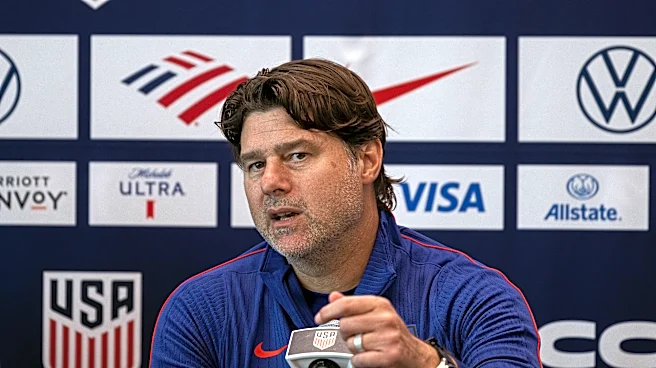








For someone who is not even two years into getting deeply acquainted with the United States, Mauricio Pochettino has takes about the nation and its soccer landscape. Some of it is right on – the USMNT does not have as many players in the top 100 compared to teams like Belgium and Portugal. Some of it belongs on loud TV broadcasts or podcast episodes, though it does make great fodder for blog content.
Last week Poch told Jeff Reuter of the Guardian that, “The difference within other countries – for
me, I know Argentina – the way that I developed my emotional relationship with football is before I started to walk because I started to kick the ball. That is the problem. The relationship is with basketball or American football. They take the ball with their hands, first thing. [Elsewhere] you kick the ball with your feet.” He said that about a country where soccer is the most popular team sport for kids to play.
Just. Man. OK. C***** de **e**@.
I’m tired.
This makes sense if you take it from the perspective of Poch bringing his own cultural expectations and – not to launch into a woke tirade – for lack of a better phrase, ethnocentrism to his seemingly conflicted relationship with his begrudgingly adoptive country. To state the obvious, the United States of America is not Argentina. For one thing, the USA has won four World Cups and never had to cheat for any of our stars.
Maybe I’m not tired.
The soccer landscape in the USA is unique in the world and is as varied and rich as the nation itself. It is full of delightful tidbits like: the most popular team in the country is La Selección Nacional de México, the most successful team is the US Women’s National Team, the most watched league is LigaMX, and the USMNT is OK sometimes. As an American soccer fan I would count myself as being somewhat typical as an elder millennial – I played the game as a kid, get in an occasional pickup game, follow Everton ironically, and LIVE AND DIE WITH THE NATIONAL TEAMS.
My emotional connection is at least similar if not the same as an Argentine. Did I not look on with only the wonder, hope and excitement that a child has when the Stars and Stripes rocked their denim kits to beat tournament favorites Colombia in 1994? Did my tears not stream down my cheeks when the team lost to Trinidad & Tobago in 2017? Did I not scream with joy on a bar patio when the ball went into the net off of Landon Donovan’s foot against Algeria in 2010? Did I not watch with my jaw dropped from a bar in Mexico when Carli Lloyd scored a hat trick in a matter of minutes in 2015? Did I not nod when Hope Solo said Sweden played like cowards in 2016? Did I not feel like I was with them as I watched the 2019 women’s team celebrate listening to Fight Night in countless Instagram videos? Did I not feel dread at Jurgen Klinsmann’s choices in his tenure, embarrassment at Gregg Berhalter saying the phrase “change the way the world looks at American soccer,” or shame at Bruce Arena because a Chicago Cubs hat was put on my head at birth in place of a soccer ball at my feet? Have I not felt the confusion of a win that felt like a loss, a draw that felt like a win, a loss that felt like a win or a I MEAN REALLY HOW DID WONDO MISS THE NET? HOW? Did I need to be born in the Buenos Aires Mataderos “Nueva Chicago” neighborhood and not on the shores of Lake Michigan in order to feel those things? Poch might say so.
When I have watched the World Cup with friends and co-workers from “soccer countries” the full experience includes sharing the same emotional toll of watching an event that carries with it so much excitement, pain, joy, agony, anxiety, fear, and love. Am I an outlier? Probably. I was amongst a handful of weirdos watching that game in 2010 and Poch might have a point about soccer not being the national sport – because it isn’t, but he’s also not the manager of the Argentina national team and opining about the relationship fans have with soccer is not going to change that over the course of a matter of weeks.
Poch could look at his own country for a better comparison when it comes to a successful team in a sport that is less popular, but experienced success all the same. In 2004 Argentina shocked the world when it won the Olympic Gold Medal in basketball. It’s not clear how Poch could explain that since his country is so focused on soccer that international success in another sport should be completely impossible. The United States is similar to his home nation when it comes to soccer and other sports. Americans broadly have no deep emotional connection with swimming, track & field, or wrestling but the Olympic medal count doesn’t care about that. Ultimately, what American sports fans care about is winning. There is no greater emotion in sports than the joy of winning, masochists and Cubs fans aside, and Poch should be focused on how to do that rather than opining about babies playing soccer.
Poch’s comments also undermine the identity that he could be trying to foster with the team – a group of underdogs who aren’t among the top 100 players globally that nobody expects to compete to win the World Cup much less upset the top teams in the tournament. It’s an identity that Americans relish and beating other countries at their sports (hey Canada) is as American as Taco Tuesday.
The United States Men’s National Team and its fans don’t need more lifelong or generational emotional attachments to a sport that it’s only been finding success in since the early 1990s than it already has across its rich cultural tapestry. They also certainly don’t need to be told they aren’t Argentinians. While Poch is dropping bombs about soccer in the country he might be missing that maybe the job isn’t to manufacture an emotional relationship with soccer — it’s to figure out how players outside of the top 100 can win games to give fans a team worth having emotions about.