



You may look at the Suns re-signing Mark Williams to a three-year, $38 million contract as unnecessary. He hasn’t exactly been the picture of health throughout his career. And while he played 60 games last season, 15 more than his previous career high, that still left him 22 games short of a full 82-game season.
So why pay him $11.7 million for 2026–27? You have second-year center Khaman Maluach waiting in the wings, along with third-year big Oso Ighodaro providing versatility behind him. On the surface,
you could make the argument that Phoenix didn’t need to spend that money on Williams.
I’ve talked ad nauseam about the optionality his contract provides in both the short and long term. If he plays well, you have a quality center on a team that isn’t going to be center-centric. If he struggles, or if Maluach exceeds expectations early, you have a highly tradable contract.
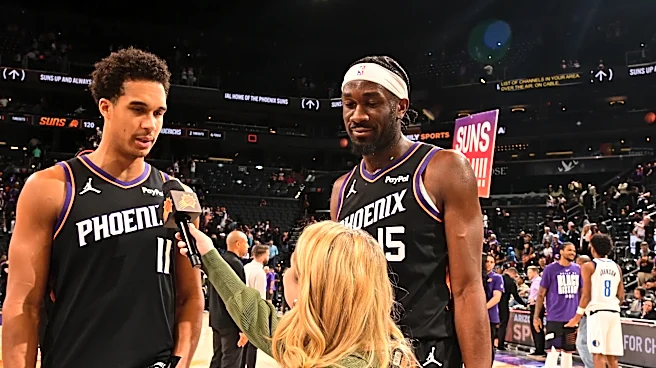
But I’m not worried about any of that today. What stands out right now is how versatile the Suns suddenly are at center. Between Williams, Maluach, and Oso, Phoenix has options depending on what a matchup calls for, and that is one area of the roster that doesn’t feel like it should create much anxiety entering the season.
Phoenix is not a city, or a franchise, that has known much stability at center. Three seasons ago, it was Jusuf Nurkic and Drew Eubanks. Two seasons ago, it was Nurkic and Mason Plumlee. And before that, you had a player with all of the promise but none of the mental toughness to allow it to come to fruition. Too often, the Suns have been stuck with lumbering, limited bigs who check only a couple of the boxes you want from a productive center.
Those boxes? Rim protection. Rebounding. Finishing. Screening. Athleticism. And if you want to add a bonus skill, the ability to stretch the floor. Throughout the organization’s history, Phoenix has gotten two of those six attributes and had to make do.
The beauty of this year’s roster is that Williams, Khaman Maluach, and Oso Ighodaro each check multiple boxes, which gives Jordan Ott the ability to play chess rather than checkers.

Williams graded in the 91st percentile with an A in rim protection, according to BBall Index. He also earned an A in defensive rebounds per 75 possessions, an A- in offensive rebounding talent, an A in offensive rebounds per 75 possessions, and an A in finishing talent, where he ranked in the 93rd percentile.
There is still room for improvement as a screener. His screening talent graded out at a C+, although he earned an A in both screen assists per 75 possessions and roll man possessions per 75.
What Williams did last season was play within the confines of the offense and complement what was happening around him. At times, it felt like he was underutilized, especially when certain mismatches presented themselves, and Phoenix continued to lean heavily into perimeter play.
Still, there’s a reason the Suns paid him. Mark Williams is a quality NBA center. Is he top 15 at the position? Probably not. But when you look at his contract within the context of the league, the value becomes much easier to understand. At an average annual value of $12.7 million, Williams ranks 34th among NBA centers. When you start talking about production relative to price, that is where Mark Williams can provide real value.
Maluach is your wild card, the kid who will be 20 years old when the season starts and showcased plenty of potential this summer in Las Vegas. He still has a lot of work to do, but he already possesses the rim protection, rebounding, finishing, and athleticism you want from a lottery pick. And screening? Stretching the floor? He might eventually be able to do both of those effectively as well. Heck, he shot 40% from deep in Las Vegas this past Summer League, and did so on 20 attempts.
If the progression continues and the opportunity follows, Maluach could become something special, not only as a prospect, but potentially as a franchise cornerstone. We don’t want to put the cart before the horse, but the skill set he brings gives Jordan Ott another piece he can weave in and out of games to disrupt opposing teams.
I think back to last season against the Denver Nuggets, when Ott put Maluach on Nikola Jokic after Jokic had been dissecting Phoenix from the high post all game. Maluach didn’t stop him, but he slowed him down. He forced Jokić to look at different angles and work harder to complete passes because of the length, tenacity, and disruption Maluach brought. That matters because disruption was a major part of what made the Suns successful last season. Maluach fits directly into that identity.
And then you have the advanced metrics darling, Oso Ighodaro.

When you look at the six attributes of a quality big, he doesn’t check every box. His rim protection graded as an A, according to BBall Index, while his defensive rebounding came in at a B plus. His offensive rebounding talent, however, ranked in the 12th percentile and earned an F. As for stretching the floor? That probably isn’t entering his repertoire anytime soon.
What Oso does possess is athleticism, finishing ability, elite screening for the position, and the versatility to switch onto the perimeter. That last part makes him an especially useful defensive option for Jordan Ott. In the modern NBA, having a big who can survive away from the rim and defend multiple types of players is incredibly valuable. Oso gives Phoenix exactly that.
When you put those three players together, you get a level of optionality at center that Phoenix hasn’t had in quite some time. I guess technically since last season, although the hope is that we see much more of Maluach this year.
When all three are healthy, the Suns can dictate pace, adjust to matchups, or respond to whatever an opponent throws at them. And if they aren’t all healthy, there is still viable depth behind whoever is available. You don’t have to sprinkle in starts for Chimezie Metu simply to survive the NBA calendar.
That versatility could end up being one of the unsung strengths of this roster because center is not the featured position in Phoenix. This isn’t Denver or Philadelphia. It’s a complementary position, one that needs to be occupied by capable players who understand their role, embrace it, and thrive within it. Williams, Maluach, and Ighodaro all have the ability to do exactly that.
Phoenix doesn’t need one center to do everything. It needs the position as a whole to provide enough answers over the course of 82 games. Williams gives you proven production. Maluach gives you upside and disruption. Oso gives you versatility and mobility. None of them is perfect, but together they cover a hell of a lot of ground. For a team built around Booker, Green, Bridges, and Brooks, that may be exactly what the position is supposed to look like.