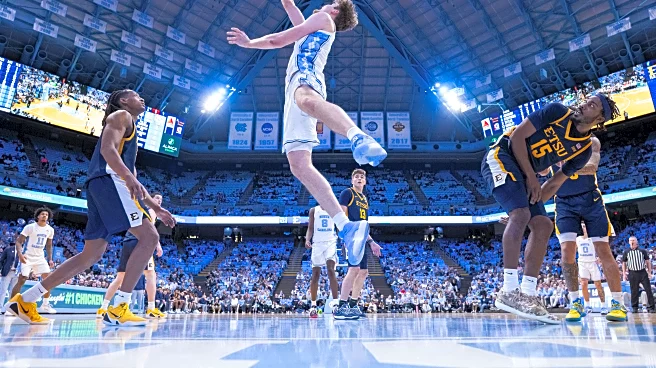

I warned readers before the game that this East Tennessee State team was not an opponent to be taken lightly, and for the first 18 minutes of action, they proved me right, forcing the Heels to play a down-tempo,
back-and-forth game that featured 6 ties and 4 lead changes. Eventually, though, UNC imposed their will, sandwiching halftime within a 12-0 run and never looking back for the rest of the game. It was an interesting Tuesday night to close UNC’s last nonconference home stretch before the CBS Sports Classic on Saturday, with more to glean from it than you might expect.
UNC’s Defense is Legit
The normal defensive numbers were pretty good, but you expect them to be against a mid-major that doesn’t shoot a ton of threes and hasn’t dealt with the kind of size and length UNC has in the post. The Buccaneers shot 38.5% from the floor and 30.4% from three-point range, which are great numbers for the Heels, but I’m more interested in the way that UNC has started to make a habit of just shutting down their opposition for minutes at a time. They held Kentucky without a made field goal for a full quarter of the game, and that was what ultimately made them able to pull off a win in a game they trailed for a lot longer than they didn’t. Since then, each UNC opponent has been forced into a second-half scoring drought lasting at least 4 minutes: a 5-minute scoreless period for Georgetown that allowed UNC to grow a lead from 8 to 15, and a 4-minute close to the Upstate game where the Heels took an 8-point game to an 18-point one before a late layup (there was also a 3-minute drought earlier in the half). This time, UNC held the Bucs without a point for 5 minutes, starting with about 12 minutes left in the half, while they extended their lead from a competitive 12 to a blowout 24 that basically ended the game with a fifth of it left to play.
UNC currently ranks 24th in Kenpom’s adjusted defensive efficiency, which is pretty good, but for me, these stretches are worth more than what the stats show. I’m not sure it’s an exaggeration to say that they’ve been winning games for the Heels by allowing them time to put runs together when the offense isn’t as explosive as they want it, which hasn’t been infrequent. And on the other end, missing so many shots in a row is frustrating. It takes you out of rhythm and can disengage you from the game, so even when the drought ends, its effects might not. Having the ability to change games like this in spurts will serve this team well going forward, I think.
The guard rotation is changing
Well, I mean besides the fact that Seth Trimble’s return appears imminent. We were already seeing an increase in Derek Dixon’s minutes of late, and it’s possible that a steeper tilt in that direction might be warranted as he makes his case not just as a steady point guard, but UNC’s most reliable guard shooter. But this game also featured some action on the wings. After a pretty much completely silent first half from Luka Bogavac, Hubert Davis decided to start Jonathan Powell in his place in the second half. I’m not sure I remember the last time Davis replaced a starter at halftime for reasons other than injury. Powell, coming off his career night against USCU, played 24 minutes and had an active day if not an efficient one. He’s making his mark on the defensive end, where Bogavac has struggled against NCAA athletes, and just playing solid, low-usage, team basketball.
It’ll be interesting to see how both of their minutes are affected by Trimble’s return — Bogavac’s shooting pedigree is going to be necessary for this offense to function given how many threes it generates, but that pedigree is only inconsistently showing up in games so far and the rest of his game has been a little all over the place. And Jaydon Young played 13 minutes of his own, recording a +/- of 19 in those minutes and acquitting himself well. With as much as we’ve already been through with this team, between two nonconference blueblood matchups and Trimble’s injury, it’s hard to remember sometimes that it’s not even technically winter yet, and personnel management is a fluid thing.
The ball was protected
Against a team that forces a ton of turnovers, UNC gave the ball up just 7 times, and just twice in the second half. That’s an accomplishment, and even more so that they did it in two different ways: In the first half, the ball moved sharply and a lot of offense was initiated by guards; the Heels assisted on 12 of 14 made baskets in the first half and the ones that weren’t assisted were a Caleb Wilson putback and a Jonathan Powell fast-break layup. Offense was hard to come by because of how much ETSU was slowing the game down (it finished with a Tony Bennett-like 61 possessions), but they were finding the right shots. In the second half, they just punished the Bucs inside, with Henri Veesaar and Wilson finding space inside and converting over and over again. They played the game ETSU’s way and then they played it their way, and in both cases were able to execute against a team that prides itself in blowing up your offensive plan. Even when the overall efficiency isn’t stellar, the process is really promising for this team. They clearly understand how to play basketball and can adapt to situations. If anything’s separating them from being elite, it’s just making a few more shots and free throws, and that’s not really a ton to ask.