






How much of a player’s reputation can hang on one or two games? If they come early in the season, perhaps quite a lot.
In 1974, Tversky and Kahneman formalized the “anchoring effect” — a cognitive bias where an individual’s judgement is affected by a reference point, which may or may not be relevant or representative. A common way this shows up is when we overweight what we saw first or last — comparing all other points to that original (or ending) anchor point.
What do Tversky and Kahneman have to
do with basketball, aside from the fact that I was introduced to their work by Dean Oliver’s book, “Basketball On Paper”? Well, their half-century old work may shed light into what many of us think about Kyshawn George.

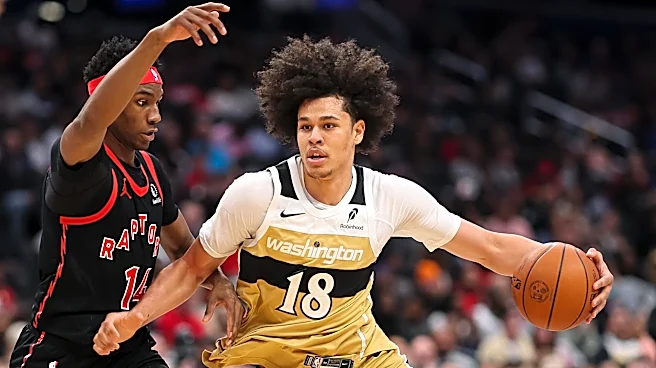
George opened the season with a pair of strong games — 21 points, 9 rebounds, 4 assists and a 128 PPA in the season opener, which he followed up with a dazzling 34 points, 11 rebounds, 4 assists and a 327 PPA in the season’s second game.
Two games into the year, and his PPA was at a dizzying 232 and his offensive rating a stratospheric 134 on 26.8% usage. In other words, he looked like a potential MVP candidate.
At minimum, most of us were thinking he’d made a quantum leap from the previous year. Many of us thought he’d likely cemented a major spot in the team’s future — and we discounted the dud games. I’m speaking for myself here, by the way. I know I was mentally discounting some of the bad games even as I was running the numbers game by game and expressing frustration at the mounting turnovers and rampant fouling.
Basically, I was telling myself that “the real” George was better than the guy missing tough shots, fumbling the ball all over the place and unable to stop hacking and crashing into opponents in ways that break the rules.
But this is part of the utility of performance EKGs. By tracking performance over the full season and giving myself the ability to zoom in on individual data points and stretches, I get to see some meaningful details.
Like, that scintillating second game of the season performance represents 9.6% of George’s total PPA production for the season — in just 2.5% of his total minutes. Great game, no doubt. And it affected my opinion of George for another 46 games.
During those final 46 games, George’s PPA was a subpar 76. His offensive rating was 105 — more than 10 points per 100 possessions below league average. This does not mean he sucked or that he’s not going to be good. It just means he has further to go than we’d thought. Or hoped.

When I ran George’s 2025-26 performance EKG, what jumped off the screen was the sharp peak early in the season followed by the steep decline and then a pretty flat line after that. The flattening out is normal — most players have a relatively stable full season PPA score game-by-game. What’s somewhat unusual is the size of the drop-off, a colossal 145-point dip from early-season peak to final average.
Along the way, George managed no 20-game stretches where his PPA cracked average. Even with the hot start, he didn’t notch a 10-game stretch with a 100+ PPA until Jan. 27. His best 10-game stretch was a 126 PPA from Jan. 14 to Feb. 1.
Now, having started with words about the anchoring effect, I do also note that George’s best sustained stretch of play came in late January and early February. For six consecutive games, his rolling 10-game PPA was above 100. It ranged from a low of 107 (the final game of the stretch) to a high of 126 (the fourth of the six games).
Except, maybe I’m just doing it again. Because that stretch of games includes George’s second best game of the season — a 260 PPA performance where he had 29 points, 5 rebounds, 7 assists, and 3 blocks against the Denver Nuggets.
Let me throw a few more logs on the fire. I’ve written about my consistency index, including in my last article about Alex Sarr. George’s score in the index: 112, which means the variation in his game-to-game performance was bigger than his season average. While I thought his effort was consistently good, in terms of production, the Wizards literally had no idea what they’d be getting from George.
The high-end performance were truly anomalous. Here’s how frequently he hit certain PPA benchmarks last season:
- 200+ (MVP conversation) — 8%
- 150+ (All-Star level) — 23%
- 100+ (average or better) — 48%
- 100> (below average) — 52%
- 45> (below replacement level) — 29%
- Negative — 19%
What does all this mean? George has promise but still has a long ways to go to become a good NBA player. He could be useful as is, but if he’s going to make himself truly valuable, he needs that elbow to heal, and he needs a strong summer of work on his skills, decision-making and body.