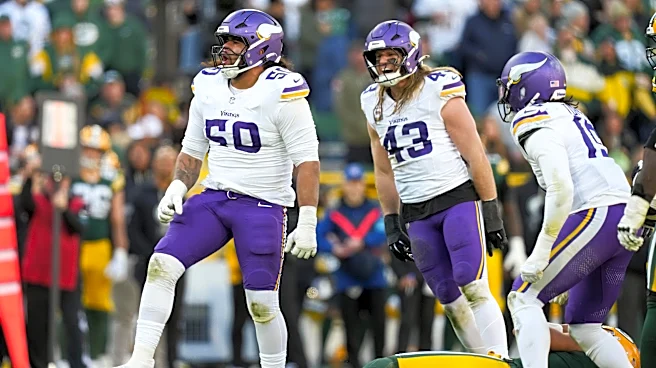


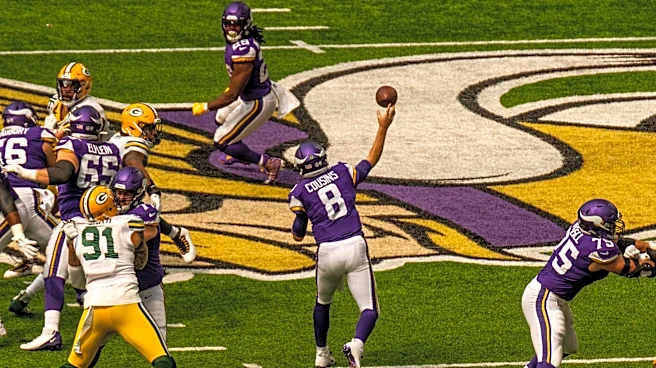
We all saw the Green Bay Packers’ offensive line get pushed around by the Minnesota Vikings on Sunday, but I’m sure some of you are wondering exactly why the team messed up in crucial situations over and over. Hopefully, you’ll learn a little more about the game and the status of the team by the end of this article.
I want to start with this up front: I don’t think the Packers’ running game was actually that bad on Sunday — at least on the relative scale of Green Bay’s running game. Where I really
think the team regressed was in the pass protection department, where they played their worst game since at least the first three weeks of the season.
Let’s start with the run game.
Running Game
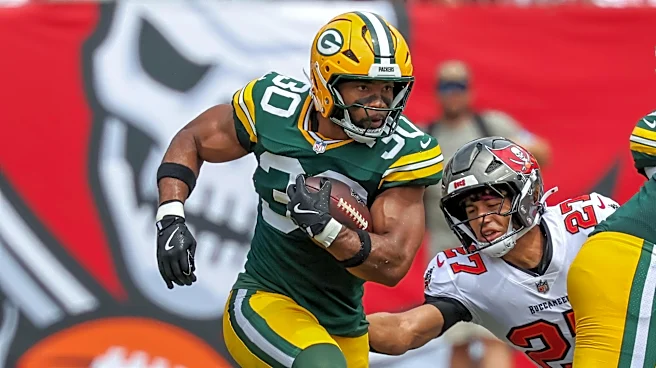
I clipped up all of the runs that the Packers’ running backs had in the tweets above, if you want to check them out. There are a couple of poor calls (like the pin and pull sweep that had no chance because of Minnesota’s defensive call), but for the most part, Green Bay got a hat on a hat against the Vikings, something we can’t say of prior games.
Can they move anyone? No! They never have been able. They have one preferred starter on the field. Can they get in front of people, at least on the ground? The last two weeks are probably the Packers’ best back-to-back performances this season.

The first big mistake the Packers made was on this duo run. The diagram above is what Green Bay’s offensive line is expecting pre-snap. Because the Vikings stunted their three-technique defensive lineman outside on the play, though, right tackle Anthony Belton never gets off his block, and there’s a free runner when the play should have gotten up to the safety level.
It’s the second play in the Johnson cutup.

The second big mess-up was on this outside zone toss, where the team handled another stunt poorly. On paper, if everyone stays in the gaps they line up in, the diagram above is what the run should look like. Essentially, offensive linemen try to “scoop” defensive linemen to their play-side, and if there isn’t a defender in that gap, they climb to the second level and try to work on backers and safeties, after first securing that no one stunted in their play-side gap pre-snap.

The problem is that the Vikings don’t stay in their gaps, and they slant weak on the play. Because of this, there should be three pass-offs. The Packers don’t execute a single one of them, leading to all three players getting penetration.
It’s the play that you keep seeing screenshots of over and over again. It’s the fourth play in the Johnson cutup.
These plays look like crap, but outside of that, the Packers mostly played their rules correctly this week — again, which has not been the case over most of the year. Over the last two weeks, they’ve found something that worked for them: running counter, a play that allows the offensive linemen to get on train tracks and just block downhill instead of worrying about assignments being exchanged by the Vikings’ blitzes and stunts.
Everyone makes a wall of down blocks except for a kickout player (either a pulling guard or a tight end) and an insert player (again, either a pulling guard or tight end). As a reminder, the zone plays that didn’t work against Minnesota are what Green Bay ran a lot of in the preseason and through Week 3 of the regular season. They went out of their way to try to get good at what they’re doing the worst this year.
On counter and split zone concepts, the Packers had 10 carries for 50 yards (5 yards per carry) on the day. On other concepts, which mostly relied on changing targets post-snap, the Packers were just 6 for 6 (1 YPC).
My guess: Green Bay wanted to punish Minnesota with the ground game this week, particularly counter and split zone runs, but the game got out of hand and they had to ditch that script when they were down three scores. The team played a lot of extra tight end looks in this game, allowing the Vikings to get an extra player in the box on defense.
Passing Game
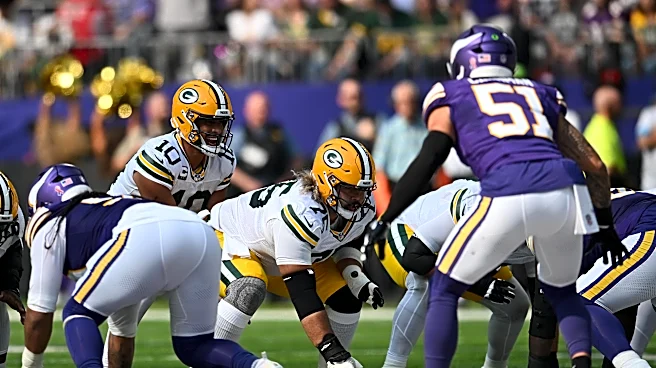
The passing game is really where the Packers’ line struggled, in part because they were playing these multiple tight end sets that added just another variable for Green Bay’s line to account for. Against Minnesota, the Packers looked completely lost on the interior offensive line, which was made up of Laken Tomlinson, John Williams and Travis Glover (left to right).
I thought we were over this. From Weeks 4-9, after the disaster that was the Atlanta Falcons game on Monday Night Football, the Packers had just a 35 pressure rate, good for the 16th-lowest in the NFL over this time. They looked like an average pass-protection unit over the last two months.
In the first three weeks of the year, the Packers cracked the 40 percent pressure rate twice, but had done it only once in the past six weeks. It seemed like they turned a corner, but then the Vikings came to town.
Yesterday, Minnesota posted a 60 percent pressure rate, the highest number that Green Bay has allowed all season. In Weeks 1-3 and 10, the Packers have allowed a 46 percent pressure rate overall, the highest mark in the league over those four weeks.
It’s hard to know what Green Bay’s offensive line will look like moving forward, because we just saw a huge regression after a streak of solid play.
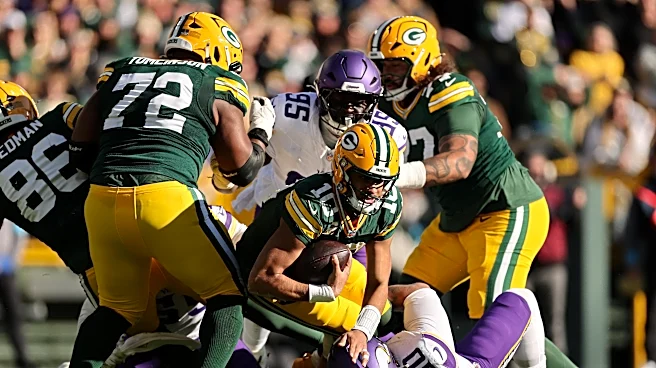
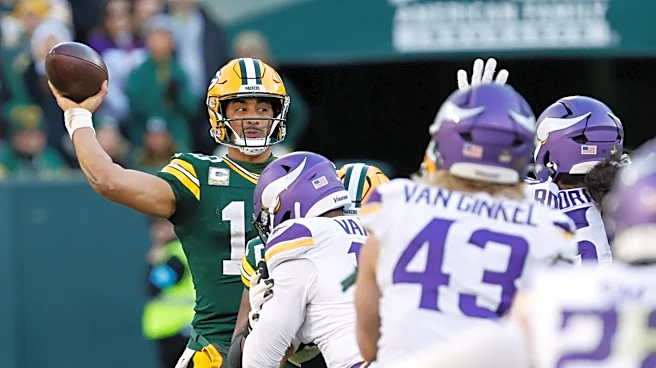
Mind you, this all came with Love’s time to throw at just 2.27 seconds against the Vikings, and they still sacked him eight times in this game. For perspective, the average NFL time to throw is around 2.8 seconds, so Love was operating about a half-second faster than the average. And he was still getting popped left and right. Had he held onto the ball at an average rate, the line’s pressure rate would have been even higher.
Here are just a few clips of the Packers’ offensive line blowing up plays from essentially the snap of the ball on Sunday, just to show how poor it was:
This tweet is supposed to say Belton, not Becton. I apologize to the Becton family.
All three interior offensive linemen had disaster games, looking consistently confused by Minnesota’s defense. Right tackle also Anthony Belton struggled, as he’s not a good athlete for the tackle position and should ideally be a guard at this level — but the injury to Zach Bako-Bewele forced him into his position this year.
—
Green Bay’s plan to add extra bodies into the formation with multiple tight end sets kind of worked in the run game, where they were able to run counter and split zone runs pretty well against Minnesota, but they couldn’t stick with the ground game once they went down multiple points — understandably. What really hurt on the ground was when the offensive line had to think and react to the Vikings’ defensive front, and the line wasn’t able to execute on those runs.
To make matters worse, the extra tight end (and offensive line) looks helped Minnesota bring an extra body in the box in the passing game, which adds exponentially more options for defensive coordinator Brian Flores for each body he could line up as a threat. Against those pressure fronts, the Packers’ interior offensive line’s heads were spinning all game.
Next time, maybe LaFleur will want to spread out the formation against those pressure looks, instead of having running backs and tight ends walk up to the line of scrimmage. It’s what the Vikings did against Green Bay’s pressure fronts, and Minnesota was able to get a good number of explosive plays in those situations, notably on third and long.
The Packers’ offensive line just isn’t good enough to deal with this many variables post-snap. They’re not coached well enough. LaFleur, the head coach, just hasn’t accepted that going into the second half of November. The offense looked better when they ditched their game plan in the second half of the third quarter, turning into a three-receiver spread team that ran the hurry-up no-huddle. The Packers went on a little run there and looked like they had a chance to get back into the game until they fumbled the ball on a kickoff return.
The fact that “do what you want, just play fast” led to better results than Green Bay’s game plan is a damning indictment of the staff’s decisions this week.