

We aren’t going to dwell on the embarrassing loss in Berkeley against a banged-up Bears team. Bryan covered pretty much everything that needed to be covered. Let’s look at where the team is as a whole at the halfway point of the season, and before Homecoming.
Embarrassing: No Other Word Fit the Cal Loss
The Cal game was probably a complete bust from the mechanical delay that kept the Hokies from arriving late and exhausted, to the opening offensive effort that completely fizzled after the defense got a stop against the Cal offense. Tech struggled
to move the ball beyond the Cal 40, and that persisted for almost the entire game. The firebirds will be blaming Pry for the defense and dumping heaps of scorn on John Love for missing field goals. We’ve already seen the “we’d be 6-0 if…” assertions.
Both the Pitt and Cal losses were critical hits since they are both peer teams on similar program trajectories. The reality is that the Hokies need to take into a serious advisory meeting, and some real changes are going to have to occur to salvage a winning season. It’s not the end of the world, but it is (sort of thankfully) the end of the “dark horse” CFP speculation and certainly should end the fumes of winning an ACC “Champeenship” at the end of the regular season. This team is playing for a mid-tier bowl bid, and a winning record for a change, and that is the sum total of the potential season outcome for 2026.
The loss at Cal was more of a quiet period on the end of the first half of the season where Hokie Nation had hoped to see either bowl eligibility or at least a one game push to get there. What we have now is a difficult schedule with no real certainty of any more than one additional win in the hopper. With both offense and defense sputtering in critical aspects of the schemes, it’s nearly impossible to up rate the Hokies against the remaining opponent base.
The Picture at Mid-Season
The image is not all dismal and horrid, though. The Hokies have done some good things and have some solid foundations that should allow for a pivot to push beyond a 6-game season push. The key issue is going to be whether or not the coaching staff has the confidence in the performing segments to alter the scope and pattern of both approaches to offense and defense. To do that the coaches are going to really have to sit down and concentrate on a mid-season reorganization of how they are linking and planning about games, and then how to change the pace of adjustments within them.
Build on What’s Working
There are still some really good things happening with various squads for the Hokies. If you break down the offense and defense, there are some solid performances from individuals and various rooms that can form the basis for a resurgence for the final 6 games, that could net a better paying bowl game.
The Intermediate Passing Game
Ethan Grunkemeyer is proving himself to be a solution to the current offensive woes, in conjunction with more than just Luke Reynolds as a target. The Hokie offense has established several really reliable downfield route runners and pass catchers in Ayden Greene, Que’Sean Brown, Davion Brown, and now Marlion Jackson. Both starting running backs are also very good at catching the ball, and of course Howle has collected a first-rate tight end corps starting with both Reynolds and Benji Gosnell. Ja’Ricous Hairston has also contributed scoring chops when in. The offense has proven that it can move the ball downfield rapidly and especially when there is a viable run vs. pass choice presented to the defense.
Coach Howle has to figure out a completely new set of general level game plans that make use of Grunkemeyer’s skill at operating from a moving pocket, and the strength of that receiving corps over the top, but not too far over the top. We still haven’t seen a ton of deep threat balls thrown and completed, but there have been some really excellent drive extending strikes to Greene and Q. Brown on the outer edge of the intermediate passing zone.
With the offensive line seriously banged up and struggling to get traction with its run blocking, the Hokies are going to have to push the game downfield over the top to loosen up the defense and provide opportunities for stretch and counter plays to turn Overton and Hawkins back into significant ground offensive threats.
The Defensive Line Plus…
We all heard at the beginning of the season that the defense wanted to get “natural” (four player) pressure on quarterbacks in passing situations and effectively shutting down the run. The defensive line has been inconsistent in its efforts to do the former, but very good at getting the latter completed. The reality is though that the two tackles and two ends can only do so much, and stripping the fourth player out to play max cover defense hasn’t worked. Pry needs to get back to the “bear front” of four down linemen and a run cover/pass blitzing linebacker (or extra edge rusher).
Tech finally has the size and power to stop normal runs at or even behind the line of scrimmage. It just doesn’t have the inside pressure power to overwhelm the Center and Guards in the “A-gap”, especially in must pass situations where Pry is choosing to cover out instead of going after the quarterback. He has the personnel to pull that off more often than once in a blue moon. There were several times in both the Pitt and Cal losses where the defense needed to “send the house” instead of trying to rush three and cover in a prevent. The secondary is struggling, and putting even more pressure on it by allowing a quarterback all day to throw is not going to help matters.
What’s Just Not Working
Giving the “Juniors” Better Oppornities
The Hokies have two of the best running backs in the ACC. Marcellous Hawkins, Jr. and Jeffrey Overton, Jr. are a potent combination of runners and receivers out of the backfield. The problem is that their abilities are only about 15% of the run game. The Hokie offensive line can best be described as patients in a M*A*S*H unit. The current configuration has #2s in critical positions, and the #1s might or might not be up to full speed when they get in. What’s worse is that event he #2s like Brodie Meadows are chronically down to injury. This is not just a “problem”, it’s a crippling situation. It’s one where the offensive line cannot be counted on to get a 2-yard push.
The situation really gets old fast because what we keep seeing is the continued use of A-gap Dive plays, straight blocking, and chronic wasting of early downs in running plays that are almost always failing to produce more than schedule yardage. Actually, the averages are showing that the Hokies are short of even “caveman football” four-yard gains on inside running plays. There are lots of modern names for the old-fashioned halfback or fullback dive play. The situation gets even more difficult with slow developing shotgun/pistol handoffs where the running back hasn’t even built up a few steps of momentum before being handed the ball.
It’s time for Howle to switch to a pass downfield first offense, going over the top of the defensive line on three second hot reads and tight end drags, or slot slant patterns. If he can get that sort of 5- to 8-yard play executed regularly, the linebackers will be forced to cover under the zone, and the blitzing will have to stop. That will get the running stretch and counter plays working, especially if the offense gets the pocket moving.
Once the passing game gives the Hokie run game some breathing room, the offensive line will also gain some confidence and find out what sorts of blocking audibles will work, and how best to execute those blocks. Both Hawkins and Overton are fast, cut well, and have good vision. Setting up the offensive line for success will also set the Juniors up for success.
The one big lesson to internalize is that “balance” in the offensive game plain might be weighted toward the pass for the remainder of the season. What is definitely not working is operating a stone age run-first-and-pass-in-a-panic on third and long or moderate.
The Short Passing Game Isn’t Working Either
This one won’t take long, because it’s becoming a chronic issue that will drop into “Dun Busted” unless the OC quits trying to do what plainly does not work. The bubble screens, flare patterns, and flanker screens that are completed behind the line of scrimmage fail almost every time they are attempted, especially against man coverage. The problem is that the “wide screen” is a slow developing play that depends on the shotgun and a short drop to somehow suck the defenders out of coverage and allow the quarterback to get the ball out to either a flanker or running back off the edge (usually into the boundary). If the player covering that receiver on the outside of the formation does not bite, the long slow pass is delivered behind, or at best at, the line of scrimmage with a defender draped over the receiver. Those passes just don’t develop enough of a percentage of reliable yards after catch to make them “go to plays”.
Sometimes these are checkdowns as primary routes fail to develop, but if it’s a Z receiver bail, it would be better to have that receiver downfield 3 or 4 yards or in the case of a first down attempt, the receiver should be at or beyond the sticks.
Also, please note that these are traditional screen plays where the quarterback baits the rush and flips the ball over their heads to a running back behind them, usually through the ‘A’ or ‘B’ gaps. This offense is going to have to rely on speed, not power for the remainder of the season. Speed is not defined by slow developing 20 yards soft pass plays that never complete beyond the line of scrimmage. Someone needs to write on a whiteboard in permanent marker.
ALWAYS GO DOWNFIELD!!!!
Okay, Now for the Hard Fails
There are two glaring holes in the makeup of this team that are going to continue to trouble games until someone somewhere in the organization finds solutions.
The Secondary is Going to Draw Flies
The secondary is now, officially, in the Dun Busted category. It’s been struggling all season long, but the complete meltdown giving up critical penalty yards, and then passing yardage to the Golden Bears with barely over a minute left in the game was hard to see. Yes, the officials threw a really ticky-tack flag on the play that, in the end zone for a potential Tech touchdown was not thrown when Luke Reynolds was practically tackled before the ball arrived. That’s a badly broken issue outside of the Virginia Tech program. This secondary is going to be targeted repeatedly and often for the remainder of the season, and there are several teams coming up, including the Hoos, that have capable quarterbacks and receivers.
This current secondary is not covering well. The coverage is often way too loose and a 3 to 4 second play series is slicing and dicing them like they aren’t even in the picture. In addition, when covering man on, the backs are repeatedly forgetting to get their heads turned around, and the receiver is either catching the ball over their heads, or the zebras are tossing yellow hankies about. It is true that the experience level of the players was often in question… regardless of the number of years they have been on a team, and their experience with playing with each other in coverage balance was low in the beginning of the season. Those “excuses” began to evaporate after game 4 or so. We saw a regression from the BC game through the Cal game.
Part of getting them help, is getting better at getting to the quarterback and disrupting the play behind the line of scrimmage, but the players, themselves, are going to have to figure out how to step up and play better football. The defensive secondary is probably one of the most complex tasks on that side of the LOS, and right now, this secondary doesn’t seem to be getting “IT”.
That means every team that faces the Hokies’ defense is going to target them soonest and often.
The Play Calling Adjustments Keep Going Back to Gutter Balls
“You have to establish the run.” “We are going to establish the run.” “We need to have success in the running game.” You’ve heard it, and some of you bite off and swallow it whole. That rule of offense comes from “caveman football” and it’s usually one of the first big “statements” an Offensive Coordinator/Head Coach combination makes as their hopes and dreams of going anywhere evaporate like a bowling ball dropping into the gutter before hitting the pins.
It’s really nice if you can control the clock by burning up time using the run game. Or so one would think. The simple fact remains, that Virginia Tech, with 18 seconds left on the clock moved from mid field to the 7 yard line and had enough time left to attempt a touchdown. And prior to that Cal went 75 yards to score a touchdown without running the ball.
The team that scores the most points per minute of possession usually wins the football game. If a team can score 14 points in possessing the ball five minutes, while the other team scores 7 with 10 minutes of possession, who wins the game?
Tech’s offensive coaching staff still has the urge to burn plays on snuffed runs and pass in a panic on 3rd and long. We can also add those short bubble screen thingies as running plays that fail at the line of scrimmage. The coaches need to change their thinking and base assumptions if they want to go bowling after the season is over.
The Hokie offense has proven that it can reliably go fast and downfield in the air, and that loosens up the defense for the running game to work as balance. That’s modern football, and the staff needs to fix the problem, and keep it fixed. No more getting a strike, followed by plopping the ball right back into the gutter in the next frame.
Next Saturday it’s a 3:30 Kickoff at Lane
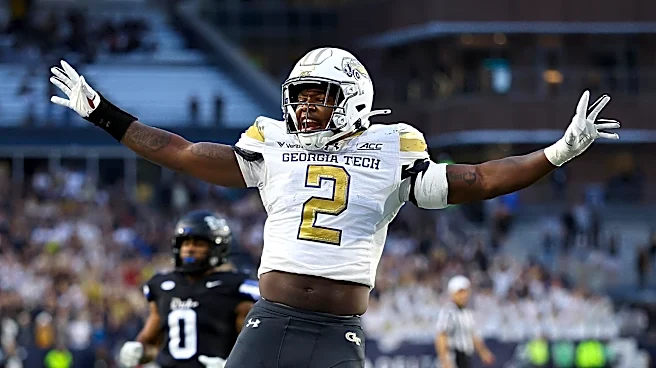
The weather is promising to be cool and breezy. The leaves are changing and its Homecoming for the Hokies. Georgia Tech was looking shaky in the beginning of the season but just handed Duke a big defeat. Virginia Tech has a bunch to fix, and this one is a toss-up game, now.