



If the name Thilo Widder sounds familiar, you have a good memory! Thilo is a contributor at our Minnesota Timberwolves sister site Canis Hoopus, and he participated in the second round of Fraternizing with the Enemy with J.R. Wilco during their playoff series against the Spurs. He also enjoys contributing to other blogs, and we have the great honor of him providing this amazing piece on Carter Bryant and his contributions to the deaf community to Pounding the Rock. Enjoy!
What’s the first thing you
think of when you think basketball? Do you see the sight of the ball dropping through the net? Can you just feel the excitement burst into your bloodstream, a memory turned physical with a moment’s notice?
Or, do you hear it?
Because I hear basketball. I hear its presentation when Mike Breen yells “bang.” I hear the sound of shoes squeaking up and down the court, of Mark Cuban’s speaker system bafflingly installed inside the hoop itself.
I hear it all. I live for it. It’s essential to how I have fallen in love with basketball.
But what if it hadn’t been? What if I, like thousands of fans, could not hear the game? Deafness continues to be a more and more common disability. Over 430 million people world-wide already deal with some sort of hearing loss with the WHO estimating that number to rise to over 700 million by 2050, approximately 10% of the world’s population by that time.
There’s an ESPN story about “Invisible Disabilities” faced by sports fans that has stuck with me many years after it was originally posted just about two years ago. There’s one section about a deaf fan, Amy Gomme, who said the following:
“These leagues, these teams are missing out on a new fan base, potential fans who would show up to games if the experience was inclusive enough.”
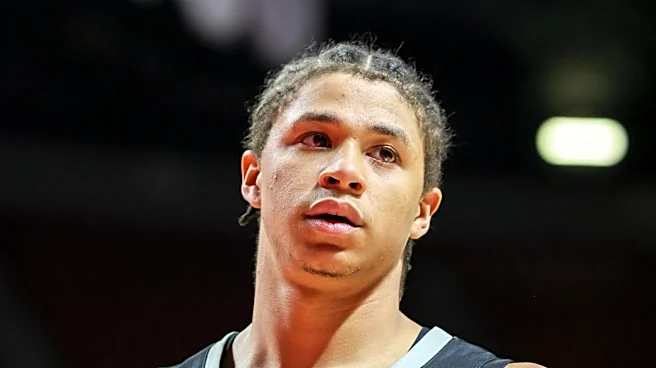
I wonder how Carter Bryant feels about that.
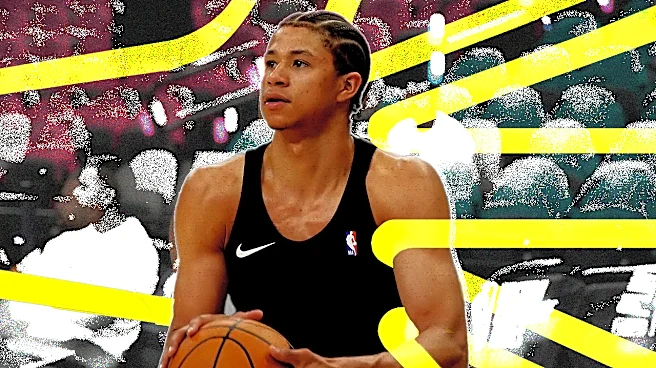
To be clear, Bryant is not deaf. Instead, he’s been molded by the community that still seems like such an afterthought to the NBA’s production. As a child in a non-hearing family, and a special advocate of Gallaudet University, a school for the hearing impaired, Bryant called himself the “face of their platform” in a pre-draft video. That seems more important than ever.
“For the longest time, I thought half the population was deaf and half the population was hearing,” Bryant said. “Because, just how I was brought up, half my day was spent with deaf people.”
Bryant is something called a GODA – or a grandchild of a deaf adult. The slightly less known acronym than its generationally separated CODA (child of a deaf adult) has fundamentally shaped the man he is today.
That G part of that set of four letters carries more than it seems. Bryant’s grandfather is Doc Torres, who few of you will know. Widely considered the brightest star of an 80s Gallaudet team, Torres was shunned from the NBA for his deafness. He would go on to play nearly 20 years in Puerto Rico and win two gold medals at the Deaflympics.
There has only ever been one deaf NBA player. Lance Allred played for the Cleveland Cavaliers for three games in the 2007-08 season. He would spend 16 seasons bouncing around 17 different teams from the early 2000s to the mid-2010s.
During his time in the G-League, Allred faced discriminatory abuse from his coach while playing for his hometown Utah Flash.
It was clear that the NBA was not ready to empower deaf players. Whether it was for a lack of readiness or a lack of care, they simply did not set up Allred – or Torres for that matter – for success.
It is certainly not from a lack of talent. That much is very clearly certain.
Carter Bryant decided on Arizona, a university with an established pipeline to the NBA, for any number of reasons. They played the fast paced brand of basketball that would empower him. His aunt had played volleyball there and he knew the coaches well. They had a history of turning forwards with similar body types to his own into lottery picks and champions. From Aaron Gordon to Derrick Williams to the more recent Benedict Mathurin, the fit was clear.
Still, there was an option that must have tugged at Bryant’s heart-strings. Gallaudet University could offer him a third generation of his family, tied to a school and a community that he clearly cares about so strongly.
And yet, it never could’ve been in consideration. To go to Gallaudet would be to abandon the dream he had built in his parents’ home.
He understandably made the only real choice he had, the only choice that loving family would’ve allowed.
Still, at Gallaudet, his grandparents would be able to attend games and be treated as people first, not as their disabilities.
Instead, Arizona had an incredible season. Bryant was a blur in transition and his body rapidly took form as his defense did the same. Transfer Caleb Love joined him to lead the Wildcats to the Sweet Sixteen.
During that run, or even during his whole college season, Carter’s mind was on his family, as undoubtedly theirs was on him. Yet, despite their continued care for him, Bryant’s games were getting harder and harder to follow and watch for the people that he wanted there most.
It seems silly to say. Arizona’s games were all televised. There are gaggles of reporters doing write ups for these contests. Coverage was not too far out of reach.
And yet…
“I think basketball is unique, because it’s a live event, so I think ways I could relate to that would be theater, cinema, concerts. It’s really hard to find caption films when they come out live, and so there’s a lot of delay in access to information.” said Apolline Tardy, a Ph.D student at Berkley College and an advocate and researcher of accessibility technology.
“Movies will come out in theaters, they don’t have captions yet… even if something is coming out live, the captions often have a delay, especially if they’re manually typed, and it’s just.. it’s such bad of an experience that I don’t follow at all. I don’t want to, because it’s kind of incoherent. The timing is so important. I imagine basketball is so visual, like you don’t want to see someone shoot and then wait 40 seconds to, to know who did it”
Only four teams – the LA Clippers, the Phoenix Suns, the Portland Trailblazers, and the Brooklyn Nets – offer OneCourt, a disability aid for low vision individuals or the vision impaired. As far as whatever is publicly available, no teams offer any sort of support for deaf fans.
The assumption is that fans who need them will have their own cochlear implants, that all these fans need to do is to join the “hearing world.”
In 2021, Zach Lavine took a group of hard of hearing students to a Chicago White Sox game, continuing a commitment that started when he was in high school. The interpreter he includes in his messages are a stark reminder of what the NBA has not done.
What’s your favorite part of being a fan of the NBA? Or any sports league for that matter?
Is it the moments in play that remind you of when you first fell in love with the game, the nostalgia of remembering what it was like ten, fifteen, however many years ago?
Is it the transactions, the trades that promise endless debate and the thoughts of different universes? What if the Spurs had lost Tim Duncan to the Magic? What if they had drafted better players in the first few years of their rebuild?
Or, as it is for me, is it the community that comes with discussing these questions with peers, who decide to unite in their care for a sport that is slowly but surely becoming the world’s second most popular game?
Many of those who push back on accessibility claim that communities should be responsible for their own engagement. There hasn’t been much proof that the deaf community wants to engage with sports so why should we build out tools to help them?
The better question is: how many fans have we missed out on learning from because the league failed to invite them into the game.
Carter Bryant was invited to join the game that those fans shunned had made, a space they could play without the usual questions. Whereas hearing players, players who have been socialized yelling out orders on the basketball court, can communicate with ease, there is no place for signing in these runs.
“If I’m guarding the ball and I have four other people behind me, you kind of have no idea what’s going on,” Bryant told The Athletic in a February interview. “So being able to check out your peripherals, use your feet and just have a sense of natural feel for the game, it’s different. We take it for granted as players, and we don’t use our other senses as much, but we don’t have to.”
Bryant heard the same floor squeaks, the same sound of the swish we have all fallen in love with, but without the barking. He didn’t hear a screen called out, or a switch, it instead became a second instinct.
Schemes were internalized, matchups memorized, in a way that would not require communication but instead only the trust that his teammates would be there.
Inherent, unthinking belief that someone would be there. That someone would reach out.
The priority of the NBA has been globalization.
They have, to their immense credit, found ways to build basketball from a game for fans all over the world to a worldly game, which is not an insignificant jump to make. Fans can now experience their favorite teams in Spanish, Japanese, French, and any of the other 60 languages offered.
If you’ll bear with me, Spanish broadcasts of NBA games first started in 1995 when the Miami Heat partnered with a local radio station and decided they would supply the local market with dubbed commentary of Heat games. For over a thousand straight games, Jose Pañeda sat in the booth and excited fans who had not been ignored entirely, but certainly also hadn’t been invited.
A few years later, the NBA greenlit a deal with Telemundo, leading to a 15 game trial period across three years, opening the door for ESPN Deportes and the ilk. Decades later and those are cornerstones of the ESPN network.
It is insane to argue that the league would never have sought out a way to communicate with fans outside of the English language. However, it took just one act of one franchise, 25 years ago, to make the league better, not just for Spanish speakers but for fans in China or Germany or Brazil.
Because they reached out. They assumed someone would be there if they opened their doors and they were right.
“I think an argument you should make is that deafness is very similar to a language barrier,” said Tardy, “If I only spoke French and I went to the NBA in the US, I wouldn’t know what was going on… Some deaf people just consider themselves a linguistic minority. They say ‘if everybody spoke ASL, then it wouldn’t be a problem at all for anyone, because everyone could just operate on other senses.’”
What would a broadcast for deaf fans even look like? It’s certainly not as easy as an option as for different non-English verbal languages. Would it be as simple as having an interpreter, as has been provided for concerts and films?
“My goal is that it doesn’t become secondary, that you know you have the primary source of information, that speech, for example, and then you have the secondary source, like it’s translated in another way, and then you become the second to hear it.” continued Tardy, “I think what would make the experience so much smoother is if there was a primary way to access information… why can’t there just be a deaf commentator that’s not translating a hearing commentator?”
430 million people are deaf worldwide. That is more people than the population of all but two countries in the world.
They – and their potential fandom – are ignored.
Carter Bryant is being ignored.
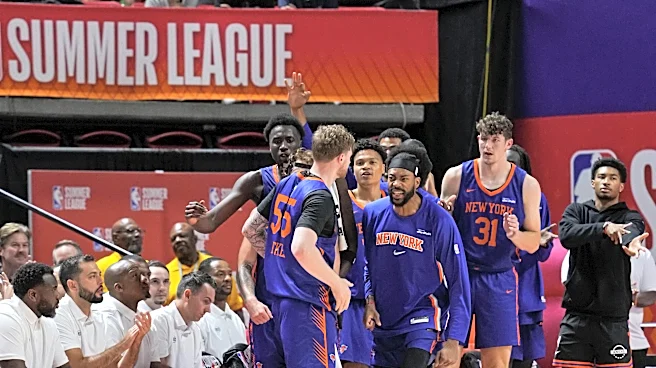
It’s the middle of the season and the 15th pick has still not cracked the rotation. He has been sent back and forth from the G-League, and he is playing against the end of the bench guys that NBA fans so frequently forget are among the top 500 players in the world.
Worst of all, he’s missing dunks. What was once the easiest thing on the planet is now coming harder and harder. It’s like the court is screaming at him. Gone is the quiet, the focus on simply trusting and executing, here is the new reality.
At first, he gets loud. He plays the character he thinks he needs to. He becomes robotic. His movements are stiff. He falls further and further from a normal role.
He is transferred back down to the G-League again. However, this time it comes not with a focus. He is not told to practice his mechanics or on-ball creation, although I’m sure that was in the notes as well.
No, he’s told to find himself.
There’s a concept in accessibility circles called imagined needs. In Apolline’s words, “accessibility has a long history of being made by people who don’t experience the disability and who imagine what the needs might be, and then when they actually show their products… this is fun, but I won’t use it in my day-to-day life, because it’s impractical, or because I just feel embarrassed to use that in public.”
I think the same concept applies to development in the NBA. We assume we know the swing factors for players to succeed. We rave about whether a handle or a buffer frame or any number of things are the things that will take our favorite young players from prospect to star.
Maybe these two things are unavoidable. What did it take for Bryant to find a spot as the first forward to sub in for a Spurs team that would make their first final in 12 years? Was it a better shot? Was it a return to non-robot form?
No, it was finding home. And he found it in the fraternity that grew him.
Bryant would re-engage with the deaf community, although it’s more accurate to say he extended an open hand in a new place. He led events at the Sunshine Cottage School for the Hearing Impaired in San Antonio. He signed hello to deaf families when out and about, an act so simple that had become so foreign.
For Carter, silence is home. Not just the lack of sound, but the lack of outside input. He speaks sparingly. He is kind, yet soft spoken. He is looking out for obstacles that he does not expect to be announced. He is compared to dumplings on Twitter.
In a world full of invisible barriers to the league, those silent and those overwhelmingly, unendingly loud, he has focused on what is directly in front of him.
It’s a quiet journey. But it was never one without communication. Maybe the next step is helping to take the courts he grew up on, the ones without the relentless chatter, and shaping the NBA landscape with them in mind. Maybe it comes first in the form of a breakout sophomore season on the Western Conference Champion. Maybe it does not come at all.
But what is undeniably certain is the means he will use to pursue that journey, wherever it leaves him.
With silent growth, and ever open arms.
With words unheard but not unspoken.
With a future he is sure to grasp, and a community he has never stopped hearing.
Silence has never been quite this loud.