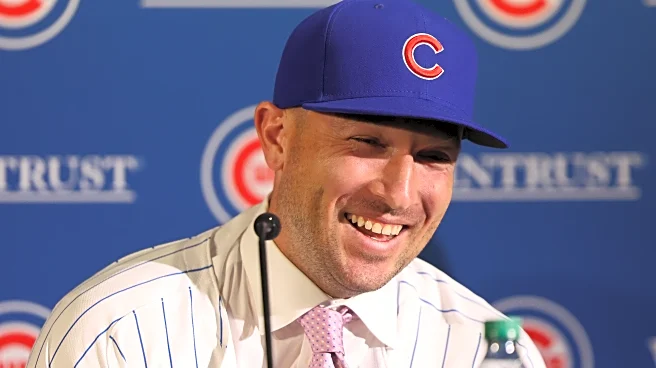

With the signing of Alex Bregman by the Cubs to a five-year, $175 million deal, reported Saturday though not yet officially announced by the team, I thought it was time to take another look at the team’s
payroll and luxury tax figures for the upcoming season.
Based on reporting on Bregman’s deal, this is not necessarily an easy thing to do. Why? Check out this report from Ken Rosenthal:
Based on that information, we are going to split the difference here and assume a 2026 salary and luxury tax hit on Bregman’s deal of $30.5 million for 2026. That number might wind up being adjusted up or down once more information is obtained, including the exact amount of the deferral.
Even the deferral is newsworthy, because it marks the first time the Cubs have done such a thing in many, many years. More than four decades ago the Cubs gave Rick Reuschel a contract with deferrals which, had it still been in force, would still have five years to go! That deal was eventually bought out.
Anyway, that’s just an aside to the Bregman deal. Here is our best guess as to the Cubs’ current payroll and luxury tax. Remember that the pre-arb player numbers here are estimates; they could fluctuate a bit either up or down from what’s posted here.
As you can see, if these numbers turn out to be accurate, the Cubs are just a tiny bit over the first luxury tax level, by about half a million dollars. However, the numbers above include an estimated $8 million for mid-season acquisitions and players replacing others on the 60-day injured list, so the team might actually still be under the tax. Note that there are 27 players listed above. That includes Justin Steele, who will almost certainly start 2026 on the 60-day injured list, which means that some of the “reserve for 60-day IL replacements” will be used as of Opening Day.
One more interesting note — if the players listed above are the Cubs’ 26-man Opening Day roster — and that very well could be — it will include seven players, more than 25 percent of the roster, who were not in the Cubs organization at all in 2025. That seems significant.
As usual, I have asked BCBer The Deputy Mayor of Rush Street for his analysis of these numbers. The rest of this post is Dep’s.
The 2026 Cubs: The Cake is Baked… With the Cherry on Top
To cut to the chase, Kenney claimed that you can’t just compare the gross revenues to the player payroll to determine if the Cubs are spending their fair share of your money on players.
Cubs $584M-$213M = $371M difference (spending 36% of revenue, 26th in MLB)
NYY $728M-$384M = $344M difference (spending 50% of revenue, 11th in MLB)
LAD $752M-$549M = $203M difference (spending 73% of revenue, 2nd in MLB)
Saturday was quite a night for Chicago sports, and just when the Bears needed a boost the most, Jed Hoyer reeled in the big fish to pretty much cap off his building of the 2026 Cubs.
There was quite a discussion that night which I mostly observed, as Al and I were already working on this update before the big news broke, so I reserved my say for the aftermath.
On the spending issue, there were a lot of the familiar arguments getting tweaked, and called out, and argued… though my opinion has not actually changed. The Cubs went out and spent — and kudos to them for doing so — but they’re still playing as if the luxury tax threshold is basically their limit.
With due respect to Crane Kenney and his $50-60M of “unique” Cub expenses that no other team has to bear…
Cubs $584M-$244M = $340M difference (spending 41.8% of revenue, 24th in MLB)
In a theoretical recalculation, the Cubs move up just a couple of notches, and would have finished just behind the Red Sox, while passing up the Guardians and Brewers on a percentage basis.
I’ll give credit to Hoyer for finding a way, and possibly getting permission to maneuver his payroll where he could land a “Marquee Player” to help fill the void of losing Kyle Tucker’s bat. But barring a truly shocking further move, this signing really fits in with the Hoyer plan I’ve been attempting to explain in these team-building pieces.
For now, the discussion can continue as before. But if you’re of a mind to, I think the die-hard fans can take a moment to pat themselves on the back for sustaining enough pressure on the team, to the point where some national writers took note and felt comfortable in lending a megaphone to our voices.
And if you’re on the business-friendly side of the coin, you can take comfort in knowing that the franchise is still taking in copious amounts of excess profits, and maintaining their status as a major-market, top-3 revenue team that spends more like a mid-market operation. Also, you now have a new point, that the local TV money will drop a bit further now that Comcast has moved Marquee Sports Network to their “premium sports tier.”
TOP LINE: In the wake of the announcement, Ken Rosenthal reported that the Bregman deal includes $70M in deferrals, to where the AAV for tax spending purposes is expected to fall between $30-31M … and reducing the immediate cash salary to 5/$105M. Even if that money is spread evenly, I believe the Cubs will end up sitting at just about where they ended last season on a cash money basis, though closer to the limit on a luxury tax spending basis.
Although I believe the team is complete as it stands and the Cubs can afford another one-time small luxury tax bill in 2026, if there is a mandate from ownership, Hoyer might look to shed some money at this point. Stay tuned on that angle, I guess.
But as to the question of are they now Under or Over the tax threshold?
When I first heard 5/$175M, I was at “no… but yeah, they’ll leak over”. With the deferrals report it’s flipped me to “no, but they’ll have to manage it very carefully”. The BCB estimate has the Cubs virtually on the tax threshold — BUT — that’s including the $8M buffer zone we leave for a July trade budget and an estimated cost of replacements for players on the IL. So at this stage it appears to be manageable.
And as for possible Qualifying Offer candidates … Suzuki, Taillon, Happ, Hoerner, Boyd… are any of them worth the risk of having them take the money? Or are at least some of them where Hoyer wouldn’t mind them coming back for one more season?
Here’s what’s happened since our last update:
RP Jacob Webb was signed for 1 year at $1.5M plus incentives, with a $2.5M team option for 2027.
RP Hunter Harvey was signed for 1 year at $6M plus incentives.
RP Ryan Rolison was selected in what appears to be a game of ‘roster roulette,’ as two teams have failed to sneak him past waivers this off-season so far.
The Cubs traded for SP Edward Cabrera.
Justin Steele, Edward Cabrera and Javier Assad all reached agreements with the Cubs in advance of arbitration hearings.
And in news that broke while PCA was apparently waiting for the coach to suit him up as a free safety, the Cubs signed 3B Alex Bregman to a reported 5 year, $175M contract with deferrals, and I suspect some back-loading. No opt-outs, and a full no-trade clause.
The 40-man roster stands at 38.
Current Player Payroll:
(Note, the figures for each player’s salary and ‘tax hit’ are per Cot’s Contracts, ‘tax hit’ being the charge against the Cubs’ luxury tax spending level. The base luxury tax threshold is $244,000,000 for the 2026 season.)
Players with Guaranteed Contracts (16):
Bregman $30,500,000
Swanson $25,285,714
Imanaga $22,025,000
Happ $20,333,333
Suzuki $17,000,000
Taillon $17,000,000
Boyd $14,500,000
Hoerner $11,666,667
Maton $7,250,000
Rea $6,500,000
Harvey $6,000,000
Kelly $5,750,000
Thielbar $4,500,000
Milner $3,750,000
Webb $1,500,000
Austin $1,250,000
============
TOTAL $194,810,714
============
GRAND TOTAL FOR TAX PURPOSES $244,583,381
LUXURY TAX THRESHOLD $244,000,000
CUBS STAND OVER THE TAX BY $583,381
(but… with the $8M buffer for July trades/IL replacements)
¹- Optional Expense, but some amount figures to be held back from wherever Tom Ricketts sets the baseball budget.
² – Estimating approximately four seasons’ worth of MLB minimum players for eight 60-Day IL stints of varying length. For example, Justin Steele may not return from TJS until June.
ADJUSTED FOR ACTUAL PAYROLL EXPENDITURES IN 2026
GRAND TOTAL IN CASH OUTLAY $248,327,667
(This figure includes adding $2,964,286 in adjustments between contract payouts and tax valuations. It does not include an anticipated 2026 cash reduction for Bregman, as his 2026 salary and precise tax hit have not been reported yet.)
Current Projected Roster – Again, there are now 38 players on the 40-man roster.
OF (4): Happ – Crow-Armstrong – Suzuki – Alcantara
IF (6): Bregman – Swanson – Hoerner – Busch – Shaw – Austin
C (3): Amaya – Kelly – Ballesteros
SP (5): Horton – Boyd – Cabrera – Imanaga – Taillon (Steele IL)
RP (8): Palencia – Maton – Harvey – Thielbar – Milner – Webb – Assad – Rea
(Note: Only Palencia and Assad on this reliever list can ride the Shuttle in 2026.)
2026 60-Day IL (1): Steele
40 man pos. players in minors (1): Pedro Ramirez
40 man pitchers in minors (9): Ben Brown, Porter Hodge, Gavin Hollowell, Luke Little, Riley Martin, Jack Neely, Ethan Roberts, Ryan Rolison, Jordan Wicks
Notable non-roster players in minors: Jaxon Wiggins, Jonathon Long
BOTTOM LINE: They DID find room for one more major addition. Again, kudos!
But does my opinion that the team is complete as it stands — will that hold up to a closer look? You be the judge.
Do they have enough starter depth?
Horton
Boyd
Cabrera
Imanaga
Taillon
Steele (likely to start on the IL, but back by June)
Rea
Assad
Brown
Wicks
Wiggins
Relievers?
Palencia – Maton – Harvey – Thielbar – Milner – Webb – Rea … plus one who can ride the Iowa shuttle, of which I’ve tentatively selected Javier Assad for his flexibility, and ability to throw multiple innings. (Assad also has an arbitration contract, which means that he makes his full salary even if he’s optioned to the minors. Ergo, inside track.)
But the main candidates appear to be Assad, Porter Hodge, Ben Brown, Jordan Wicks, Riley Martin.. possibly even a non-roster invitee, but that’s a high bar, to claim the one final spot (if everyone’s healthy).
The only possible hole I see here is no experienced closer to back up Palencia, just in case. But Craig Counsell seems pretty open to mix and match “out-getters.”
As for the position players, the question Saturday night was: What about Matt Shaw? Nico Hoerner? Will there be enough at-bats to go around? I say yes, effectively the roster has 10 “starting” players for 9 spots in the lineup. (Or 9 for 8 if you put Kelly and Amaya to the side to handle the bulk of the catching duties).
You have Tyler Austin to “help” Busch against lefty pitching. But if Ballesteros is mainly a DH against righty pitching, that gives CC 150-200 ABs to mix among Shaw, Bregman, Swanson, and Hoerner, and then perhaps another 100-150 PAs while each of the infield regulars get some rest days (sorry, Dansby — time to cut back from the ironman act). And none of that includes any injuries which might pop up.
And keeping Shaw is important to Hoyer’s long term plan, to continue mixing pre-arb talent onto the team, so you can afford an upper-level player or two, or three on the roster – while keeping in line with the family’s budget.
Justin Steele, Ian Happ, Nico Hoerner, Miguel Amaya, Michael Busch, Pete Crow-Armstrong, Matt Shaw… if not Owen Caissie, there are Cade Horton and Moises Ballesteros this season. The plan relies on a steady stream of production from the farm system, and will be expected to transition from this coming season to a new core in 2027.
Also note that Shaw put up a slash line of .258 /.317/.522 (.839) in the second half.
Do you see any further moves to make, given that there’s likely little-to-no wiggle room in the budget now?