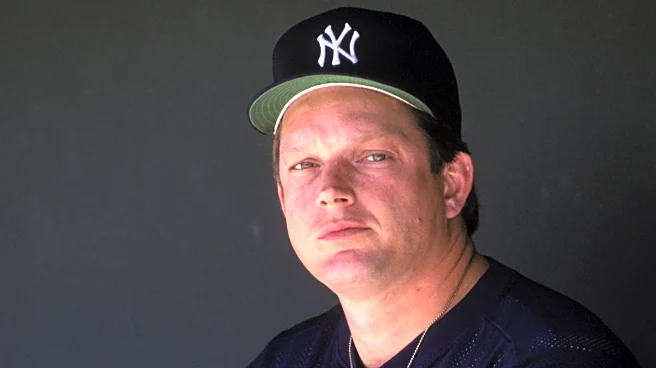



Steve Howe was an extraordinary pitcher. Featuring a bowling-ball sinker that he could locate with pinpoint control, his arm talent and tenacity distinguished him from the competition at every stage of his baseball life. He accomplished things on the field that should form the foundation of a proud legacy. Unfortunately, Howe never got the chance to cement that legacy as the cycle of addiction consumed his life.
Steven Roy Howe Born: March 10, 1958 (Pontiac, MI) Died: April 28, 2006 (Coachella, CA)
Yankees Tenure: 1991-96
Steve Howe grew up in Michigan, where he was a standout at Clarkston High School before starring as a Michigan Wolverine. The talented left-hander was selected by longtime Dodgers GM Al Campanis in the first round of the 1979 MLB Draft, jumping straight to Double-A and spending just a single year there before making it to the Show. Howe was an immediate sensation as a rookie, posting a 2.66 ERA in 84.2 innings as the team’s closer while allowing just a single home run. “The kid’s got ice water in his veins,” raved a giddy Campanis of his new phenom. When asked if Howe was deserving of Rookie of the Year honors, his Hall of Fame manager, Tommy Lasorda, retorted: “Rookie of the Year? How about MVP?”
Howe did indeed take home the 1980 NL Rookie of the Year Award and followed up on his success in the years to come. In 1981, he made four scoreless relief appearances in the first two rounds of the playoffs to help the Dodgers to the pennant and was on the mound when his team defeated the Yankees in the Bronx for the title.
It was not until after the 1982 season that the cracks in this young superstar’s facade began to show. Howe entered himself into a substance abuse treatment center at his wife’s urging and, though he would be ready for the start of the following season, by May of 1983 he was back in rehab after no-showing for a game. Commissioner Bowie Kuhn (along with the Dodgers) fined Howe $54,000 for his use of cocaine, beginning a cycle of punishment and redemption that would continue for more than a decade. Howe returned in June and pitched at an elite level through September, when he missed a team flight, was fined another $54,000, and entered back into rehab. That following November, Howe tested positive for cocaine, at which point Kuhn suspended him for all of 1984.
This suspension began what would be a seven-year wilderness period for Howe. He cycled in and out of baseball, with brief stints with the Twins in 1985 and the Rangers in 1987. He spent time with the Single-A San Jose Bees and in Independent ball, as well as agreeing to terms with the Seibu Lions in Japan before the NPB vetoed the deal due to his history of drug use.
It wasn’t until 1991 that Howe would get another shot at a comeback. His agent arranged a tryout for Yankees GM Gene Michael, who offered him a spring training invite the next day. “He’s getting a chance because he’s good,” the matter-of-fact Michael, always a stickler for talent, told the press. “There’s always a need for left-handed pitching.” For his part, Howe espoused that he was leaving his troubles behind him. “That’s in the past,” he said of his drug abuse. “I am recovering today, and I have two years of sobriety. Believe me, if you went through what I’ve gone through, you’d want to forget, too.”
For a former Rookie of the Year, world champion, and All-Star, Howe’s introduction to pinstripes was ignominious. He initially had to wear the uniform of another non-roster invitee, Van Snider, and donned a pair of Don Mattingly’s cleats while waiting for his own equipment. But his golden left arm quickly jumped him back up the food chain. “I haven’t forgotten how to pitch,” Howe said. “I haven’t lost my competitive edge. That’s the key. You take those two things and put them with a 90-mile-an-hour fastball, and that’s success.”
That success would, indeed, come. Howe allowed just one unearned run through 18 innings with Triple-A Columbus before Michael called him up on May 10th. “They tell me he’s throwing as good as he can throw,” the GM said. “He’s as ready as he can be.” The next day, at the age of 33, the reliever cleared a hurdle that would have been unthinkable just months before, making his first big-league appearance since 1987 in a scoreless ninth “I made it,” he declared afterwards. “If I don’t pitch another inning, I got back.”
Howe recorded a 1.68 ERA in 48.1 innings that year and, in a full-circle stat line reminiscent of his halcyon rookie campaign, allowed just a single long ball. Having gone through hell and back, Howe established himself once again as one of the game’s top bullpen arms.
Alas, that December he was arrested by Montana police in a sting operation while purchasing cocaine. Despite protestations that he was coerced—and the fact that he continued to pitch at a high level through early June while the legal proceeding played out—he eventually pleaded guilty and was banned from baseball indefinitely by commissioner Fay Vincent.
It was Howe’s seventh suspension from baseball and, just as many had celebrated his redemption arc upon returning to baseball, the New York press reveled in the chance to beat him while he was down. “Seven-Time Loser” read the back page of one paper. Chris Russo of the newly minted “Mike and the Mad Dog” talk radio show repeatedly called for the suspension to be made permanent.
The banishment would be lifted before the 1993 season, in part because Howe’s manager went to bat for him. “I had to ask myself: how are you going to feel if two or three years from now Steve Howe ends up dead somewhere and you had an opportunity to help him, and you didn’t?” asked Buck Showalter. “I couldn’t live with that.”
Howe would stick with the Yankees for the next four seasons, showing intermittent flashes of his former dominance and avoiding an eighth suspension. His organization aided in his recovery, even giving him a job selling tickets in early 1995 while players were locked out due to a labor dispute so that he could continue to comply with the terms of his probation. After he pitched to a 6.35 ERA in 17 innings during the 1996 season, the Yankees released the 38-year-old. In some ways, being forced into retirement due to age and declining performance was a triumphantly extraordinary outcome for Howe in its ordinariness.
In 2006, Howe died at the age of 48 in a single-car crash. An autopsy revealed he had methamphetamine in his system at the time of the accident. It was a sad end for a man who had worked so hard for so long to keep his life on track. Perhaps that is Howe’s greatest legacy — a man who, despite scorn, ridicule, and ostracism, never stopped trying to live up to his potential, both as a ballplayer and as a person.
See more of the “Yankees Birthday of the Day” series here.