


If you were to rank the best and most beloved Yankees in history, most of them would share at least one trait: they probably won a couple World Series rings. There’s some people on the current day team that unfortunately haven’t checked that off the list yet, but basically since Babe Ruth showed up in 1920, almost every great Yankee has celebrated a championship at some point.
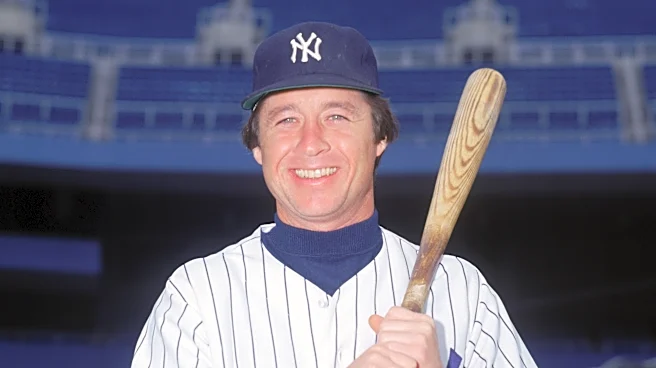
It’s a testament to Bobby Murcer as a player and a person that he’s such a beloved Yankee without a World Series ring. Even
beyond that, he only ever appeared in one and that was at the end of his career. However, between being a bright spot in a dark period in franchise history and his time in the broadcast booth, Murcer remains beloved. Today on what would have been his 80th birthday, let’s celebrate him.
Bobby Ray Murcer
Born: May 20, 1946 (Oklahoma City, OK)
Died: July 12, 2008 (Oklahoma City, OK)
Yankees Tenure: 1965-74, 1979-83
The second of Robert and Mae Belle Murcer’s three children, Bobby Murcer was born in Oklahoma in 1946. From an early age, Murcer showed a love and aptitude at sports, playing all of baseball, football, and basketball in school. Despite his small stature, he starred at all three at Oklahoma City’s Southeast High School.
While named an All-City basketball player, baseball and football were the sports where Murcer truly stood out. In football, he was named to the All-District team after leading the way for his team as a quarterback, halfback, linebacker, and punter. He was even considered good enough to be offered a football scholarship by the University of Oklahoma. That was quite the big deal as the Sooners were one of the preeminent college football teams in the country, having won three national championships in the 1950s.
Despite all that, baseball was Murcer’s true calling and what he thought his future was in. Playing shortstop and occasionally pitching, he had helped lead his high school to a conference championship, and caught the eye of MLB teams. Several offered to sign him out of high school, and at least one — the Dodgers — offered him a larger signing bonus, but it seemed that Murcer only had eyes for one team.
In June 1964, Yankees scout Tom Greenwade — who had also signed fellow Oklahoma native Mickey Mantle for the franchise — landed Murcer for the Bombers with a $10,000 signing bonus. The Yankees had been Murcer’s childhood favorite team and Mantle his childhood idol, and he eagerly joined the organization.
Murcer began his professional baseball career with the Johnson City Yankees of the Appalachian League in 1964, and he quickly impressed. While a knee injury would end that campaign a bit early, he had impressed the Yankees enough for the team to add him to their 40-man roster to protect him from other teams snatching him away.
Murcer made his major league debut on September 8, 1965, starting at shortstop and hitting second for the Yankees that day, where he went 0-for-5. His second game came a couple days later on September 14th. He had a far more notable performance that day, as his first career hit came on a two-run, go-ahead home run in the seventh inning that wound up being the difference in a 3-1 Yankees’ win. It was a pretty impressive feat for someone who was still just 19 years old.
After a couple stop-and-start stints in the majors, Murcer was drafted into the army, and spent all of the 1967 and ‘68 seasons away from baseball. Upon his return, he won the starting third base job for the 1969 season. However a few weeks into the year, manager Ralph Houk asked him to take some reps out in right field, and the rest is history — though center would be his home for much of 1970-73.
The Yankees as a team had fallen off a cliff after their 1964 World Series loss, but by the time the 1970s came around, they were starting to show some better signs, and Murcer was a big part of that. Murcer put up career best seasons in 1971 and ‘72, where he accumulated 6.5 and 7.4 fWAR, with wRC+ figures of 176 and 171. Those seasons also began a run of five consecutive All-Star appearances.

In 1974, the Yankees began a two-season stint played at Shea Stadium as Yankee Stadium was undergoing renovations. The difference in dimensions had a massive impact on Murcer in particular, who put up his worst offensive season since before his stint in the military. He also hit just 10 home runs that season, having consistently hit the 20 mark prior to that. The down season apparently led to the Yankees’ brass asking some questions, and after 1974, they dealt him to the Giants for Bobby Bonds.
Unfortunately for Murcer, the next couple years began the Yankees ascension back to the top, cultimating with the 1977 and ‘78 World Series wins. As that was happening, Murcer had a couple productive seasons in San Francisco, but he found it difficult to adjust to the extremely windy Candlestick Park. He eventually requested a trade, and was sent to the Cubs ahead of the 1977 season.
Murcer felt more at home in Chicago, and had the respect of his teammates. However, the front office and the fans didn’t always take to him, especially considering his production was no longer at a star level like it had been in his prime. Adding to that, Murcer had a big contract and a no-trade clause, limiting his options somewhat. In June 1979, the Cubs approached Murcer with a trade that would sent him back home — to the Bronx. Murcer happily accepted and made his return.
On the field, Murcer’s second stint with the Yankees allowed him to appear in the postseason for the first time in 1980 and then in the World Series for the first time the following year. While he was no longer a star and definitely used as a role player, he was back in the place that loved him the most.
However, his second stint in the Bronx also included tragedy. On August 2, 1979, Murcer’s longtime friend and teammate Thurman Munson was killed in a plane crash. Famously, Murcer delivered a eulogy at Munson’s funeral and then later that day had five RBI and a walk-off hit as the Yankees rallied to beat the Orioles, a moment that is probably Murcer’s most iconic in his career.
Murcer remained in a part-time role with the Yankees through 1983. He got off to a slow start that season, and the Yankees eventually told him that they were going to release him, as they needed a roster spot for a youngster named Don Mattingly. Murcer then decided to hang up his spikes and joined the team’s announcing booth.
Over the next couple decades, Murcer held a variety of roles in the Yankees’ organization, but his stints as a broadcaster were the most notable. Over his years in the booth, Murcer became a beloved voice of the Yankees and was even honored with three Emmy Awards for live sports coverage.
In December 2006, Murcer was diagnosed with brain cancer. He battled the disease and made an emotional return to Yankee Stadium for Opening Day 2007, receiving a standing ovation from the crowd. He even got to go back to work with the YES Network that May.

Sadly, his cancer later returned and Murcer eventually passed away in 2008 at the way too young age of 62. Three days later, MLB held a moment of silence in his memory just before the start of the All-Star Game, which took place at Old Yankee Stadium that year in its farewell season. Murcer was survived by his wife Kay — who has still been a regular at Old-Timers’ Day, attending in Bobby’s place — and several children and grandchildren.
If you were making an all-time team of Yankee greats, Murcer probably wouldn’t make the roster, especially as the outfield is quite crowded. However, if you were making an all-time team of beloved Yankees, Murcer could very easily make that.
See more of the “Yankees Birthday of the Day” series here.