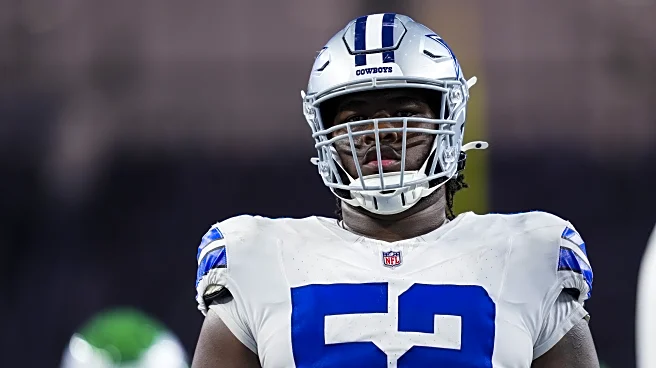

2025 Dallas Cowboys first-round pick Tyler Booker got 14 starts in his rookie season. Second-round pick Donovan Ezeiruaku got nine starts as he got acclimated to the NFL. Third-round pick Shavon Revel
spent the first half of the season in the trainer’s room before notching five starts in the last seven games. Fifth-round pick Jaydon Blue notched just 78 snaps on offense over five games and needed “a lot of coaching” in his first season. Fellow running back Phil Mafah only saw limited action in the season finale, and two draft picks never made the 53-man roster.
Doesn’t sound like an auspicious start for the 2025 rookie class, does it?
Yet thanks in part to a strong second half of the season, some help form UDFAs, and fifth-round LB Shemar James getting six starts, the 2025 rookie class accumulated 2,956 snaps, which is 11.7% of the total amount of snaps the Cowboys played on offense and defense last year. That may not sound like much at first glance, but those 11.7% are the equivalent of 2.6 starters, which is slightly above the Cowboys’ multi-year average.
A solid but certainly not record-breaking rookie class performance, but not many people expected a record-breaking contribution to begin with.
At the end of April last year, just a few days after the draft, I posted an article here on Blogging The Boys titled “Why Cowboys’ 2025 rookie class may deliver up to four starters.” At the time, I wondered if the 2025 draft class might yield four eventual starters, even if the 2025 class might not have had the star power of some successful previous draft classes. I also took a stab at projecting the snap counts for the nine players the Cowboys had just drafted. Here’s how that projection compares with the actual snap count:
| 2025 Rookie Class Snap Count | |||||
| Round | Name | POS | Projected Snaps | Actual snaps | |
| 1 | Tyler Booker | OG | 1,144 | 1,002 | |
| 2 | Donovan Ezeiruaku | DE | 223 | 604 | |
| 3 | Shavon Revel | CB | 598 | 334 | |
| 5 | Jaydon Blue | RB | 204 | 78 | |
| 5 | Shemar James | LB | 32 | 544 | |
| 6 | Ajani Cornelius | OL | 39 | — | |
| 7 | Jay Toia | DT | 233 | 90 | |
| 7 | Phil Mafah | RB | 0 | 10 | |
| 7 | Tommy Akingbesote | DT | 9 | — | |
| Total Draft class snaps | 2,673 | 2,662 | |||
| Draft class in % of total | 10.7% | 10.6% | |||
| Waiver pickup | Trikwese Bridges | CB | — | 248 | |
| UDFA | Alijah Clark | S | — | 40 | |
| UDFA | Zion Chlidress | CB | — | 6 | |
| Total Rookie rookie class | 2,956 (11.7%) | ||||
It’s widely held that a good draft class yields two solid starters. Two starters may not be a great draft, but it is certainly a solid draft. However, those two starters are not necessarily expected to be starters in their first season.
It’s still early, and it’s still hard to estimate how many future starters could emerge out of last year’s rookie class. Tyler Booker and Donovan Ezeiruaku certainly look to figure prominently on next season’s team, and Shavon Revel could benefit from a new DC and a healthy offseason. Beyond those three, every emerging player would just be a bonus.
Three years (and sometimes even more) is the standard usually used to fully evaluate a rookie class. Which is why we’re now going to look at how the snap percentages of each season’s rookie class have progressed over the years. We’ll look at the data since 2013 (when Will McClay took over), which allows us to look at how different rookie classes performed in terms of snap percentage in each of their first five years in the league. To make the table below easier to read, it is color-coded as follows:
Blue = 3 or more starters
Green = 2-3 starters
Orange = 1-2 starters
Red = less than 1 starter
For this analysis, let’s assume that adding the equivalent of two starters (or 9.0% of all snaps) to the roster is a good target for a rookie class, and getting the equivalent of three starters (13.5% of all snaps) is outstanding.
body .sbnu-legacy-content-table td, body .sbnu-legacy-content-table th, body .sbnu-legacy-content-table { border: 1px solid #000 !important; border-collapse: collapse !important; }| Class | Year 1 | Year 2 | Year 3 | Year 4 | Year 5 |
| 2013 | 15.3% | 14.8% | 14.1% | 11.9% | 11.3% |
| 2014 | 9.5% | 12.8% | 9.0% | 10.3% | 7.0% |
| 2015 | 10.0% | 10.8% | 14.2% | 15.4% | 7.8% |
| 2016 | 13.5% | 17.2% | 19.3% | 16.8% | 11.0% |
| 2017 | 10.6% | 13.4% | 12.3% | 10.0% | 5.3% |
| 2018 | 12.1% | 10.4% | 16.7% | 16.1% | 11.3% |
| 2019 | 2.4% | 10.5% | 5.4% | 10.2% | 6.4% |
| 2020 | 14.0% | 16.8% | 18.0% | 16.1% | 13.3% |
| 2021 | 9.7% | 11.0% | 7.7% | 10.2% | 2.7% |
| 2022 | 13.7% | 22.5% | 14.5% | 19.1% | – – |
| 2023 | 5.2% | 12.9% | 5.3% | – – | – – |
| 2024 | 12.9% | 12.4% | – – | – – | – – |
| 2025 | 11.7% | – – | – – | – – | – – |
| Red <= 1 starter, Yellow = 1-2 starters, Green = 2-3 starters, Blue = >3 starters | |||||
From the data accumulated above, it looks like adding the equivalent of two starters (9% of all snaps) to the roster is a good target for the first year of a rookie class. The Cowboys had missed that mark for six straight years from 2007-12, but have only missed it twice in the last 13 years, one in 2019 when they traded their first-round pick for Amari Cooper and drafted Trysten Hill in the second, and once more in 2023 when they drafted Mazi Smith and Luke Schoonmaker in the first and second and then lost DeMarvion Overshown to injury for his entire rookie season.
The numbers get better in the second year, where the Cowboys have hit the 2+ starter mark every year since 2013. Also since 2013, the rookie classes mostly show a sea of green and blue in years two, three, and four, which is exactly how you want it to be.
The fifth-year drop in playing time contribution is partly due to the way many rookie contracts are structured. Most players reach free agency after four years and move on to other teams, so a drop in snaps is to be expected to some degree. But that drop can also mean that the players from that rookie class simply weren’t good enough to warrant a second, and bigger, contract, or turned out to be too expensive to retain.
There are Cowboys fans who will look at this data (and any other analysis showing the Cowboys doing something well) and gleefully point out that since it didn’t help the Cowboys win a Super Bowl, it can’t be important. But that’s not the point.
The point here is that you have to systematically build a foundation of young talent if you want to be a contender in the league, even if it takes a lot more than just a few strong rookie classes to win the Super Bowl. But it’s also clear that just getting replacement-level talent on your roster is not going to be enough to make it to the big game.
If you look at the color codes above again, you’ll notice that every 2-3 years the Cowboys have had a “blue” rookie class. Those are the classes that elevated the talent across the roster. You’ll also notice that there’s not a single blue cell in the last three years, which carries the very real risk of diluting the talent on your roster – something we’ve definitely seen on on the defensive side of the ball.
The 2023 rookie class is a lost cause, and for the 2024 and 2025 classes, there is at least some hope that additional players could emerge in their second and third years in the league. But the 2026 rookie class, with two first-round picks has to be a “blue” class, even if the Cowboys currently don’t have any Day 2 picks.
A “solid” rookie class won’t do it, and certainly not for the fourth year in a row.
Bucky Brooks of NFL Network made an observation yesterday about the talent level need to compete for a title. He wrote it in a different context, but it applies just as much to the Cowboys:
How many blue-chip players do you think the Cowboys have on their roster? Include the players you think could be future blue-chip players. The gap between your number and the 8-12 Bucky Brooks mentions is the gap the Cowboys need to close to contend again.
**************
Also, in case you were wondering, here’s how the Cowboys compare to the rest of the league in terms of rookie snap counts.