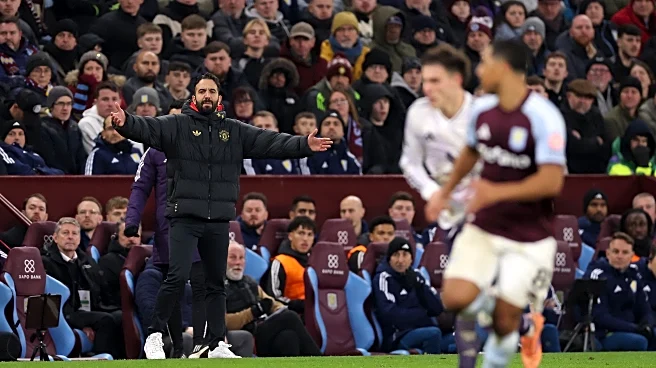

There wasn’t a Manchester United fan in the world that didn’t let out a grown when they first saw the team news for Sunday’s match against Aston Villa. We knew it was going to be rough. Noussair Mazraoui,
Bryan Abeumo, and Amad were all away on AFCON duty and Casemiro was suspended. The news that Kobbie Mainoo had picked up an injury in training, leaving Manuel Ugarte as the only available midfield partner for Bruno Fernandes had fans reaching for the largest hit of copium they could find.
All this was set against the backdrop of United facing a team that had won nine of their last 10 games. United have a fantastic record against Aston Villa despite the reversal in form for the two clubs in recent years, they’ve still managed to be a bogey team for the villains. That was the one bit of positivity coming into the match but other than that, Ruben Amorim was essentially playing with house money in this one as expectations were on the floor.
The team news went from bad to worse when Bruno Fernandes was removed at halftime with an apparent hamstring injury leaving United’s squad paper thin. Despite that, United held their own. That probably wouldn’t come as a surprise to anyone who’s watched Aston Villa this season – they don’t blow people out – but set against extremely low expectations United’s performance started to rise in stature.
After the game Ruben Amorim was full of praise for his squad’s effort:
“I think we were the better team today,” Amorim told Sky Sports. “We were unlucky, even with the injury of Bruno, but during the game, even without him we were the better team.”
Again, I think we deserved so much more today, but the better team did not win.“
It’s understandable why Amorim feels that way and we’re not here to question it or bring anyone down. But Amorim’s comments do raise an interesting question – what exactly constitutes being “the better team.”
Manchester United outshot Villa 15-12, an a slight advantage but far from something that suggests a dominant team in control of a match. The quality of shots is another story. Both teams can claim a ‘win’ in the expected goals column, depending on who you ask, with United coming out ahead (1.3-1.2) according to Fbref and apps like Fotmob (who also use Opta data) having the Villains ahead (1.54-1.33). Regardless, these are pretty even metrics and either number shows that Villa had slightly higher shot quality than United who had just five of 15 shots coming from inside the box.
The big numbers came in terms of possession – United had 58 percent – and pressing. For the second straight game United’s press was relentless. According to Opta United pressed Villa on 16 different sequences – their second highest total of the season – and forced 11 high turnovers, also their second highest total.
The biggest number of all is likely the following. 49.9 percent of Aston Villa’s touches came in their own third of the pitch, the highest share of any United match this season. For large portions of the game Villa literally couldn’t get the ball out of their own end.
Is it that simple though? Is a high press and lots of possession all that it takes to be considered “the better team?” Well, what if you’re playing a team that doesn’t want to have the ball? What if they want you to have it? And what if that team is totally ok with conceding a lot of territory and playing the game predominantly in their own end?
That was the case on Sunday, and it’s been the case in several of United’s recent matches.
The team with the second-highest share of touches in their own third against United this season was Everton, who took 49.66 percent of their touches there. This might not have been Everton’s plan from the jump (though it is David Moyes) but when they were reduced to 10 men 13 minutes into the match they quickly adopted it. Everton took a 1-0 lead and then were happy to sit back and let United have all the ball.
Usually it would be suicide to drop deep and defend for over an hour with 10 men, but Everton were fine because they knew how to neutralize United. The benefits of playing a back three system are that you can create overloads in different parts of the pitch and there should always be a spare man.
Everton simply controlled who the spare man would be. They dropped into their block off the ball and sat on all the potential United playmakers/receivers, forcing the ‘spare man’ to be the two wide center backs who they left completely open.

This would often force Bruno and Casemiro to drop all the way into the back line just to find space to get on the ball. Everton were fine with them being back there. Their block stayed tight and the open men remained the wide center backs.

Ruben Amorim never adjusted to this. Amorim kept defensive players in those positions the entire game and United struggled to create anything. They took 25 shots against the Toffees but registered just 1.7 xG for 0.07 xG per shot – their joint lowest total of the season.
Two weeks later, West Ham came to Old Trafford and simply said, if Everton can do that with 10 men, surely we can do the same with 11?
Right from the jump, the Hammers just chose to leave United’s wide center backs wide open.

They’d pressure the midfielders, they’d pressure the middle center back, they were not going to go near the wide ones.

If the wide center backs wanted to carry the ball up the pitch, by all means go ahead.

Even in the attacking third, look at the space afforded to both Mazraoui and Shaw.

United had 69 percent of the possession against Everton and 65 percent against West Ham. These teams were happy to play like that because they also knew that United conceded the fourth-lowest xG per shot in the league. In other words, just keep doing your thing because United might defend well for 88ish minutes, but there will be a 90 second period where they slip up. They knew that at some point they would get a good scoring chance, they’d just need to make it count.
When United arrived at Villa Park on Sunday, they were greeted with the same tactics. Villa were more than happy to sit off United’s back line, leaving the wide center backs wide open.

Villa were not going to engage United high up the pitch. When United’s center backs had the ball they were going to back off and allow them to slowly walk the ball up the pitch, but still give them no passing options.

United had all the possession and territory but they were playing Villa’s game. Villa were baiting United in certain situations and United were falling for the trap.
Here Ayden Heaven has the ball with nowhere to pass except for Manuel Ugarte.

This is exactly what Villa want. Ugarte will have nowhere to go once he receives the ball and Villa have four players ready to collapse on him. Heaven falls for the bait, Ugarte takes a bad touch to make it easier, but as soon as the pass is made Villa spring into action. They steal the ball off Ugarte and it’s off to the races.

Villa find the open man and it’s up to Senne Lammens and Ayden Heaven to prevent United from facing an early deficit.

Villa were happy to let United have the ball deep. They didn’t want someone like Matheus Cunha to have the ball, so when he dropped deep, they’d immediately pressure him.

Here we see it again. Yoro and Shaw are wide open. When United play it in to Cunha Villa collapse on him forcing him to go wide to Dorgu.

That’s exactly where Villa want the ball to go because Dorgu is completely isolated on that left side. He has no choice but to launch an ambitious cross for Benjamin Sesko that never reaches it’s target.


For a team that dropped deep and allowed United to almost park outside their own box, Villa never seemed to be under pressure. They weren’t hoofing the ball into the stands to give them a chance to catch their breath from relentless pressure. Rather whenever they won the ball back they were calmly trying to play out from the back, but there was a notable difference to how they did that compared to United.
When United win possession of the ball back – regardless of where the ball is – the two wingbacks will immediately start pushing forward. They get up on the last line and become wingers who play high and wide. This has the knock on effect of when United turn the ball over, they can be caught of position very quickly, an example of this being Antoine Semenyo’s goal last week.
Villa were very interested in making sure this didn’t happen. When they got the ball off a turnover, or when they were building up from the back, they were very careful about not devoting too many people going forward. Here, they win the ball back from United and look to break, but despite having numbers, only three players start breaking up the field.

Therefore when the break doesn’t work, they still have plenty of players back so United can transition on them.

They showed the same caution when playing out the back. Players were not leaving their defensive positions even though their team had the ball. This limited their passing options and ultimately limited their ability to get out of their own end, often times they’d run out of options and were forced to launch hopeful long balls that were nothing more than giving possession back to United.
The other side of the coin was when United pressed them and stole the ball off them, they still didn’t get an advantage the other way.

Villa always had more than enough men back to limit United’s opportunities.

In a way this became a self-fulfilling prophecy. United aggressively pressed to try and win the ball high up the pitch. Rather than try to play over the press Villa tried to play through it, but very casually. The lack of passing options just meant that they were going to turn the ball over.
Villa outshot United 7-5 in the first half, but with United’s possession and territorial dominance, it was easy to say United had been the better side. But Villa didn’t go into the dressing room at halftime thinking they were being outplayed and would need to make adjustments for the second half. They went into the dressing room believing things were going exactly as they should – that if it weren’t for one mistake from Matty Cash they’d have the lead. If they kept this up for the second half they’d have a good chance of winning.
Villa felt that way because this is how Villa have been playing the entire season! 13 of Aston Villa’s 17 matches this season have been decided by one goal or fewer, eight of them having been level at halftime. Villa take closeness to the extreme. Over the last 11 games they have an xG total of 14.2 goals with an xGA of 14.5. That’s about as even as you can be and yet they’ve turned that into 10 wins and one loss!
We can argue about how sustainable this is and whether or they can keep getting away with it – and I’d be right there with you to say they absolutely cannot keep getting away with it – but the bottom line is this is what they are betting on every single game and so far no one has rolled a seven. Over this 11-game span Villa have averaged 49 percent possession. Four times they’ve had 52 percent possession or more and that came against Burnley, Leeds, Wolves, and West Ham – four of the bottom five teams in the table.
Villa want you to have the ball, so if you want it at all you’re going to have a lot of it. At the same time Villa controlled where United were able to play with the ball and where they were going to make life difficult for them. This combination allowed them to keep United from generating anything dangerous.
This isn’t to diminish what United did. Their press was very good. Outside of the Ugarte turnover six minutes into the game United did not allow Villa to really generate any dangerous attacks. This is just Manchester United right now. They’ll defend brilliantly for 88 minutes of the match, but no matter how well they’re defending, there will be just enough moments where they slip up and the opposition takes advantage.
Jack Fletcher made his debut in central midfield and didn’t look out of place, while Lisandro Martinez made everyone wonder why both Ruben Amorim and Erik Ten Hag had previously said he couldn’t play in central midfield. There was plenty of good in this game, it’s just when you factor in how Aston Villa want to play it’s tough to determine exactly how good some of those things were.
Ruben Amorim said the better team didn’t win on Sunday. Maybe he’s right. But if one team isn’t worried or trying to be the better team what does that even mean? And how much does it matter?