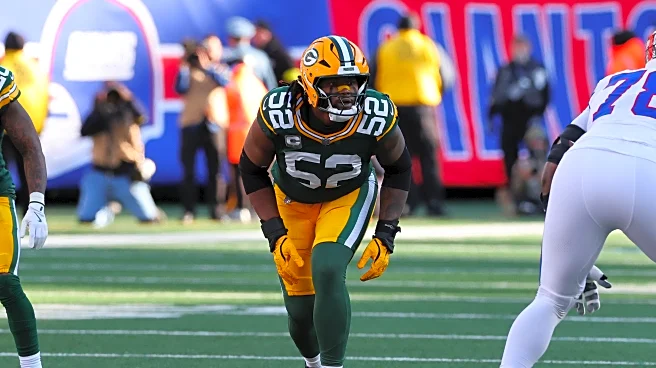

Over the Cap has just dropped their cap casualty rankings for the upcoming offseason, which includes four Green Bay Packers in their top 100 players. Only three teams have more plays on the list than the Packers:
the Arizona Cardinals (nine), the Minnesota Vikings (seven) and the Washington Commanders (seven).
Personally, I only think that Green Bay will make two cuts. Let’s go ahead and talk about each player’s situation.
#7: Elgton Jenkins, OL (78.6 percent for “negative fate”)
This is the easiest one to predict, as it was obvious based on his 2026 cap hit (and struggles in 2024) that Jenkins was headed for being a cap casualty even going into the 2025 regular season. It’s the reason why he attempted to gain an extension this offseason by holding out, but general manager Brian Gutekunst and cap guru Russ Ball didn’t budge.
Eventually, Jenkins returned to the practice field for the Packers as a center, where he didn’t fare any better than last year, when his slip in play began, at left guard. In Week 11, Jenkins fractured his fibula, more than likely ending his career with the green and gold.
If Green Bay releases Jenkins this offseason, they’ll immediately gain $20 million in cap space. This one is happening. Take it to the bank.
#t-33: Keisean Nixon, CB (65.9 percent)
I wouldn’t hold my breath on this one. I don’t think the team actually has any ambition to move off of Keisean Nixon’s contract.
Here are a couple of things to keep in mind:
- Nixon is only making $5 million in cash next year, about one-fourth of the price of an average veteran starting cornerback on their second contract in the NFL. He’s a very cheap option for the team. Cheap matters to the Packers’ current cap situation A LOT.
- When Trevon Diggs got on the field for the Packers last week, all of his snaps were at right cornerback, the position that Carrington Valentine starts at, not at left cornerback, where Nixon starts.
- Against the Vikings, when the Packers actively tried to keep their most valuable players off the field, the team kept Nixon on the sideline (after the first drive, which he requested to start, according to head coach Matt LaFleur) while safeties Javon Bullard and Evan Williams continued to see action (they could have structured the defense in a way where the opposite was true, based on the personnel they had available to them). The coaching staff would have rather risked a Bullard injury, which happened, going into a win-or-go-home game, rather than Nixon. That’s an important piece of context.
Ultimately, with the Packers’ cap and pick situation (it’s not good) going into 2026, I think the team will have Nixon, Valentine and Nate Hobbs compete at outside cornerback, again, with the possibility of Diggs returning, if the team and his camp can find a number that works for both sides.
I expect that defensive tackle is going to be the team’s number one priority in the offseason. I don’t think that the team will go into free agency for a starting player on either side of the ball, at least as long as they bring back center Sean Rhyan. If the team spends their first pick on the draft on a defensive tackle, the next highest pick that can be used on a cornerback will be 84th overall, as it stands today — it could be even later if they win playoff games. The Packers draft for the future, not the present. Over two decades, the average first-round pick has started just a third of the season for them, let alone a third-round pick.
I don’t think the team is going to take $5 million in cap relief to open up a hole at cornerback (or at least make it less competitive room in 2026), because they are going to have very few ways of filling that hole.
#t-43: Josh Jacobs, RB (64 percent)
This is another one I don’t buy. I get it. Josh Jacobs is already the geriatric age of (checks notes) 27 years old. The horror.
The running game was limited this year, but much of that had to do with blocking more than running back ability (when healthy). The other two running backs on the 53-man roster are Chris Brooks and Emanuel Wilson, who are restricted free agents. The cost to tender them is gonna be around $3.5 million, a number that the Packers will decline for both, allowing Brooks and Wilson to hit the market as true free agents.
If the MarShawn Lloyd situation had played out differently, maybe a Jacobs release could be on the table, but I don’t see the team taking $8 million in cap savings to move on from Jacobs. Going into the draft with just one back who has ever played for you, being Lloyd, who has only ever played in one regular-season game, seems like a mistake. I’d be surprised if this one happens.
#t-98: Rashan Gary, DE (50 percent)
I would expect this one to happen, or at least a restructuring to happen. We’ve talked about this topic at length before. After a great year-and-a-half of play in his prime, Gary has now been on a slide. In 2025, he’s hit what I have to imagine has to be rock bottom, where he’s one of the most inefficient players from a pass-rushing perspective, despite playing a bunch of snaps for the team.
The Packers can save $11 million by cutting Gary this offseason. I’m working under the assumption that they do it. Between the cuts of Jenkins and Gary, if you bring back center Sean Rhyan on a modest deal and make some smaller moves to retain players on the bottom end of the roster, that basically gets Green Bay’s cap situation to where it needs to be going into the draft.
–
If the Packers dip their toes in free agency this offseason:
- First of all, they would have to borrow cap space from the future, which will make the teardown (beginning in 2027) more aggressive. The window for this roster, as constructed, is really the 2025 and 2026 seasons. They will likely have to rebuild in 2027 and 2028 before getting put in a similar position again in 2029.
- Secondly, they will probably add players who were released from other teams (cap casualties), not players whose contracts expired.
Why, you might ask? Because players whose contracts expire count against the NFL’s compensatory pick formula, which is going to be very important for the team (maybe the most impactful part of the Packers’ 2026 offseason).
As it stands right now, projections have Green Bay netting a 2027 fourth-round pick for the loss of left tackle Rasheed Walker, should he hit the market, and 2027 fifth-round picks for losses of quarterback Malik Willis, receiver Romeo Doubs and linebacker Quay Walker. The most compensatory picks a team can earn in one class is four selections, and the players listed above are highly likely to be the players who will earn the Packers their highest picks in 2027 (the first year of the post-Micah Parsons trade teardown).
Other compensatory pick options include center Sean Rhyan and defensive end Kingsley Enagbare, who I’d guess would earn the Packers sixth-round picks, should Green Bay re-sign one or two of the Walkers, Willis or Doubs (I really think that Quay Walker is the only player who has a chance to come back from that list, but I even have my doubts at that at this point.)
The Packers will not offset their high compensatory pick selections. That is not how this team operates. So if they sign a decent-sized free agent deal, it is probably a player on OTC’s cap casualty rankings. Feel free to mine the data and find your favorite option.