
The sturdiest Louisville Slugger is made of rock maple, a wood that is as tough as it sounds and the vibrant crack of a baseball off the bat usually reflects that. But over time, even rock maple will weaken, slowly rot and eventually break.
The same can’t be said for the exploits of a real-life Louisville slugger, a man named Jim LaFountain who 50 years ago achieved arguably the greatest hitting performance in baseball history. It’s an often overused expression to say “that record will never be broken,”
but it’s hard to believe LaFountain’s accomplishments ever will be surpassed.
On March 24, 1976, the University of Louisville hosted Western Kentucky in a doubleheader at Parkway Field. Mired in a slump, LaFountain, the Cards’ muscular catcher/first baseman, had been dropped to sixth in the batting order, the first time the senior had hit anything but cleanup. He had one single in Game 1, along with two solid groundball outs, “but,” he said, “I felt good that I was finally making contact. I was still ticked off but more optimistic.”
LaFountain was a blend of brains and brawn. He majored in Exercise Physiology, minored in Psychology, was named an Academic All-American en route to eventually earning two Masters degrees while at the same time winning the 1979 Mr. Southeast USA bodybuilding competition and finishing as runnerup in Mr. Kentucky that same year. But the brains occasionally got in the way, according to Jim Zerilla, Louisville’s then-head coach.
“Jim was the most natural power hitter I ever coached but he was so hard on himself he always was seeking answers, sometimes when there were none – slumps were simply part of baseball.”,” said Zerilla. “When I dropped him to the six hole he wanted to know why, the reasoning behind it — looking for analytics before there were analytics. I just said, ‘Hey, batting sixth you’ll see a lot more fastballs.’ “
Ever studious, LaFountain had sought a more detailed answer the night before by re-reading Ted Williams’ noted book “The Science of Hitting.”
“It reminded me to really focus on the (pitcher’s) release point,” he recalled. “Also keeping my palms down, keeping my hands on top of the strike zone. To hit down on the ball. There’s no way I could do what they’re doing today with the emphasis on launch angle.”
Williams is still regarded by many as the greatest hitter in Major League history but the Red Sox outfielder never came close to achieving what LaFountain did in Game 2.
In the first inning, he crushed a two-run homer.
It would be LaFountain’s least productive at-bat of the game.
In the second inning, he smacked a grand slam. In the third inning, with the rest of the Cardinals now jamming the basepaths, LaFountain came to the plate twice more with the bases loaded. The result? Think of back-to-back breakfasts at Denny’s.
Grand Slam.
Grand Slam.
Last month, Baylor senior first baseman Tyce Armstrong became just the second NCAA player to hit three grand slams in a game, the third and final blast coming in the seventh inning. But what makes LaFountain’s performance likely unsurpassable is that his final totals — four homers, three grand slams (two in the same inning) and 14 RBI – technically occurred in just a five-inning game. With Louisville ahead 26-4, the game ended after Western Kentucky batted in the top of the fifth, a decision comparable to the mercy rule used in Little League baseball
“And to be even more technical,” said Zerilla, “Jimmy did it all in just three innings.
“It didn’t matter what they threw him, the contact that he made – the balls would have gone out of anywhere,” said Zerilla. “They even tried to knock him down once but it had no effect on him. He was in that type of zone.”
LaFountain was hardly a one-game wonder, judging by his full-season stats. In 54 games he clubbed 22 homers, drove in 84 runs and batted .372, leading the Cards in all three categories. He would become the first baseball All-American at Louisville, until then a “basketball school” best known for greats like Charlie Tyra, Wes Unseld, Butch Beard and Junior Bridgeman.
A native of Utica, NY, LaFountain, 71, spent his first two years at a junior college in upstate New York before taking recruiting matters into his own hands and writing personal letters to a dozen major college coaches. He visited four schools on his own dime but initially saw little daylight – both figuratively and literally – for a chance at the big time.
“I visited Virginia and it snowed,” he recalled. “There was extreme sleet the day I went to N.C. State. And then I went to Kentucky where the rain was pouring down so hard I didn’t have the chance to show anything to the coach.”
Louisville turned out to be an oasis of opportunity. “It was 67 degrees in March,” LaFountain said. “After the game ‘Z’ (Zerilla) gave me a uniform and put me in the batting cage.”
“It all materialized from the letter he sent me,” said Zerilla. “I didn’t know anything about Jim beforehand. But his initiative impressed me. And he just stood out as a hitter. He was so strong. The ball just came off his bat different than most anyone else.
“He was also a great teammate, always passing around credit. He always mentions that if 14 men didn’t get on base in front of him that day none of this would have happened.”

Zerilla, now 81 and living in Siesta Key, FL, served as Louisville’s head coach from 1973-79 before working as a minor league instructor for various MLB teams. He returned as the Cards’ pitching coach from 2000-2005. Louisville now has emerged as a national power under coach Dan McDonnell but Zerilla says LaFountain’s achievements were a vital part of the program’s development.
“Jimmy brought national attention to the program, no one had heard of Louisville baseball,” he said. “His performance that day was so remarkable it still stands out after 50 years.”
LaFountain’s first year with the Cards in 1975 led to their first winning season in nine years. But it wasn’t easy as resources were scarce.
“We had limited scholarships and the team was constantly selling raffle tickets to support the program,” said LaFountain. “I remember the Triple-A team in town, the Redbirds, letting us have an old, rusted batting cage of theirs. We lugged it back to campus and cleaned it all up so we could finally have a ‘new’ batting cage.”
Residing in his native Utica, LaFountain, a grandfather of eight, has operated his All-American Fitness Center since 1981 but will always have Kentucky ties. He has been married to Cindy Trahan, a former Louisville gymnast, since 1979. Their oldest child, JT, also played baseball for the Cards, collecting over 200 hits, and like Dad, married another Louisville athlete, softball player Audrey Rendon (they live in Louisville).
In 1984, then-Governor Martha Layne Collins named Jim LaFountain a Kentucky Colonel, the highest title of honor bestowed by the state.
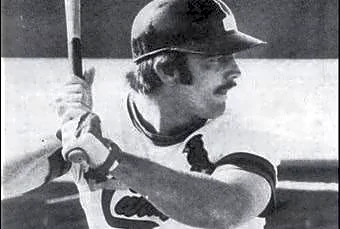
LaFountain’s two most prominent Kentucky legacies both exist at his alma mater. As a senior in 1976, he founded the university’s Fellowship of Christian Athletes chapter. And a giant photo of LaFountain at bat adorns the outfield wall at Jim Patterson Stadium.
It is the first photo on the wall’s All-American section, fitting since he was indeed the Cardinals’ original baseball All-American. In it he sports 1970’s-style sideburns, an equally-bushy moustache and Popeye-like forearms, an image that is frozen in time, much like his heralded performance of 50 years ago. Bats may erode over the years but the exploits of this flesh and bone Louisville slugger will likely be around forever.
(Rob Lawin, then a junior at Syracuse University, had just been named sports editor of The Daily Orange when he was intrigued by a wire service report about a Louisville player doing remarkable damage on a baseball diamond. He would finally meet Jim LaFountain some 48 years later and is glad to finally have the opportunity to write about the man and the mythical day).