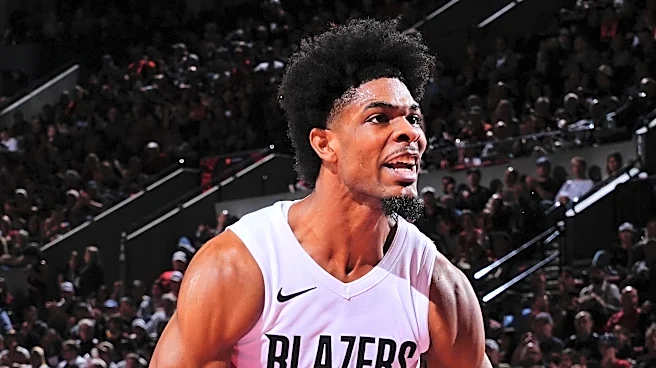







The Scoot Henderson roller coaster ride took more twists and turns during the 2025-26 NBA season. The young guard spent most of the year in street clothes, recovering from a preseason hamstring injury. After he returned to the lineup and ramped up, he became an important part of Head Coach Tiago Splitter’s bench rotation, then moved to the starting lineup at the end of the season.
What did the Portland Trail Blazers get from Henderson this year? What might they be looking for going forward? Let’s
take a look in our season review.
Season Stats
Here’s Henderson’s basic stat block:

OTHER STANDOUT STATS
The biggest standout stat for Scoot this year was games played. After suffering that hamstring tear he appeared only 30 times during the regular season. He’s now missed over one-third of Portland’s games during the first three years of his career. That’s not egregious, but it’s an item to watch.
Henderson shot 84% from the foul line this year, a fantastic number. There’s reason to hope that he can draw more fouls, especially if he gets the ball in hand and can drive more. Either way it’s a shooting-based skill in which he excels, a positive sign.
Scoot’s turnovers remained basically stable, still slightly high, but that’s way better than his rookie season when he led the league in turnovers committed per possession.
We can also turn to Henderson’s performance against the San Antonio Spurs in Portland’s first-round playoffs matchup for hope. He was one of only two Blazers to excel in the series. He averaged 47.5% shooting from the floor, 46.4% from the three-point arc, and cut his turnovers substantially in the postseason. He provided a shining run exactly when his team needed one.
Change Year-Over-Year
Scoot’s basic stats didn’t change too much year-over-year, but he did improve (and/or change) in a few key areas.
- He played two fewer minutes per game but his point production rose from 12.7 to 14.9, leading to a substantial increase in per-minute and per-possession scoring. (+3.5 points per 36 minutes, +4.2 points per 100 possessions)
- Though his three-point percentage remained essentially unchanged, 47.4% of his shots came from three-point range this season against 43.4% the year prior. In compensation, he took fewer attempts at the rim. (20.5%, down from 23.5%)
- His assist percentage (percent of teammate field goals assisted on) dropped sharply from 28.1% to 22.8%.
- As mentioned, his free throw percentage rose to 84.0% from 76.7%.
- Most importantly, Scoot’s plus-minus per 100 possessions (+2.9) and his net plus-minus per 100 possessions (+4.0) were both positive this season. The Blazers produced better when Scoot was on the floor. By comparison, his rookie year those numbers were -13.9 and -8.2. That’s an extraordinarily large leap in less than 100 games.
Analysis
Limited sample size clouds the ability to pass judgment on Henderson’s season, but we do know a few things.
He played more off-ball this year than in years past. He became more of a hybrid guard than point, a potentially confusing development. He handled it fine. His assists declined, but you’d expect that. His turnovers stayed steady. His shooting percentages didn’t drop. His scoring went up. He also had that fantastic playoffs run. Coming off of injury, faced with a cloudy role, he responded with basic stability and even improved in a couple aspects.
Though it doesn’t show statistically, Henderson also became a more dangerous defender this year. He was often a menace in the midcourt, slowing down ball-handlers and harassing passes. He’s still not the strongest point-of-attack defender, but he’s beginning to harness his athleticism in the spaces in between. Most of all, you didn’t notice as many horrible defensive stretches as he once showed. He’s no longer a liability or a worry. That’s huge progress, a key to staying on the floor.
Henderson remains a streaky player. His highs are incredible, showing all the promise of his third selection in the 2023 NBA Draft. The best word to describe him during his hot runs is “devastating”. Only Shaedon Sharpe’s rim-rattling dunks can compare with Scoot on the drive or dead-eyeing a three. But when his production fades, the basic infrastructure still isn’t quite there. His missed shots are bad misses. He still doesn’t have an instinctive connection to teammates on offense. His defensive acumen doesn’t make up for his offense bottoming out.
In most ways, Scoot resembles Spongebob taking Mrs. Puff’s infamous boating driver’s test. The proper thing is to shift it into gear, check blind spots, and pull out of the parking spot sensibly. Instead we get, “Floor it? FLOOOOOOOOR IT?”
CRASH
Sigh.
“Ohhhhh Scootbob.”
When it works, it’s spectacular. When it doesn’t, there’s too much randomness, disconnect, and just plain danger to feel comfortable.
Unsurprisingly, how you view Henderson depends on which reel of film you’re looking at. He could be anything from a burgeoning star guard to an interesting, but basically nondescript, bench player. We just don’t know yet. But he doesn’t appear to be a bust anymore. That’s significant, a welcome development.
The Future
The biggest question in Scoot’s immediate future is what the heck the Blazers want to do with him. Is he a point guard? Is he a shooting guard? Is he expected to start or come off the bench? He hasn’t stepped forward and claimed a role, but it’s not like the team has opened up a direct avenue for him either. The ascendance of Deni Avdija as a primary ball-handler, the recruitment of Jrue Holiday and Damian Lillard…obstacles remain between Henderson and flying free in the fast lane. That’s true whether he’s expected to be a floor general, a big scorer, or both.
The next biggest question is the same one facing so many Trail Blazers: what’s up with that three-point shot? Scoot looked brilliant in the playoffs. He did the same in a few other streaky stretches. But his overall percentage sits at a decent-but-not-spectacular 35. He looks increasingly comfortable hitting the long shot off the catch. Can he also do it off of the dribble, becoming a true threat that causes opponents to overcommit, opening up those precious driving lanes and fouls? That’s his key to becoming a 22-point scorer instead of a 15-pointer.
We also have to ask if Scoot can stay healthy and in a steady growth arc. Honestly, he did really well not going backwards this year. Everything he improved on in his sophomore season, he kept up. Marginal improvement and flashes of brilliance lead to a fairly positive assessment. But he still hasn’t had a true, extended breakout. The work is there, the growth is evident. When will it all come together?
This is especially important because Henderson is entering into his last contractual year before potential Restricted Free Agency. Both he and the Blazers will want to have a better idea who he is, and who he’s going to be, before they commit to a firm dollar amount for his next contract. There is a potential avenue of approach where Portland extends him on the cheap before that juncture, much as they did with Shaedon Sharpe and Anfernee Simons in the past. Both variance and stakes are higher with Scoot. It’d be nice to know more about the trip, and the destination, before they set a price for the ticket.
Until then, Scoot Henderson remains who he’s always been: a potential star ascending in fits and starts. His floor is higher now than it once seemed to be. That’s the good news. Whether he’ll reach his ceiling remains to be seen.