

Portland Trail Blazers history is studded with All-Stars and significant contributors. Clyde Drexler and Damian Lillard have eras named after them. Bill Walton is linked inexorably with the franchise’s only NBA Championship. In between we can talk about Brandon Roy and LaMarcus Aldridge, Maurice Lucas, Kiki Vandeweghe, Arvydas Sabonis, and any number of easily-recalled players who will bring smiles to the faces of Portland fans.
But what about the lesser-known contributors?
This summer we’re running
a series called “Do You Remember?” It highlights players who didn’t produce 20 points per game or lead the team to playoffs victories, but proved distinct for one reason or another. Maybe these guys aren’t a main course all on their own, but they’re side dishes who gave the Blazers more flavor. Over the years, you may have forgotten that they existed. Let’s bring them back for a walk down memory lane!
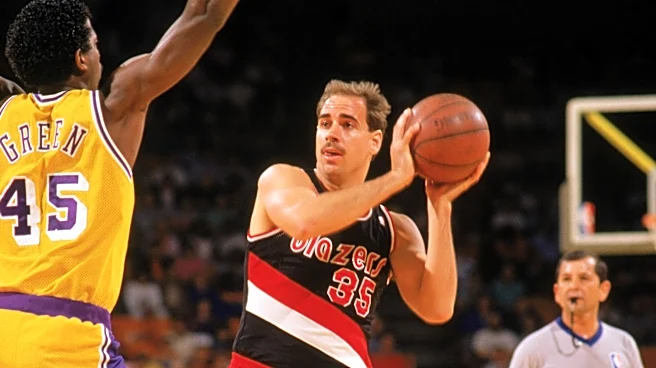
The first player we want to highlight is forward Richard Anderson. He played 140 games for the Blazers between December, 1987 and May, 1989. Portland picked up Anderson off of waivers mid-season in 1986-87 after the Houston Rockets waived him. They would eventually end up trading him to the Charlotte Hornets in ‘89 for Robert Reid. In between he averaged 5.9 points and 3.9 rebounds in 17.8 minutes per game.
Normally those stats would go unremarked, but Anderson had two nice qualities to his game.
First, he was a good offensive rebounder. He had a nose for the ball. This was not unusual for a 6’10 power forward at the time. That was part of the job description for the position.
Second, and just as importantly, Anderson had a face-up shot that was two decades before its time.
Back in the day, if you were 6’8 and above and had some bulk to you, your job description was clear: get down in the lane, put your back to the basket, catch it, pivot, and score high-percentage buckets from five feet and in. Power forwards bruised opponents with their muscular frames. They shot 49% from the field. They certainly did not take the ball out in the 16-20 foot range and attempt jumpers, let alone attempt three-pointers. That was a job for the backcourt!
Anderson defied those expectations. He’d often head out to the midrange on the left side of the floor, just wide of a spot that would later become Aldridge’s playground. Defending forwards would dismiss him. What’s the tall guy going to do from there? He’d catch it with the opponent sagging back into the lane, rise into his shot, and put the ball through the hoop. Shots that would get other forwards pulled from the floor were his bread and butter.
During this era, the three-point shot was no longer considered pure gimmick, but it had not yet risen to prominence. In the 1988-89 season, Anderson’s full year with Portland, he attempted 2.0 threes per game. That was second to Vandeweghe (2.1) and point guard Terry Porter (2.7). But both of those players doubled Anderson’s minutes. He obliterated everyone in per-minute three-point shot attempts. He also had the third-best three-point percentage on the team at 34.8%. Drexler attempted 1.3 triples in 39.3 minutes that year, shooting a comparatively-homely 26.0% beyond the arc.
Even when they bothered to guard him, few defenders could close quickly enough or get their hands high enough against his tall frame to bother the shot. In his final year in the league, with the Hornets, Anderson would average 1.9 three-pointers in 11.2 minutes per game with a positively-modern 37.0% success rate.
During his time, Anderson was considered an oddity. Commentators and coaches never failed to remark on the weird, tall forward who shot like a guard. Plenty of head-shaking accompanied. Why would you ever go with a lower-percentage option when standard power forwards were available in the post? Had he come along after the turn of the millennium, Anderson’s floor-stretching game would have been considered more normal, if not desirable. As it was, he became a player with the skill to do things differently at a time when that took a bit of courage and an understanding coaching staff.
Plenty of good players cycled through Portland in the years just before the ascended to the NBA Finals, but Richard Anderson was one of the most interesting among them. Do you remember him? What other players should we cover in this series? Share thoughts and memories in the comments section below!