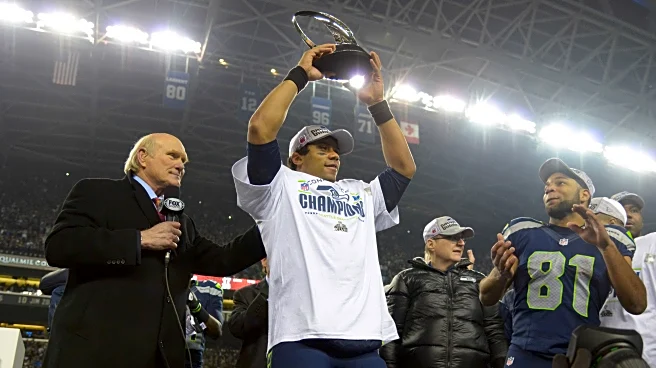


Once the Seattle Seahawks reached the Super Bowl, the comparison to 2013 became almost automatic. Not only because that team won Super Bowl 48 in dominant fashion, but because it set a historical benchmark for the franchise — a reference point for identity, roster construction, and on-field execution. The current team arrives on the same stage with a very different proposal, shaped by an NFL that has changed dramatically over the last decade: more open to the passing game, more aggressive in obvious
passing situations, and far less tolerant of low-volume offenses.
This comparison, then, is not emotional or nostalgic, it is technical. Placing the current Seahawks starters side by side with the 2013 roster requires understanding context, philosophy, and production — not just names. This is not an exercise in deciding “who was better,” but in examining how each team won, and what that reveals about the evolution of the franchise and the league itself.
Numbers
2013 season: 13–3 record, 1st in the NFC, Super Bowl 48 champions
Current season: 14–3 record, 1st in the NFC, Super Bowl appearance
2013 identity: a historically dominant defense paired with a low-volume, highly efficient offense
Current identity: a dominant defense paired with an efficient, more flexible offense
Overall offensive production: Two very different contexts
The 2013 Seahawks finished the season ranked 8th in the NFL in total yards, but that ranking masks the true nature of the offense. Seattle was 4th in rushing yards, 1st in rushing touchdowns, and just 26th in passing yards. That was not a flaw — it was the point. The offense followed Pete Carroll’s blueprint: control the clock, lean on play-action, minimize mistakes, and let the defense dictate the game. The passing game was complementary, not the engine.
The current team shows very different results. While Seattle still runs the ball frequently in terms of attempts, the 2025 rushing attack has never been the same kind of threat the 2013 unit was. Even so, the run game remains essential, primarily as a tool to establish play-action, which is still the foundation for success throwing the ball downfield.
Quarterback: Russell Wilson (2013) vs. Sam Darnold (2025)
Russell Wilson threw for 3,357 yards, 26 touchdowns, and just 9 interceptions in 2013, finishing 12th in the league in passing yards but top-five in passer rating. His impact was never about volume. Wilson was lethal off play-action, elite at protecting the football, and added more than 500 rushing yards, fundamentally altering defensive geometry and coverage rules.
Sam Darnold closes the current season with roughly 4,300 passing yards, 31 touchdowns, and 14 interceptions, ranking top-five in the league in passing yards and top-10 in passing touchdowns. Unlike Wilson, when Darnold struggles, the offense struggles with him. The volume flows directly through the quarterback, often behind a line that allows consistent pressure, which helps explain both the statistical explosion and the higher turnover count.
Running backs
In 2013, Marshawn Lynch rushed for 1,257 yards and 12 touchdowns, while Seattle as a team surpassed 2,300 rushing yards. The run game was physical and, even when predictable, overwhelmingly dominant. It was the structural base of the entire offensive plan.
On the current roster, Kenneth Walker III and Zach Charbonnet combine for approximately 1,400 yards and 11 touchdowns. The production is solid and more diverse schematically, but it does not impose the same cumulative, four-quarter wear on defenses that Lynch consistently delivered.
Wide receivers
The 2013 receiving corps produced modest numbers but was highly functional. Golden Tate led the team with 898 yards and 5 touchdowns, serving as the primary yards-after-catch weapon. Doug Baldwin finished with 778 yards and 5 touchdowns and was the most reliable target on third downs and in the red zone.
Jermaine Kearse posted just 346 yards and 2 touchdowns, but his value came as a physical X receiver responsible for clear-outs, perimeter blocking, and situational vertical routes. Percy Harvin, limited by injuries, recorded only 202 receiving yards and 1 touchdown in the regular season, yet his presence alone forced defensive adjustments even when he was not targeted.
The current group sits at the opposite end of the spectrum. Jaxon Smith-Njigba finishes the season with roughly 1,450 yards and 8 touchdowns, operating as the engine of the passing game and consistently winning both in the intermediate areas and vertically. Cooper Kupp checks in just under 600 yards with 2 touchdowns, serving as a preferred option on third downs and as a critical blocker. Rashid Shaheed’s raw production is modest, but his vertical speed dictates coverage structure and adds value as a high-impact special teams weapon.
Tight ends
In 2013, the tight end group played a largely auxiliary role. Zach Miller led the position with 387 yards and 2 touchdowns, functioning primarily as a blocker with delayed releases off play-action. Luke Willson had minimal impact as a receiver.
On the current team, tight ends are still heavily involved in blocking — both in the run and pass game — but play a more defined role in the passing structure. AJ Barner serves as a reliable outlet against blitz and a middle-of-the-field option, producing over 500 yards and 6 touchdowns. Elijah Arroyo has the athletic profile to contribute more statistically, but his usage has remained limited.
Offensive line
The 2013 offensive line — Russell Okung, James Carpenter, Max Unger, J.R. Sweezy, and Breno Giacomini — was not dominant on an individual level, but it was extremely cohesive, especially in the run game. Seattle finished top-10 in sack rate allowed and was particularly effective in play-action protection.
The current line is the weakest unit on the roster. Charles Cross has developed as a pass protector but remains inconsistent, Abe Lucas battled availability issues in the past but that hasn’t been the case this year, and the interior struggles against simulated pressure and stunts. Without a center of Max Unger’s caliber organizing protections, Seattle ranks among the teams allowing the most interior pressure. While Grey Zabel is an outstanding talent, Anthony Bradford is clearly the weak point of the group.
Linebackers
In 2013, Bobby Wagner and K.J. Wright formed one of the best linebacker duos in the NFL. Wagner led the league in tackles, Wright was elite in zone coverage, and together they provided unmatched flexibility within the defensive scheme. Malcolm Smith, the Super Bowl MVP, added depth and big-game impact.
Today, Ernest Jones is the backbone of the defense, finishing with more than 140 tackles, while Drake Thomas brings lateral speed and coverage ability. Jones is the engine — the defense’s worst games coincided with his worst performances — while Thomas fit into the system and delivered solid production.
Pass rush
Bruce Irvin finished the 2013 season with 8 sacks. Combined with Michael Bennett and Cliff Avril, Seattle totaled 44 sacks, operating a system-driven pass rush that consistently collapsed pockets without relying on a single dominant star.
The current team records roughly 47 sacks, led by Leonard Williams, DeMarcus Lawrence, and Boye Mafe. The production is comparable, though achieved with a different balance between scheme pressure and individual wins.
Secondary
In 2013, beyond Richard Sherman, Earl Thomas, and Kam Chancellor, Seattle relied on Byron Maxwell as a steady outside corner and Walter Thurmond as a versatile nickel defender. The result was the league’s best pass defense in yards allowed, points allowed, and interceptions.
The current secondary — Devon Witherspoon, Riq Woolen, Julian Love, Coby Bryant, and Nick Emmanwori — finishes among the league’s best in passing yards allowed and defensive takeaways. The potential is real, but the 2013 unit remains almost impossible to compare directly.
Final thoughts
The 2013 Seahawks won by imposing limits: a historic defense, an efficient offense, and total control of the game’s rhythm. The current team is trying to write a similar story through different means, with a higher-volume offense and a defense that is aggressive and creative. They are two elite teams shaped by very different eras of the NFL — one a historical reference point, the other a reflection of the modern league.