


I know that the Green Bay Packers’ coaching staff — whether it’s if Matt LaFleur will come back to be the head coach , defensive coordinator Jeff Hafley will get a head coaching job or what LaFleur’s potential staff in 2026 will look like — is the hot button topic right now. With that being said, one question that has been sent to me over and over, in between questions about the staff, is whether the team can release kicker Brandon McManus, who was just signed to a three-year contract this offseason,
in 2026.
The answer is yes, if they actually want to. If that’s all you wanted to know, feel free to go on with your life. On the topic, though, I do want to talk about how we got here and what the Packers’ options at kicker are in 2026, including salary cap details.
2023
After the 2022 season, when Packers all-time scoring leader Mason Crosby hit just one field goal of 50-plus yards and led the NFL in kickoffs that failed to reach the end zone, Green Bay moved on from its kicker. Crosby went on to play just three more NFL games, as a 39-year-old injury substitute for the 2023 New York Giants.
At the time, the Packers had virtually no cap space after spending $283 million on players in 2022 (second in the league, only $3 million short of the Los Angeles Rams) to make a final push at the end of the Aaron Rodgers era. It wasn’t viable in 2023 to spend on a veteran kicker (Green Bay will be under similar cap constraints in 2027 and 2028 with their current contract scheduling, even after Elgton Jenkins and Rashan Gary are released this offseason).
I don’t want to go too deep into this topic, but there were a lot of teams in the kicker market in the 2023 offseason, due to how many veteran kickers retired and/or fall off around the same time. The Packers needed to address kickers in the draft that year, but so did other teams.
The consensus was that there were two draftable kickers in the 2023 class:
- Michigan’s Jake Moody, ranked 209th on the consensus draft board
- Maryland’s Chad Ryland, ranked 253rd
On draft day, though, you saw how truly desperate teams were to fill their vacancies. The San Francisco 49ers spent their third-round pick on Moody, taking him over 100 slots above his expected selection. Ryland went 13 slots later. These were stunners.
Bad bets? Yes. Both are now on different teams, after failing to meet expectations with the 49ers and New England Patriots. A non-rational market didn’t mean that the Packers didn’t need a kicker any less, though.
So to fill the void, Green Bay waited until the 207th pick (in the sixth round) to draft Auburn’s Anders Carlson, whose brother, All-Pro Daniel, had previously played under Packers special teams coordinator Rich Bisaccia. He was the only kicker taken in the class after Moody and Ryland each went three rounds higher than expected.
I won’t cape for Green Bay’s selection of Carlson (they should have just not taken a kicker when the top two went off the board in my opinion). Even at the time, Carlson looked like a bad prospect, from a numbers standpoint, compared to the average drafted kicker.
With that being said, it’s not like there was some gem in undrafted free agency that year that could have been a Carlson alternative (if you had to add a rookie kicker), either. No kicker in the 2023 class remains on the team that originally brought them in. Truly, it was a draft class where there wasn’t a long-term starter at the position. Just a bad time to need one, especially if free agency wasn’t an option for your team.
Carlson went 27 of 33 on field goals as a rookie and 34 of 39 on extra points. The Packers were still dead last in touchback percentage on kickoff team, but it did improve from 22.5 percent in 2022 under Crosby to 43.4 percent in 2023 (hang the banner).
2024
A rotating cast of characters was brought in to push Carlson in 2024, on the cheap, as the team was still recovering from the cap debt that the team placed itself in during the late Rodgers era. Greg Joseph, James Turner and Alex Hale all had their opportunities in camp.
Ultimately, the team wound up cutting all options and made a waiver claim for undrafted rookie Brayden Narveson at the cutdown deadline. Narveson went 12 of 17 on field goals and 16 of 16 on extra points before being waived. He ended up playing a game for the Tennessee Titans, where he spent camp, as a rookie on a 13-day stint with the team’s regular season roster. He missed his only field goal attempt as a Titan.
Narveson was an Edmonton Elk for three days in 2025, the only time he’s been on a football team since his rookie year.
Obviously, the Packers needed to make a change at kicker after Narveson’s early issues. Enter Brandon McManus.
At the time of his signing in Green Bay, McManus had played 10 years in the NFL and suited up for 161 games. That offseason, McManus signed a one-year, $3.6 million deal with the Washington Commanders. He was released from that deal when two flight attendants, who worked on a plane at his previous stop with the Jacksonville Jaguars, sued him for sexual assault.
Once signed to the Packers, McManus’ camp said the lawsuit was “resolved,” but wouldn’t state whether McManus paid damages to the flight attendants to drop the lawsuit. McManus ended up making $1.2 million in his first year with Green Bay, one-third of the rate he signed for in Washington, because the market changed — there were fewer teams in the kicker market in October of 2024 than in March of 2024, and there were certainly fewer teams in the McManus market after the lawsuit dropped in June, which was followed shortly by his release in Washington.
If you want to go deeper into the McManus lawsuit, it was initially dismissed by a Florida judge on September 4th of that year, but only because the alleged victims wanted to have their anonymity protected, not because of the allegations of sexual assault. In short, the judge said, if you want to go through with this, your names have to be on it, and you have 10 days to file an amended complaint. At the time, their attorney said they would be doing so, but by the end of the month, the NFL said their investigation, which did not include the questioning of the alleged victims, closed their case because they lacked “insufficient evidence” of a personal conduct violation.
A couple of weeks after the NFL closed its case, McManus was a Packer on a two-thirds discount, his camp said the case was “resolved,” without going into details of what “resolved” meant, and Green Bay general manager Brian Gutekunst said he was “comfortable” with McManus. He also said the following statement:
He wouldn’t be available right now if those accusations weren’t out there, but I think the league did a thorough investigation and we leaned on that as we went through it.
McManus went 20 of 21 on field goals in 2024 and hit all 30 of his extra points.
2025
In March, the Packers re-signed McManus to a three-year, $15.3 million contract.
Before McManus injured his quad in practice on October 8th, he was 7 of 9 on field goals and 11 of 12 on extra points. With that being said, even the misses came with an asterisk.
Against the Cleveland Browns in Week 3, the Packers’ preferred field goal protection unit had their lone mistake of the year: Allowing defensive lineman Shelby Harris to block a 43-yard field goal that would given the Packers a 13-10 lead. Instead, the Browns got the ball back at midfield, because of the block, and were able to move 16 yards in 21 seconds, setting up what wound up being a game-winning field goal for them.
Against the Dallas Cowboys in Week 4, with offensive linemen Zach Tom, Aaron Banks and Anthony Belton all out of the game and injured, the Packers backfilled with practice squad offensive linemen coming up and playing the the field goal protection unit.
Brant Banks, the team’s 12th or 13th offensive lineman in the pecking order, who was brought up from the practice squad for this game and this game only in 2025, ended up missing his assignment on an extra point, while starter Elgton Jenkins watched from the sideline. After that blocked kick, the Packers played their starting offensive linemen on the field goal protection unit for the remainder of 2025, and didn’t have an issue again.
The Cowboys game ended in a tie, meaning that the blocked kick would have been the difference in the game.
For all the complaints about LaFleur now that the 2025 season is over, this is probably the one that gets overlooked the most. He didn’t let his special teams coordinator have a starting offensive lineman to play a three-second (at most) play and instead put the team at risk with a deep backup so that Jenkins, who wasn’t even good anyway in 2025 and ended the season on the injured reserve anyway, could take a breather. That absolutely cost them (half) a game.
So on the three missed kicks to start the year, McManus really was not at fault for two of them, to his credit (and I promise I’m not giving him much for 2025).
Then came the quad injury. Lucas Havrisik, a former substitute teacher, played the next two games for the Packers at kicker, going a perfect 4 for 4 on field goals and 6 for 6 on extra points. This included a franchise-long 61-yard make against the Arizona Cardinals.
With Havrisik’s makes, there were certainly fans calling for him to take over for McManus, despite the $15.3 million deal that McManus had in hand. Instead, McManus returned to the lineup, despite being on the injury report weekly, after Havrisik made the franchise-long kick.
Over the next three weeks, a clearly injured McManus went 4 of 8 on field goals but 5 of 5 on extra points.
McManus sat out the following game against the New York Giants, due to injury, and Havrisik reentered the lineup only to go 1 of 3 on extra points. He didn’t have a field goal attempt in the game. And so died the fantasy that Havrisik would replace McManus.
After the Giants game, McManus, who finally looked healthy again, had a perfect seven-week stretch of play to end the regular season. He went 13 of 13 on field goals and 16 of 16 on extra points.
Excluding the two blocked kicks, not his fault, and his stretch of playing through injury, maybe his fault if he felt Havrisik breathing down his next and pushed to play while not being able to perform, McManus was 21 of 22 on field goals and had hit every extra point in 2025. It looked like all of the kicking issues this year, which there’s no doubt there were, were because of early-season protection issues and McManus’ injury, not actually the kicker having poor performances when he was healthy.
Then last week happened.
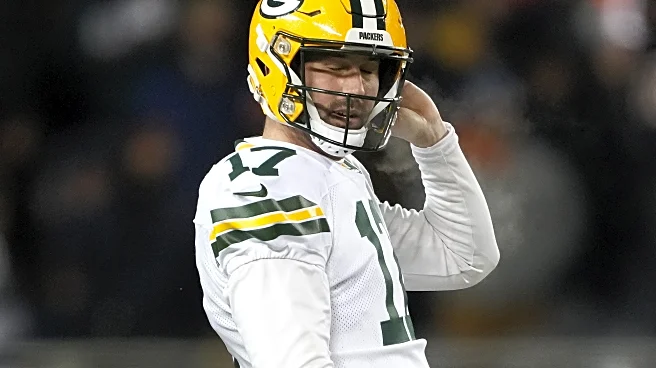
In a windy day in Chicago, McManus missed both field goal attempts and one of his three extra point attempts, costing the Packers seven points, in a playoff loss that was decided by four points. Was wind a factor? Sure, you could clearly see the ball being moved by the wind on these kicks. With that being said, Bears kicker Cairo Santos hit three field goals (including a 51-yarder) and two extra points in the same conditions.
Now, again, there is doubt about what McManus can do when healthy, but it’s really based on a windy one-game sample size. It’s like this playoff loss was made in a lab to drive us Packers fans insane. It has to be an amazing day to run a sports talk radio station right now. I would just be taking calls on the air for the entire shift.
2026
For the upcoming season, McManus has a $5.4 million cap hit and comes with a $3.3 million dead cap if he’s released by the team. This means the team will save just a little more than $2 million in cap space with his release, which even on the kicker scale in the year of our lord 2026 doesn’t mean much. He’s due his $1 million roster bonus on the third day of the new league year in 2026, so the decision to release or keep McManus will be made before that date, either by action or inaction.
If the Packers want to replace McManus, they can. What they won’t be able to do is replace McManus (at least with an experienced veteran with a good track record) with the cap space they save from his release. If they get rid of McManus for a veteran, they will be spending more on the cap sheet at the position this year than if they just keep him.
If they look toward the draft, there is not currently a kicker who is expected to be draftable in the upcoming class. The smarter bet in 2026, if the team is going to get rid of McManus, is simply to pay a veteran, but that will cost the Packers some precious cap space, as two-thirds of McManus’ $5 million signing bonus he received in 2025 are still on Green Bay’s cap sheet. His release will accelerate all of that to 2026 accounting instead of spreading it over the 2026 and 2027 seasons. There is no post-June 1st option, either, which would essentially prevent the acceleration of the dead cap hits, because McManus is due the $1 million signing bonus on the third day of the new league year (in March).
You’d have to pay him that extra $1 million signing bonus, which would still hit the cap in 2026, to prevent the extra $1.7 million dead cap scheduled to hit in 2027 from accelerating to 2026. You’d pay an extra $1 million to save $700,000 of cap space in 2026, only to still have to pay $1.7 million on the cap in 2027 with a post-June 1st release. The math isn’t mathing for a post-June 1st cut.
So, yes, the team can get rid of McManus. But it will cost them more cap space in 2026 to replace the kicker, because of the deal he just signed and the fact that this draft class doesn’t have a kicker (that people are aware of yet, at least).
Whether or not the team keeps McManus or not will tell us a lot about whether the team thinks of him as a kicker who went 41-43 when healthy (excluding blocking mistakes) over two years before a poor performance in the playoffs, or if his numbers as a whole are truly reflective of his current talent level.