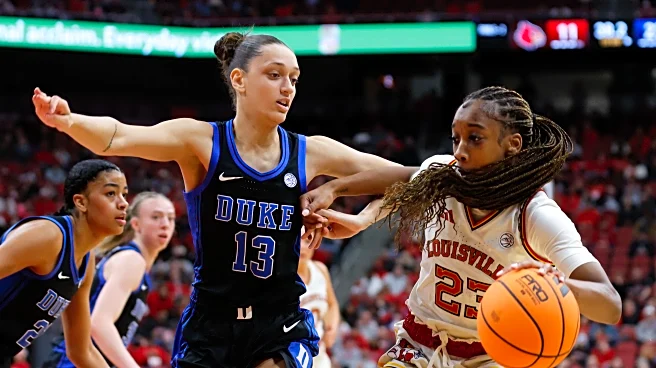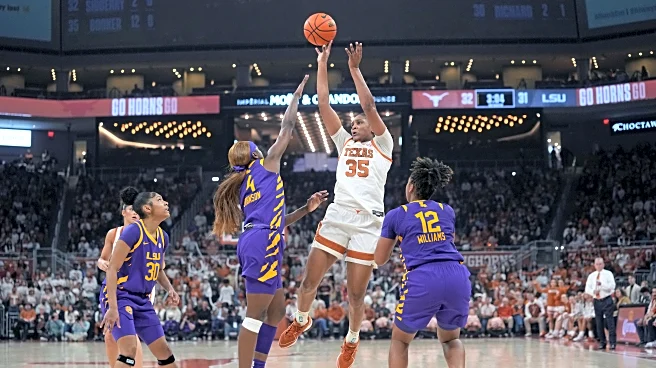


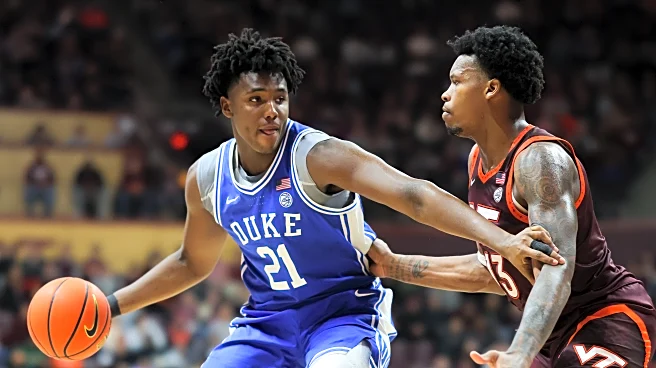
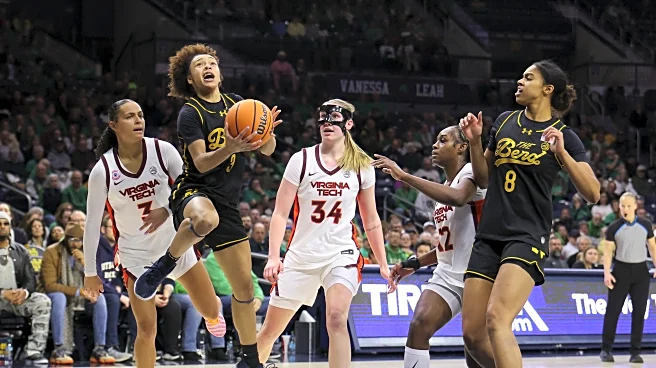
On Dec. 4, then-unranked Duke lost their fourth-straight game, defeated at home by No. 5 LSU in the ACC/SEC Challenge to fall to 3-6 on the season.
Since then, the now-No. 17 Blue Devils have won 13-straight games, steadily working their way back to the top-10 ranking they sported entering the season. A win on Thursday—when Duke visits No. 6 Louisville (7 p.m. ET, ESPN)—would go a long way towards substantiating the Duke’s in-season turnaround.
For now, there are plenty of reasons to hold onto lingering
skepticism about Duke. Are they really dangerous? Did their early struggles steel them to become a stronger team? Or, are the simply the beneficiaries of a friendlier schedule?
Here’s more on whether Duke is deserving of confidence or doubt.
Duke has benefitted from a pretty bad ACC

The answer to the final question asked above is, undoubtedly, yes.
Of the 13 teams the Blue Devils have beaten during their winning streak, none currently claim a top 25 ranking. That resume, certainly, raises suspicions about their improved quality. Notre Dame was ranked No. 18 when Duke beat them in South Bend, yet the Irish have since fallen out of the top 25, going 4-4 over their last eight games.
In the weakest ACC in years, the Blue Devils have beaten up on teams on the fringes on the 68-team NCAA Tournament field. ESPN’s Bracketology has Notre Dame as a No. 8 seed, Stanford as a No. 10 seed, Virginia Tech as a No. 11 seed and Clemson as a No. 12 seed. Virginia and Miami, two more teams defeated by Duke during their current stretch, are among the first and next four out of the projected 68-team field.
While conference play usually is the proving ground, the opposite is true for Duke this season. The Blue Devils were put to the test in non-conference action—and mostly flunked. Now, they’re coasting against conference foes. The divergence makes it difficult to discern the real Duke.
Duke, as always, is winning with defense

The Blue Devils, however, deserve credit for convincingly taking care of business against ACC foes. Eight of their 11 conference wins have been by double digits, with two of their single-digit victories, four points over Cal and seven points over Stanford, coming on the West Coast.
Duke’s dominance, unsurprisingly, has been driven by their defense. They’re holding conference opponents to an ACC-best 54.8 points per game, successfully limiting opponents’ free throw and 3-point attempts. They’re also forcing 17.5 turnovers per game in conference play.
Louisville, the second-highest scoring offense in the ACC, will demand sharp defensive execution from Duke. The Cardinals have a balanced offense, with the likes of Laura Ziegler serving as 3-point shooting stretch big who can create space for the dynamic drives of Taj Roberts, Imari Berry and Skylar Jones.
The Blue Devil offense has (probably) improved

Offense, or lack thereof, was the source of Duke’s early-season woes.
Over the course of the season, Duke’s shooting has perked up from all areas of the floor. Their 3-point shooting, at 36.3 percent as a team in ACC play, is most encouraging, although the Blue Devils attempt just 16.5 3s per game. Duke succeeds at getting to the free throw line more than 20 times per game, the most in the ACC, yet they still are leaving points off the board, as they shoot 70 percent on free throws as a team.
Cleaning up those margins—taking more 3s and making more free throws—will be necessary against a team like Louisville.
Although the culprit for Duke’s free throw woes, as she is making only half of her team-leading six free throws per game, Toby Fournier has otherwise progressed toward the star offensive role envisioned for her. In conference action, she’s scoring 18.5 points per game, shooting 61.4 percent on 2-pointers. She’s also improved as a rebounder, grabbing 8.5 boards per game, including 2.8 offensive rebounds, in conference.
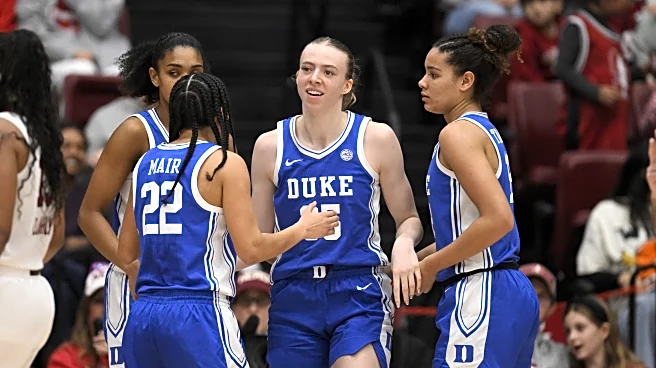
Alongside Fournier, Delaney Thomas has offered increased offensive punch from the Duke frontcourt. Thomas is averaging just under 12 points per game in ACC play, which is almost five points per game more than she averaged last season. The Blue Devils’ starting guards, Taina Mair and Ashlon Jackson, are providing a similar level of offensive production. Albeit at a low volume, Mair is shooting over 46 percent from 3 in conference. Jackson, the Blue Devils’ only high-volume 3-point shooter, is up to 38.6 percent against ACC teams after a cold shooting start to the season.
The interior production of Fournier and Thomas, supported by the shooting of Mair and Jackson, gives Duke a sustainable offensive formula. As Louisville is stronger on the offensive side of the ball than the defensive side, Duke should be able to generate some good offense against the Cardinals.
If not, they’ll not only be heading back to Durham with their first ACC loss, but also with re-emerging questions about whether or not head coach Kara Lawson’s team can even threaten to make noise in the NCAA Tournament.