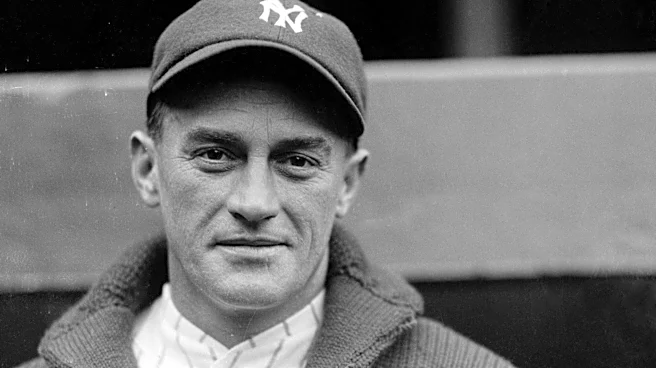

If you were to make a lineup of the all-time best Yankees based solely on having fun names, Urban Shocker would have a strong argument to be the starting pitcher, however he was also much more than that. While his best years didn’t come in the Bronx, Shocker was a very good MLB pitcher, including in six seasons across two stints with the Yankees. One of those stints came as part of the 1927 “Murderers’ Row” World Series-winning team.
Were it not for his health leading to his departure from the majors
and eventual way too young death, he might’ve been able to pitch a few more years and make a case for the Hall of Fame. With today marking his 136th birthday, let’s look back on the life and times of Mr. Shocker.
Urban James Shocker
Born: September 22, 1890 (Cleveland, OH)
Died: September 9, 1928 (Denver, CO)
Yankees Tenure: 1916-17, 1925-28
While he was known professionally as the name listed above, Shocker was born as Urbain Jacques Shockcor in Cleveland in 1890. His father was of French heritage, hence the name, but the pitcher’s name eventually became Anglicized as his baseball career progressed.
Shocker was raised in Cleveland as well, but he eventually made his way to Michigan, where his career began. After playing for semi-pro teams around the state, he made his professional debut with a Windsor, Ontario team in the Class D Border League in 1913. He got off to a bit of a bad start there, posting an ERA near five, but showed good “stuff,” striking out 90 baters in 121 innings.
With some more seasoning, that “stuff” began to show through, and Shocker got on the major league radar with an impressive 1915 with the Ottawa Senators — a baseball version — of the Canadian League. He put up a 1.99 ERA in 303 innings that year, and the Yankees went on to take him in that September’s rule 5 draft, a different version than the one we now know today. Shocker then spent most of 1916 with the Toronto Maple Leafs — again, a baseball version — but he did make his MLB debut in April and threw over 80 innings in the bigs that season. In Toronto, he posted a 1.31 ERA and had a 54.1 inning scoreless streak at one point.
Despite that and putting up better than average numbers in the bigs the next season, Shocker still remained a swingman guy for 1917. Miller Huggins then took over as Yankees manager for 1918, and looked to improve the roster. Looking to acquire Del Pratt to play second base, Huggins included Shocker in a package traded to the St. Louis Browns for Pratt.
With a bigger role, Shocker broke out in St. Louis. He was good in 1918, and then one of the best pitchers in baseball over the next couple years. From 1919-23, following a stint in the military during World War I, Shocker put up 24.3 fWAR, which trailed only Stan Coveleski and Grover Cleveland Alexander among all pitchers in baseball. He also won 104 games over those five seasons, including 20+ in four-straight years, and 27 in 1921. Shocker was one of a number of pitchers whose success came from the “spitball,” and was grandfathered in to using it, despite its 1920 banning.
The trade would probably be more remembered had the Yankees truly suffered from it, but they won a couple AL pennants in that period and then finally brought home the 1923 World Series. The Browns also weren’t able to capitalize on Shocker’s success at the team level to any great degree. They came close to winning the AL in 1922, finishing one game back of the Yankees. Every other year though, they ended up double digit games back behind the pennant winner.
In 1924, Hall of Fame player George Sisler took over as the Browns’ manager. He and Shocker did not always see eye-to-eye. Shocker also had a dip in numbers that year, and St. Louis decided to put the pitcher out on the market. Huggins and the Yankees decided to atone for their earlier mistake and traded Bullet Joe Bush and Milt Gaston for Shocker ahead of the 1925 season.
Individually, Shocker was pretty good in 1925, however the team dropped to seventh place with Babe Ruth limited to 98 games due to his “Bellyache Heard ‘Round the World.” Ruth returned the following year, and thanks in part to another good season from Shocker, they won the AL to go to the World Series.
Shocker made his World Series debut as the Yankees’ starter in Game 2, but allowed five runs in a loss to the Cardinals. He didn’t make another start, but did come out of the bullpen in Game 6. While none of them ended up getting charged as earned runs to him, Shocked was on the mound for four Cardinals’ runs, as St. Louis opened up a big league on route to a series-saving win. The Cardinals would win Game 7 the following day to take the series.
In 1927, Shocker remained a good pitcher for the Yankees, posting a 2.84 ERA in exactly 200 innings. He again helped the Yankees take the pennant. Shocker was on the roster, but he wouldn’t appear in the World Series as the Yankees swept the Pirates.
The following offseason, Shocker was one of a number of Yankee holdouts, looking for better contracts. Eventually as those discussions dragged on, the pitcher shockingly (sorry) announced his retirement. However, Huggins continued to try and get the pitcher back in the fold, and eventually got him to agree to a deal just before the regular season.
Once Shocker did begin to ramp back up to return to baseball, something appeared wrong. In addition to wrist problems, Shocker had also lost a dramatic amount of weight. His SABR bio says he was at 115 pounds, down from a normal 190, which would be a baffling amount for someone listed at 5-foot-10. Shocker appeared in one game for the Yankees in 1928, but passed out while pitching batting practice one day, leading to his release.
As it turned out, Shocker had battled heart problems for many years, which he had kept to himself for many years. He tried to battle through and pitched in some semi-pro games in Denver, but continue to have issues. He eventually checked himself into a hospital in August, but he soon took a turn for the worse. A couple weeks later, Shocked passed away at 37 due to a combination of his heart issues and pneumonia.
Urban Shocker’s 55.1 rWAR ranks fourth among all pitchers from 1916-28, which was the course of his major league career. He was probably better than a couple of the old timers that have been elected, and could’ve been even better were it not for the unfortunate circumstances that led to his passing.