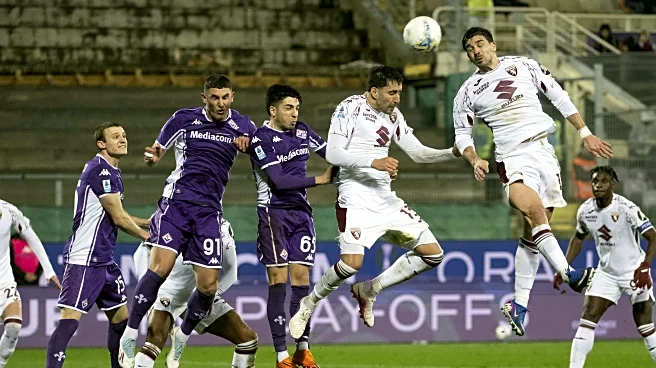

After coughing up a stoppage time equalizer to Torino on Saturday, Fiorentina’s emotional state is somewhere between crumbling and smoldering. It had looked as if the Viola were going to record their first
comeback win of the Serie A season; they’ve conceded first in 13 of 24 league matches in this year, taking a total of 5 points from them. That’s left manager Paolo Vanoli and his squad facing what feels like their 15th consecutive inquest.
I’m just as frustrated as everyone about Fiorentina’s inability to hang on in the dying minutes of a game, not least because this equalizer was so predictable that even I saw it coming. As I often do when I’m sad, I decided to suck as many of the emotions out of my head as possible and turned to the pure, cold realm of numbers, hoping to throttle my sadness with math like a healthy person does. Long story short, I made myself a little table.
I started out wondering if Fiorentina’s conceded more late goals (final 10 minutes and stoppage time) of any team in Serie A this year, but I quickly realized how limited that approach was because it ignored everything else. I decided to include the number of goals teams had scored as well as conceded, as the net value felt more important.
I also decided figure out the rate at which teams conceded late goals. Dividing a 90 minute game into 6 10-minute periods made the most sense. You’d expect teams to concede about 16.67% of their goals in each 10-minute period. Anyways, I grabbed my data and went to my trusty visualizing website. The table’s sortable by any column if you want to play around with it.
Much to my astonishment, I discovered that Fiorentina isn’t the worst team in Serie A at the end of games by any measure. Hellas Verona and Pisa have both conceded 10 goals in the final 10 minutes, while Fiorentina sits at “just” 9. The percentage of total goals conceded late pulled me up short: the Viola are only 5th-worst, with Verona and Pisa below them, as well as high-flying Roma and Inter Milan? What? That’s wacky.
The attacking numbers were equally anemic for Vanoli’s boys: just 3 goals scored in the last 10 minutes of games, comprising 11.11% of the total goals conceded. In a truly bizarre statistical quirk, that’s the same as Sassuolo and Udinese while also being considerably higher than both Verona and Roma. Inter, by the way, is blowing everyone else away in late goals, turning this apparent weakness into a strength. In short, the Mastini are for sure the worst late-game team in Serie A, with Fiorentina, Pisa, and Roma jostling for the other two spots on the podium.
Okay, so we’ve determined that Fiorentina isn’t Serie A’s worst late-game team. Let the joy be unconfined, et cetera. The performance in crunch time, though, is obviously a concern and is one of several culprits for the Viola swoon into the relegation places. We’ve got the numbers here to contextualize how dire the situation is but they, like the stars, offer us no solutions.
Much of it comes down to that squishiest of hard facts: late-game mindset. Against Torino, Fiorentina dominated the second half, scored twice to overturn an undeserved first half deficit, and seemed to be cruising. The only shot the Granata mustered from minutes 46-80 was Saul Coco’s speculative blast from 30-odd yards. Clearly the Viola defense had bottled up the visitors: Torino had 3 touches in the Viola penalty area and none were threatening.
Right around the 80 minute mark, though, Vanoli lost his nerve. He knew that Marco Baroni’s guys, seeing every opportunity to get something from a fragile opponent, would throw everything forward, and the Viola mister wasn’t sure his guys could weather the storm. To help, he brought on Luca Ranieri for Manor Solomon, adding an out-of-form defender for the winger who’d scored one of Fiorentina’s goals and had a hand in the other. Roberto Piccoli also replaced Moise Kean.
It’s obviously much easier to say this in hindsight but that was a massive error for three reasons. First, Torino no longer had to worry about Solomon and Kean’s pace. That allowed everyone to move up the pitch, safe in the knowledge that there was no counterattack coming. Indeed, Piccoli did some great work late on in beating 2 defenders and getting down the wing but there was nobody with him by the time he reached the end line and it went for a Torino goal kick.
The second reason was relational. Having defended with a back 4 for 80 minutes and done it quite well (aside from the opening goal), introducing Ranieri to create a back 5 threw everyone off. Torino easily overloaded the wings, forcing Fiorentina’s midfield 3 to shuffle back and forth across the pitch. That eventually created creases like the one Zakaria Aboukhlal found in stoppage time. Sure, Comuzzo shouldn’t have fouled him. But the Moroccan also shouldn’t have had half the pitch to himself and the Ginger Prince, uncertain about the covering defense, opted to bring him down rather than give him a free run.
Finally, Vanoli’s substitutions told his players that they weren’t on the front foot anymore. Fiorentina’s got the mental and emotional strength of a clinically-depressed rutabaga so seeing the team brimming with confidence en route to retaking the lead was a welcome change. That mindset led to a strong second half performance. By dropping deep, the mister essentially told his players, “I don’t believe that you can keep this up so we’ve got to hang on by our fingernails instead.” Confidence isn’t quantifiable but, for a group like this, anything that could damage it has to be weighed carefully.
It’s easy to fall into the post hoc facto rationalizations, of course. Vanoli’s a smart coach and understands the game and this roster better than any of us. If Torino hadn’t scored, we’d be applauding his sensible parking of the bus. Alternatively, if he hadn’t changed anything and Torino had still equalized, we’d be fuming about his failure to react to the scoreboard in the final moments.
This is also an overreaction based on a single outcome. The Torino result was uniquely psychically damaging for a number of reasons, not least because it resulted in the 6th and 7th points lost to late goals over the past 10 league outings. To me, the difference is in perceived strength of the opponent. Fiorentina is terrible and Milan isn’t, so losing that game is irritating but also feels like justice. Losing to Hellas Verona, the worst late-game team in Serie A, is an act of god from which nobody is safe.
Torino, though, is historically a club more or less on par with Fiorentina: not big enough to consistently trouble the Champions League places but too good to accept mid-table anonymity. Getting punked by your betters or ambushed by your inferiors stings but not as much as messing up against an equal. That’s the sort of result that forces you to take a long look in the mirror and reassess who you are.