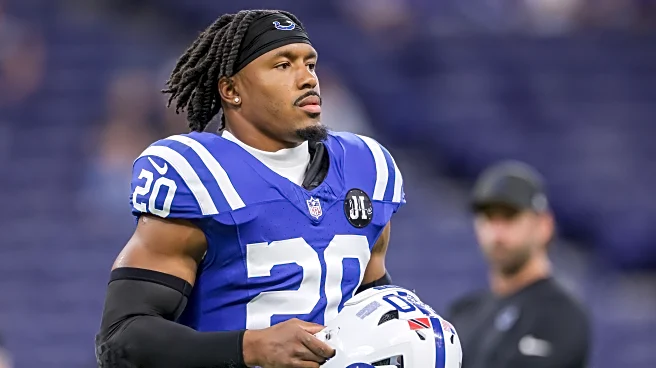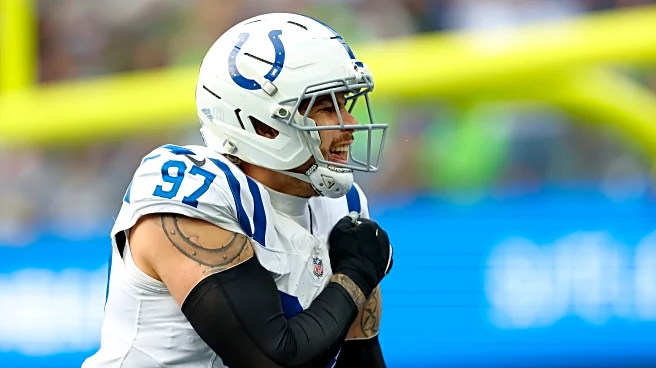



Indianapolis, IN — Indianapolis Colts second-year defensive end Laiatu Latu already has more sacks than he did as a rookie, poised to lead the team in sacks as they enter the final stretch of the regular season.
Despite this progression on the surface, some fans and analysts seem to think that Latu will never take the next step in his ascension, often citing claims that his high-pressure numbers are nothing more than empty calories, given that he struggles to finish his sacks.
Colts general manager
Chris Ballard took Latu with the 15th overall pick in the 2024 NFL Draft, serving as the first defensive player to come off the board. This naturally baked in an expectation for Latu that he simply must be the best defensive player in his draft class, from the moment he’s drafted no less. Couple that with Ballard’s draft day comments that confidently, or arrogantly, depending on how you look at it, deemed Latu to be the “best [expletive] rusher in the draft,” and it begins to make sense why patience is running thin with the second-year pass rusher.
Entering Week 16, Laiatu Latu has the T-7th-highest pressure rate (14.2%) among qualified defensive ends, according to Next Gen Stats. The names above him: Will Anderson Jr., Myles Garrett, Aidan Hutchinson, Bryce Huff, Danielle Hunter, and George Karlaftis.
The biggest difference? Latu has the slowest get-off amongst the group. His get-off (0.91 seconds) is the only average over 0.90 seconds. The rest have averages from 0.73-0.89. Latu also has the least amount of ‘quick pressures’ — a pressure logged in under 3 seconds — among them, with 9, the only player with less than 10.
Latu’s 352 pass rushes in 2025 are 1 more than his rookie total, aka the perfect sample size to compare. His sack percentage and pressure rate have both improved from his rookie season, but his get-off and time to pressure have fallen off.
Time to pressure: 2.69 seconds -> 3.05
Get-off: 0.84 seconds -> 0.91
Furthermore, you begin to question Latu’s impact when breaking down each of his 10.5 sacks in the league thus far. Broken up between his rookie and sophomore campaigns in the NFL, here’s the type of protection Latu is beating for each of his sacks:
2024-25 (Rookie)
Bears: two tight ends (Marcedes Lewis and Cole Kmet)
Dolphins: tight end
Jets: rookie tackle Olu Fashanu
Lions: swing tackle Dan Skipper
2025-26 (so far)
Rams: tackle Alaric Jackson
Chargers: third-string tackle Austin Deculus
Titans: tackle Dan Moore Jr.
Steelers: tackle Broderick Jones (2x), tight end Darnell Washington
Chiefs: rookie tackle Josh Simmons (1-yard scramble drill)
Seahawks: running back Zach Charbonnet
This isn’t to discredit Laiatu Latu’s efforts thus far, but rather to provide context for how it is he’s landing sacks. He receives his fair share of chip help from tight ends or running backs when 1-on-1 with tackles when rushing the passer, proving that opposing offenses strategically account for his gravity across the defensive front. Latu is undeniably talented; it’s the inconsistency and types of blockers that he’s faced and won against that offer long-term concern.
Regardless of the potential brief setback, Latu is indeed finishing sacks at a much higher and more effective rate than as a rookie. This would make three consecutive years of new schemes to digest, which alone serves as a reason to remain patient with him. His 6.5 sacks currently lead the team heading into Week 16, with Kwity Paye’s 4.0 sacks holding second place down.
Then you add in how he’s tapped into the athleticism from his college days as a bluff rusher who falls back into coverage under defensive coordinator Lou Anarumo, resulting in three interceptions so far this season, which is tied for the team lead (safety Camryn Bynum).
As my fellow draftniks may recall, Laiatu Latu’s popular pro player comparison coming out of college was Cincinnati Bengals’ superstar pass rusher Trey Hendrickson; therefore, the mere idea of pairing him with the defensive coordinator who fully unlocked Hendrickson, Lou Anarumo, seemed like a match made in heaven. It’s certainly paid dividends thus far, though you begin to wonder if Anarumo’s scheme, as well as the added weight in the offseason, caused Latu to lose some explosion, particularly in his get-off.
As far as meeting normal expectations, I’d argue that Latu is chugging along. When it comes to reaching those lofty, immediate expectations of a dying regime and its fed-up fanbase, however, the waters get muddied. People have the right to make speculative remarks and/or attempt to predict a player’s career outcome, but it feels disingenuous to paint Latu, at this point, as anything other than a very good football player. Deeming him a bust will certainly be some’s prerogative, though I find it hard to deem his career thus far as a disappointment.
Patience is important, and it’s especially difficult to maintain when the organization seems to be going nowhere, but other than Chris Ballard’s abysmal draft history of edge rushers in the first two rounds of the NFL draft and a couple of statistical setbacks, there’s hardly a reason to fret about the start to Laiatu Latu’s career.