

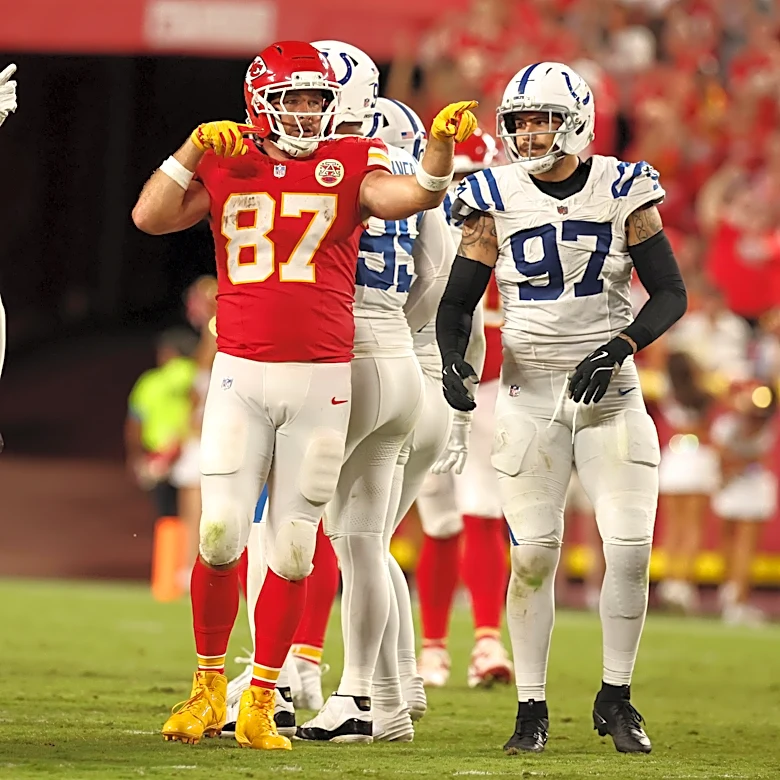

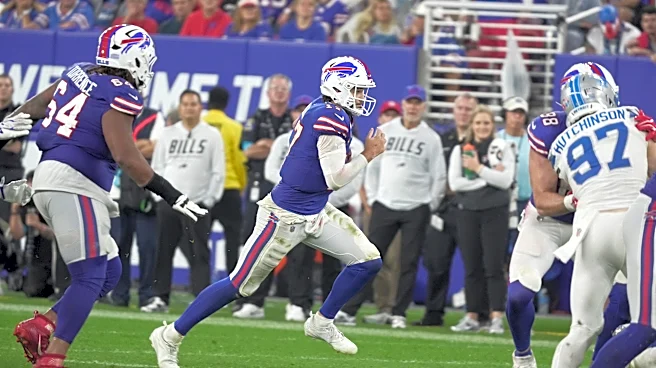

We already suspected the Buffalo Bills loved their tight end group, but when they kept four tight ends and five receivers on their initial 53-man roster after the preseason, we should have realized they planned on frequently using those bigger bodies this season.
And it hasn’t just been the most common double tight-end look — 12 personnel — from Buffalo.
No.
It’s been the significantly more rare three-tight end grouping — 13 personnel — the Bills have featured offensively. Through two weeks, the Rams
(36.4%) and Bills at 33.8% are lapping the field in 13 personnel.
Dalton Kincaid’s bulked up physique has a two-fold benefit to his game and this Bills team. There’s the idea that added strength, particularly around his knee, will help his durability. Also, with more power, Kincaid can become a more stable, people-moving blocker. He’d demonstrated clear improvement in that aspect in these opening two weeks.
And check this takeaway from Max Toscano on Twitter/X:
Remember, in the first three seasons of his NFL career, Kincaid was one of the league’s most glaring tells that it was going to be a pass.
Through two games, while 13 personnel — with Kincaid on the field of course — the Bills have an exactly even 50-50 run-pass split.
In my five takeaways article after Bills-Lions, I wrote about the showcasing of Buffalo’s real-time adaptability in the second half of Week 2’s win after DJ Moore’s injury.
And they were able to roll out plenty of 13 personnel looks to keep the defense honest when they really wanted to lean on the ground game without their No. 1 wideout on the field and holding a sizable lead.
Over the past few years, as analytics has taken the NFL by storm, teams have discovered they can generate tremendous efficiency throwing the football from heavy personnel in large part due to the personnel groupings defenses feel obligated to counter with.
One example — the Rams’ 331 plays in 13 personnel netted a considerably higher Expected Points Added per drop back than the No. 1 EPA per drop back offense (Packers) in 2025 on all plays. Of course, sample-size difference matters here. But that fact alone is very noteworthy. Los Angeles’ used 13 personnel on 30.4% of their snaps last season, the first time in at least four years in the NFL any team deployed the three tight-end look on more than 17% of the time.
I ran my own study, using the nflverse play-by-play database and FTN’s participation data from 2018 – 2025, and this is what note how much more EPA per drop back teams have generated throwing out of 13 personnel than the other most commonly used groupings with tight ends on the field:
*other groupings accounted for 16.7% of offensive snaps in this large sample
The other noteworthy observation from that chart is this — offenses are less efficient running the ball from 13 personnel. BUT, the simple presence of those three tight ends on the field brings larger, less-coverage capable defenders onto the field, thereby inviting the offense to actually pass the football.
For clubs like the Bills with at least one tight end who’s a dangerous receiving threat, not a blocking liability, and their presence on the field doesn’t telegraph run or pass, 13 personnel has become the ultimate efficiency creator for an offense.
And Joe Brady’s team has joined the Rams at the forefront of this movement.