


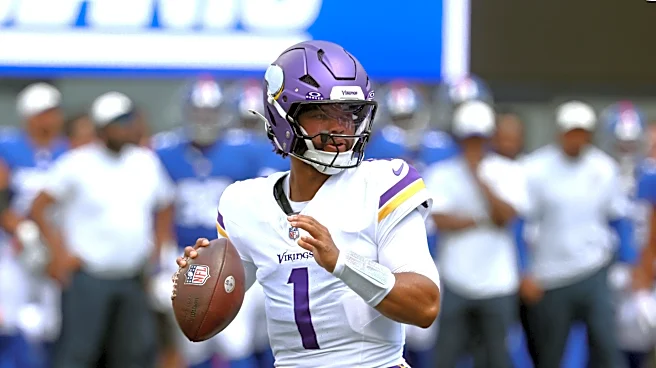
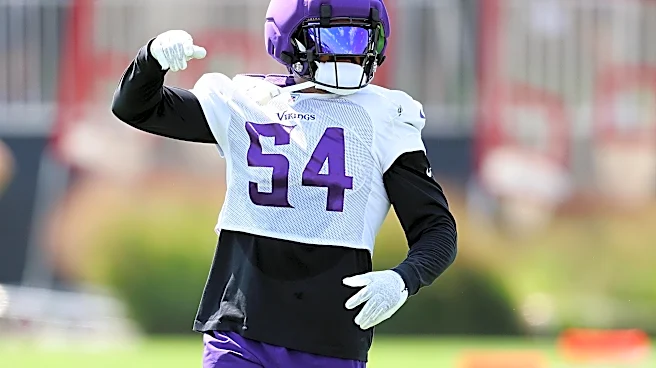
One week ago, you’d have been hard-pressed to find a Minnesota Vikings fan who wasn’t in favor of Harrison Smith returning to the team for a 15th season.
Now, after Jamal Adams’ season-ending non-contact injury on the shoddy turf at MetLife Stadium this past weekend, that collective whimper has been upgraded to a shriek.
The team’s current depth chart — unofficial, of course — has Joshua Metellus and Jay Ward penciled in as starters at safety, with some combination of Theo Jackson, Tavierre Thomas,
Jacob Thomas and Jakobe Thomas filling in thereafter.
Personally, I’d call that acceptable safety depth from top to bottom, but the folks over at Two Deep have them ranked as the No. 4 unit in the NFC North.
Among 107 safeties with at least 200 coverage snaps, Ward graded out 30th in PFF coverage grade at 68.6 — one spot behind Smith (69.0). Metellus was markedly worse, finishing 92nd (46.8).
Metellus was markedly better in pass rush grade (27th at 72.6), which obviously plays up in this scheme due to Brian Flores’ blitz-heavy tendencies. Smith, for his part, was 29th (71.5), while Ward was 101st (44.8)..
All three were pretty mid, as the kids say, in run defense, finishing 52nd (Ward), 64th (Metellus) and 85th (Smith) in that regard.
With all that considered, the players’ grades for last season were as follows:
- Smith: 36th (68.9)
- Ward: 26th (70.4)
- Metellus: 85th (55.6)
What this leads me to believe is that Metellus is uniquely a fit in this specific defense — not surprising given Flores’ penchant for finding and molding unicorns to fit his whims — and that Ward, who only played 249 coverage snaps, merits a longer look.
It also insists to me that Smith is more of a need than a luxury.
Smith played 793 snaps last season, 50th among safeties and potentially proof that less is more for the 37-year-old defensive back. He’d be on a pitch count to an even greater extent this season, most likely, allowing Ward and Metellus to play as much as their on-field results dictate, with Smith filling in as needed in terms of injury replacement or sub-package fit.
But what are reasonable expectations for a safety of Smith’s age if he decides to come back?
First of all, here’s a list of players from Smith’s draft class who saw action last year with their 2026 team — if applicable — in parentheses:
- Smith – unsigned
- Guard Kevin Zeitler – unsigned
- Linebacker Bobby Wagner – unsigned
- Linebacker Lavonte David – officially retired
- Punter Bryan Anger – punter, who cares (kidding, he’s on the Cowboys)
- Quarterback Russell Wilson – officially retired
- Linebacker Demario Davis – weak-side starter for Jets
- Quarterback Kirk Cousins – battling for playing time with rookie Fernando Mendoza Jr. on the Raiders
- Offensive tackle Kelvin Beachum – unsigned
So basically, you have a punter, Cousins and the ageless Davis starting on a bad Jets team.
That’s not a ton of company.
And how about safeties in their age-37 or later seasons over the last few years? Let’s take a look.
Only two players total had statistics last season in their age-37 (or older) campaign (age as of Dec. 31 of season):
- Calais Campbell (age 39 with Arizona): 522 defensive snaps (45.7%), 43 total tackles, 6.5 sacks, 9.0 TFL
- Brandon Graham (age 37 with Philadelphia): 113 defensive snaps (10.1%), 8 total tackles, 3.0 sacks
Graham is currently unsigned and Campbell is back (somehow) for another go-round with the Ravens. He’s truly remarkable.
Campbell was also the only age-37-or-older defender to see action in 2024 or 2023, and before that you’d have to go back to 2020 when Thomas Davis played 137 snaps (13.1%) at age-37 for Washington while Tramon Williams played 169 (16.0%) for the Ravens.
If we narrow our focus to just safeties, there are six who appeared in their age-37-or-older seasons dating back to 2000:
- 2019 – Mike Adams (age 38 with Houston): 68 defensive snaps (6.3%), 2 total tackles
- 2018 – Mike Adams (age 37 with Carolina): 936 defensive snaps (94.2%), 75 total tackles, 3 interceptions, 6 passes defended
- 2011 – Brian Dawkins (age 38 with Denver): 771 defensive snaps (70.0%), 51 total tackles, 3.0 sacks, 5.0 TFL, 6 passes defended, 1 FF
- 2010 – Brian Dawkins (age 37 with Denver): 677 defensive snaps (61.8%), 66 total tackles, 2.0 sacks, 3.0 TFL, 5 passes defended, 1 interception, 2 FF
- 2010 – Lawyer Milloy (age 37 with Seattle): 1,032 defensive snaps (93.6%), 87 total tackles, 4.0 sacks, 6.0 TFL, 3 passes defended, 1 FF
- 2000- Eugene Robinson (age 37 with Carolina): snap count unavailable, 77 total tackles, 1 interception, 1 FF, 1 pass defended, 3 FR
In 2018, Adams graded out 98th among 103 safeties with at least 200 defensive snaps played (49.2).
In 2011, Dawkins graded out 17th among 102 safeties with at least 200 defensive snaps played (69.8).
In 2010, Dawkins graded out 35th among 93 safeties with at least 200 defensive snaps played (65.0).
In 2010, Milloy graded out 56th (59.7). PFF has no data for 2000.
In other words, there is a very, very limited track record for safeties to play at 37, let alone be an asset. They’re almost always on a pitch count and most of them have Hall of Fame resumes.
Working in Minnesota’s favor is that pretty much all of that applies to Smith.
As grim as the data seems to be, if there was a player I’d be willing to bend the rules for — skip most/all of camp a la Brett Favre, create extreme defensive looks to maximize his value while minimizing snap count — it’s Smith.
And he fits exactly what they need after Adams went down.
Many times, something like this is just too simple to connect the dots for it to actually make sense. But don’t overthink it — the Vikings need Smith, and I think he wants them to need him, too.
I truly do believe he’ll be back….eventually.