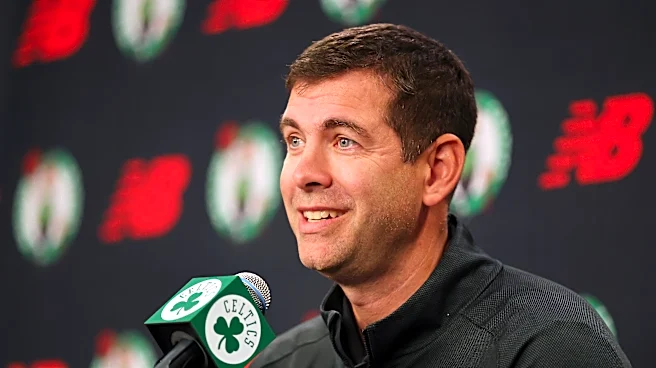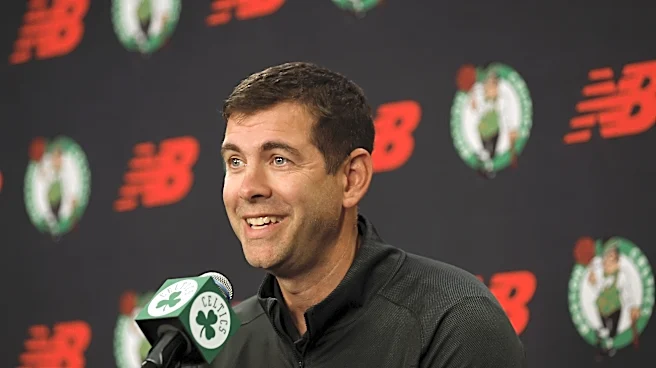




Ahead of Tuesday’s game between the Celtics and the Hornets, Brad Stevens sat down with Celtics media to discuss a slew of topics.
Here’s everything that he had to say, and what I made of it.
On Jayson Tatum’s return from Achilles:
Stevens stood by what the Celtics have always said about Jayson Tatum’s recovery timeline — he wasn’t going to come back until he was ready. And, Tatum has looked more than ready since his return: in 15 games back, he’s averaged 21.6 points, 9.8 rebounds, and 5.1 assists.
“Until he was 110% at every threshold,
had fully reconditioned, and he felt good, we weren’t even going to entertain the thought of him coming back,” Stevens said. “But it became clear, probably around the trade deadline, that early February time, that he was in a pretty good spot physically and from the standpoint of strength. And then it’s just a matter of reconditioning and getting your confidence back in a lot of ways, and playing and being back on the court.”
“And we did a lot of small games, and we had the Maine team down and got a chance to play a little bit live on the start of the post All-Star trip. And you could see that not only was he going to come along pretty quickly, but you could also see that he was getting more eager to play. So it was a really well-thought-out process by Dr. O’Malley, and Nick Sang, and Phil Coles, and followed strictly by Jayson, and everybody involved with that gets a lot of credit because of the amount of work that everybody put into it. It was nobody more than Jayson, with a close, close second by Nick. It was pretty incredible to watch up close. I got a front row seat for the whole thing. So I wasn’t sitting on the edge of my seat like others were the first time they saw him run up and down the court playing 5-on-5.”
What I took away: Brad Stevens confirms here that Tatum had been practicing since mid-February, and that he had looked good in those games (we kind of already knew that, but it sounds like these games started prior to when things were reported). Also of note — the Celtics knew that he would return when they chose to trade Anfernee Simons for Nikola Vucevic, which makes sense. Simons became more duplicative with Tatum back in the lineup, and Vucevic provides needed frontcourt depth ahead of a playoff run.
On whether the team has a ceiling:
In July, Brad Stevens made clear he wasn’t going to put a ceiling on the Celtics’ potential: “I said this when I was coaching all the time. I’d never put a ceiling on my team.”
Nine months later, he laughed when the concept of putting a ceiling on the roster was brought up: “You think now would be a good time?”
“I don’t really change. I feel the exact same as I did at the beginning. And I really feel that way normally. We’re playing today, we’ll put our best foot forward to be as good as we can be, and after tonight, we’ll be one game better or worse. And then we’ll try again tomorrow. When we get into the playoffs, it’ll be the same thing. It’s one game at a time. I don’t think in terms of the big picture as far as this individual team. I just think – I know that we can play. I’ve seen us rise and meet challenges, and I know that this team is looking forward to the next one. As you get into this time of year and get into the playoffs, everything’s hard, and the other teams are really good, and we’ll see where it all stacks out. But I’m going to continue to not put a ceiling on us.”
What I took away: When Stevens said that he didn’t want to put a ceiling on the team in the offseason, it felt like he was just saying the right thing — why would any general manager go out and put a cap on what he thought his team could achieve? But, now, with the Celtics holding a 54-25 record and on the cusp of securing the East’s No. 2 seed, that statement just hits different. The Celtics are undoubtedly championship contenders. At the same time, he also made sure to note that nothing at all is guaranteed.
On navigating the young guys playing in the playoffs:
Stevens was asked about the margins of error being slim in the playoffs and how they would go about utilizing players like Hugo Gonzalez and Baylor Scheierman, who don’t have postseason experience. Gonzalez (14.5 minutes per game), Walsh (17.5 minutes per game), and Scheierman (18 minutes per game) have all played significant roles this season, but those roles have also fluctuated significantly as the year has gone on.
“That’s the coaching staff’s job: to navigate and manage the challenges that come with the games, and challenges that come with navigating the playoffs and being the lead communicators for that,” Stevens said. “Our job as a front office is to support them in any way that we can. And so, we’ll follow their lead on what they feel like the team needs and how we can best support, but we won’t overstep our roles, and I think that’s really important. The margin is small as the playoffs start, as you get into this time of year, the distractions rise, the burdens rise, the praise rises, all that stuff, right? And the reality is, you just have to stay in the moment, be as good as you can today, and the teams that have the stamina to do that can usually play longer. Doesn’t mean you’ll win. I mean, teams that we’re competing against are all going to be good. But I do think this team, and the group led by Joe, understands the path ahead and how to navigate it, and can help the guys without as much experience.”
What I took away: The biggest thing here? Stevens fully empowers Joe Mazzulla and the Celtics coaching staff to do their job well. That’s part of what’s made the Celtics organization work as well as it has. Stevens doesn’t know which of Gonzalez, Scheierman, or Walsh will lace up in the playoffs, and he’s not going to overstep in that regard.
On his name continuing to come up when head coach vacancies in college open up:
Brad Stevens’ name recently surfaced when the men’s basketball head coaching position at the University of North Carolina opened up (the position has since been filled by former Nuggets head coach Mike Malone). There’s long been speculation that Stevens will eventually return to coaching, and he was asked directly on Tuesday about whether he’s annoyed or flattered by that speculation.
“It’s always flattering,” Stevens said. “And listen, I’m talking to people all year long, all around the game. Because one of the joys of my job now is watching, whether it be in current front office roles, people leave and get promoted, a la Austin [Ainge]. Or when I was coaching, or a part of the coaching staff, watching those guys get jobs.”
“So I’m on the phone with a lot of those people all the way through the year that are in those decision-making processes. And so it’s always flattering, right, when you’re hearing that. But, the whole idea of the coaching carousel being news is a little bit tiresome. But I get why, in this day and age, why people want to talk about it. As you know from being around me, I’m not quick to make decisions where I’m all over the place. I like being here. They’ve been great to me, and I haven’t been seeking anything else.“
“And I don’t have an agent. So I guess my circle is pretty small, although I do – Tracy still kind of helps me out. But I know that she’s pretty reliable and confidential. But, one of these days, you know, I don’t see myself… like I’m not motivated to do anything but what I’m doing is the bottom line. And I’m really happy with the people who are around and everything else. And that’s been the best part about being here and really, as you get to this age and stage, I think that’s the motivator for me. I don’t really have any other motivation than being around people that I want to be around.”
What I took away: Stevens said a lot here, but two things really stuck out. The first is that he’s really happy in Boston and fulfilled by the team around him. The second is that he’s not unequivocally ruling out eventually returning to coaching. I don’t view that as an indication that he’s likely to leave the Celtics anytime soon — I think he just picks his words carefully and doesn’t want to say anything he’s not 100% certain about.
On integrating Nikola Vucevic:
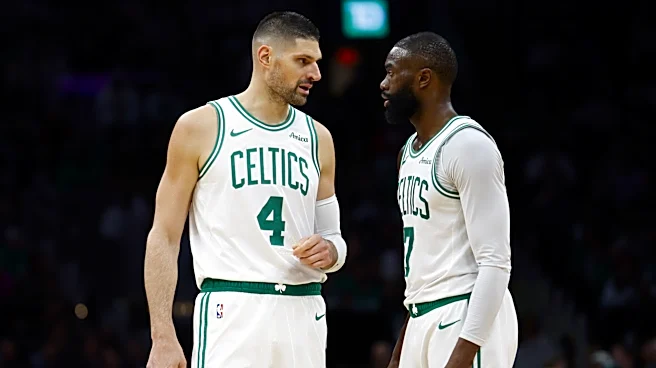
Nikola Vucevic was acquired in mid-February, played 12 games, and then was sidelined with a fractured ring finger for a month. He’s been back for two games now, with three games left to play in the regular season. In that span, Vucevic has averaged 9.4 points and 6.9 rebounds in 21.1 minutes of action, while shooting 41.6% from the field and 29.5% from three.
Stevens acknowledged Vucevic is still getting accclimated, but said he’ll be valuable down the road:
“It’s going to be a work in progress anytime you get a guy that comes into trade,” he said. “But Vooch is a pro, and I think that he immediately recognized that he’s got to do his best to find where he can help fit and where he can help impact the team. We haven’t played a ton of teams that have switched everything, like in the first game against Miami, where he really got some post-up opportunities, and that type of stuff. But I do think that he can bring an element to this group that will be really valuable down the line. I think that it’s good that he gets at least a week here to work on it with the guys. And the other thing is, we’ve been really lucky that we haven’t been in the Play-In in a while. I think we were in the one year, my last year as a coach. That turnaround, you don’t have time to work on your team as you get ready for a playoff series. Having that week in between is going to be really good, and even though we won’t have games to necessarily play with Vooch, we only have a couple left, just those practices are probably more valuable than even these next four games.”
What I took away: Vucevic has struggled a bit since lacing up for the Celtics, but that doesn’t mean he won’t eventually be very important to the Celtics. In the playoffs, if the Celtics face a team that switches everything, Vucevic will be a particularly powerful weapon. Stevens also stressed that, though there are only a few regular-season games left, the week of practice will be really helpful. That’s a good reminder for fans, too: teams hardly ever get to play.
On what he looks for in a player:
Stevens was asked about the kind of player he’s looked to bring to Boston: this past year, the Celtics added Hugo Gonzalez via the draft and Luka Garza via free agency, among others.
“Everything is information, right? And so, there’s a there’s an analytical side of it where, maybe the numbers are popping for a guy in low minutes, like they would have with Luka, because some people value possessions more than they value some of the perceived weaknesses of a player, or whatever the case may be. We do tend to look at the fact that, if you have the right competitive character and you’re more about the team, those are huge qualities.”
“Everybody’s in the NBA for a reason, and if we can figure out how to maximize the reason they’re here and not focus on the things that people see as a detriment, then we can build a team — as long as you have the cornerstones. And we’ve got the cornerstones, and that’s a huge part of it. So, I’d say that, when you talk about a guy like Luka Garza, a good example is the competitive character where team matters, you’re growth-oriented, you come to work every day, and your ambition doesn’t necessarily exceed your self-awareness. And I know that’s not always easy to find, but we watch these guys for a long time at a lot of different levels, and a guy like Luka came extremely highly recommended as a person, and we knew that he had competitive character.”
What I took away: The Celtics have done a really good job of maximizing players’ strengths, but they’ve been able to do that because they have legitimate franchise players (or, as Stevens calls them, cornerstones). I’d consider Mazzulla a cornerstone here, too. Luka Garza is often a guy the front office has pointed to, because he’s obviously extremely talented offensively (former Naismith Player of the Year!), but hasn’t found a way to be an impactful rotation player. And, a big reason why the Celtics signed him is because of his character — I’ve talked to plenty of people around the league, and few are as highly regarded as Luka.
On the job the coaching staff has done:
Stevens was asked about the work that Joe Mazzulla and the coaching staff have done this season, and nodded profusely.
“Tremendous. People talk about team chemistry a lot, and it gets overevaluated. A player’s reaction to another player, a player’s body language. But people don’t see a coach’s meeting, and when a staff doesn’t fit or work well together. And staff chemistry can kill team chemistry fast. And so, to have a staff that’s been together, that knows how they want to accomplish what they can and want to accomplish, that isn’t tied to a singular way of playing on offense or defense necessarily, because they have to wait and see what their roster is going to look like, and then can adjust to that.”
“To have the ability to say, ‘Yeah, these guys may have some things they haven’t done as well or are unproven, but they’re here for a reason. Let’s find those and soar with those, and then piece a team together.’ I think you’re going to have the best chance to maximize yourself, and this particular staff, I think, is excellent. And listen, we’ve been really lucky around here to have several people now coaching in the NBA at different stops, including both guys on the sideline today, and we’ve got more of them. And so, that’s going to be pretty cool to watch all these guys take the next step, because they truly know how to get the most out of the group. And they also know kind of how to navigate the season with the group. So, they’ve done a great job. The players have done a great job of embracing being coached, embracing those roles, and it’s all been pieced together to have a nice regular season. And they all — the players, coaches, and everybody else [that is] up for all these awards, whether they want them or not — they certainly all deserve them.”
What I took away: Brad Stevens knows he has the best coaching staff in the NBA. And, he was happy to be asked about them.