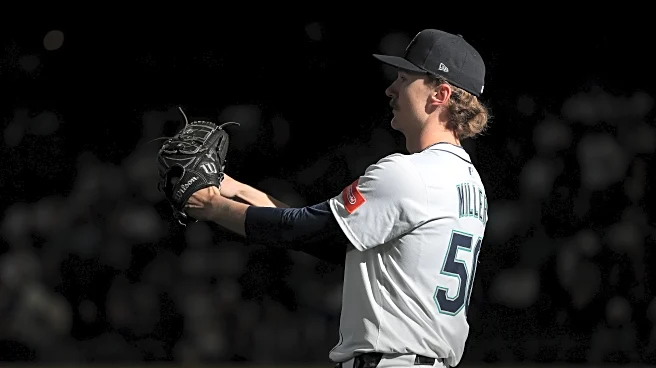

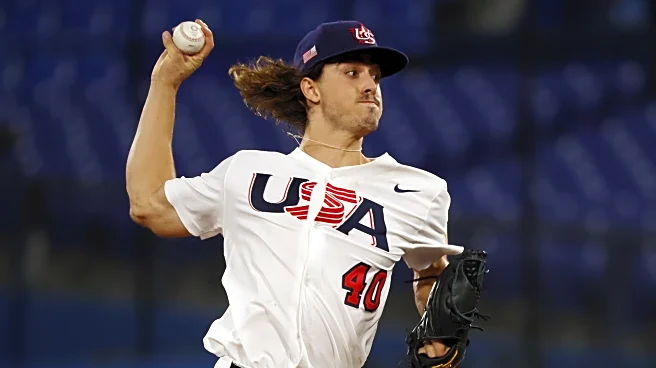
Not Jacob Misiorowski. Not Paul Skenes. No, not even Stephen Strasburg. The best starting pitcher debut this century belongs to none other than Bryce Miller.
In the first five starts of his career, way back in 2023, Miller threw 31.1 innings, allowed four runs on 13 hits, walked three, and struck out 28. By Game Score (Tom Tango’s version), his first five starts rated 79, 75, 79, 63, 76 — an average score of 74. Here are all the pitchers with an average Game Score of 70 or more in their first five starts since
2000:
- Bryce Miller (SEA, 2023) – 74
- Félix Hernández (SEA, 2005) – 73
- Jered Weaver (LAA, 2006) – 72
The only pitcher I could find on Fangraphs with a better five-start debut since 1974 (the first year game logs are available on Fangraphs) was Fernando Valenzuela, who posted an average score of 83 with the Dodgers in 1981. But Valenzuela arguably belongs in a different category, as he made his debut out of the bullpen the year before. By a different version of Game Score that stretches back to 1901 on Baseball Reference (Bill James’ version), Miller’s debut is tied for 13th all-time, with several more caveats above him for converted relievers.
Regardless of how you measure it, few pitchers have ever had more success more quickly than Bryce Miller.
Tinkertoy
Miller’s sixth and seventh starts of 2023 were terrible. His eighth and ninth starts were excellent. His 10th and 11th starts were just OK. And so went the rest of his rookie season. He ultimately posted a solid if unspectacular line: 131 innings across 25 starts; 4.32 ERA and 3.98 FIP; 22.2% strikeout rate and 4.8% walk rate. Fine for a rookie. Certainly not historic.
Still, it was the way Miller got to “fine” that turned heads. He threw his four-seam fastball 58% of the time in 2023. Only five starting pitchers relied on a single offering more. It was a good fastball, too, allowing him to challenge batters over the plate and avoid walks. His rookie heater sat 95 mph with good rise, making it appear to explode out of the top of the zone. It ranked 14th by StuffPro and generated the 10th most whiffs among starting pitchers. He was a clear model for the Mariners’ pitching philosophy: have a great pitch and throw it.
But there was work to be done. Miller struggled in 2023 against lefties. They teed off on his fastball once they learned he couldn’t throw them anything else. Miller admitted as much after the season in an interview with Brandon Gustafson at 710 ESPN:
“I got up there and I threw pretty much all fastballs and wasn’t giving up much hits, so I was like, ‘This is easier than I was expecting. All I gotta do is throw heaters down the middle and you can get through six innings,’” Miller said with a laugh. “But yeah, obviously that didn’t last. The league adjusts and I have to adjust with how they do. I think this offseason came at a good time.”
He needed another weapon, and with help from Logan Gilbert and George Kirby, he found himself a splitter. It gave him a new way to attack lefties, with the right kind of speed and movement to play off his fastball. He also started mixing in his sinker to keep righties from extending out over the plate.
The early results were more of the same. The new splitter was getting tons of whiffs, and the fastball had only improved. But he’d developed a pesky homer problem, and lefties still had him measured.
Then on June 29, halfway through another “fine” season, Miller added a new-new pitch. He called it the “death ball” and credited its development to (brief) Mariners’ teammate Mike Baumann. Officially labeled a (knuckle) curve, the pitch was another slow offering to pair off his fastball to lefties, with more vertical depth than his slider and significantly more spin than his splitter. He spoked about it with David Laurila at Fangraphs:
“As the year has gone on, with lefties it’s mostly either been splits away or heaters up, so they’re kind of on top of the plate. I think this will be a good pitch to get them off a little bit,” Miller told Fangraphs. “I’ve been trying to figure out a breaking pitch that moves glove side that gets swing-and-miss, because the sweeper and the gyro… on Stuff+, I think they’ve always underperformed, especially with whiff. The gyro has been good with results, but it just doesn’t get as much whiff as I’d like. It could be a location thing; I don’t know. The curveball, since it has more depth to it, should get more swing-and-miss.”
He was right. The curveball proved tremendously effective, generating whiffs on 37% of swings. From that day forward, he posted a 1.94 ERA, 2.96 FIP and the 15th most fWAR in MLB. He was the Mariners’ best pitcher.
In less than a year, Miller transformed from a one-pitch pitcher to having one of the deepest repertoires in MLB. This is reflected in his velocity and movement spreads on Baseball Prospectus, which improved from middle of the road to quite strong. What does this mean? As Miller releases the ball and the batter gets his first glance at the trajectory, there’s a large range of 1) speeds the pitch could travel; and 2) locations the pitch could wind up. Batters seeing the ball out of his hand have a tough time guessing when and where to swing.

Spur(ned)
If heads were turned entering 2024, they were spinning like Beetlejuice entering 2025. Miller was a popular case study for public-facing pitching analysts, he was drawing considerable buzz in the fantasy baseball space, and the reports from Spring Training were driving expectations even higher. Miller seemed poised for a season of personal achievement, and he was further evidence of the Mariners’ wealth of tip-top starting pitchers — and their ability to create them.
Then the season began.
Miller got smacked around in his first outing of 2025. He got smacked around again in his second outing. Whatever dominance he’d exhibited late in 2024 was nowhere to be seen. He wasn’t getting hit too hard, but it was clear something was off. His command was erratic. His velocity was erratic. He slogged through at bats and innings, unable to put away batters quickly. His pitch counts soared on the second turn through the order; he could hardly get through thrice.
Miller toughed it out to deliver eight mostly forgettable starts. On May 14, the team made the predictable announcement Miller would hit the injured list for the first time in his career. He had inflammation in his right elbow. It was later announced he had a bone spur, which could only be removed with season-ending surgery.
Miller and the Mariners declined the surgery. They opted for less invasive treatments and rest. He returned 2 1/2 weeks later without a rehab start. He didn’t look much different. His velocity was still down, as was his performance. He was placed back on the injured list after just two starts.
This time Miller would spend close to 2 1/2 months resting and rehabbing and pitching in Tacoma. He got his velocity up as high as 98 mph before getting the OK to return in mid August. He was saying the right things, the team was saying the right things, and there was optimism Miller might be healthy for the final stretch of the season.
In his first game back, he got torched by the Phillies. In his second, he got torched by the Padres. He made six more unimpressive starts to finish out the season. It was the worst stretch of his career.

Dropping off
It is now 2026. Miller is the Mariners’ fifth starter. They need him to be at least that.
The bone spur is still there. He hasn’t pitched in a game for about as many days as he spent on the injured list over the summer. It will have been twice as many days by the time he pitches in Spring Training. How much does that time off matter? I really don’t know. I’m not doctor. I don’t like blood. The term “bone spur” makes me uncomfortable. I’m not excited to think about it every time he walks someone.
All I can tell you is Miller in 2025 struggled to go deep into games in a way he hadn’t before. He lost nearly a full mph on his fastball between the first and second trips through the order and even more on the third pass. That’s one of the 10 largest drops in MLB and nearly double his drop from 2024. His release point also dropped significantly (and was also one of the 10 largest in MLB and nearly double his drop from the year before).

Even when healthy, Miller has noticeably different release points for each of his pitch types. He throws his fastball almost six inches above where he throws his splitter, for instance. Baseball Prospectus in its arsenal metrics publishes Pitch Type Probability, or the odds a batter might correctly identify a pitch from its initial trajectory. One part of the equation is how well a pitcher disguises a pitch with their release point. As Stephen Sutton-Brown notes on Blue Sky in a conversation with The Athletic’s Eno Sarris, Miller’s release point makes his splitter almost twice as easy to spot as the average splitter. My hunch is this difference becomes more noticeable as his arm drops throughout the game.
This isn’t a satisfying conclusion. Miller’s stuff hasn’t changed since he flashed Ace potential in the final months of 2024, and it’s changed considerably since he dominated the league with just one pitch in the earliest days of his career. There’s hardly a deeper arsenal in MLB at the moment, and he’s proven its worth. But, for whatever reason, that arsenal was only effective for a few batters at a time in 2025. Can one of the game’s great tinkerers address this issue in 2026 and fulfill his potential? The only thing we can say for sure: there’s something in Bryce Miller’s arm.