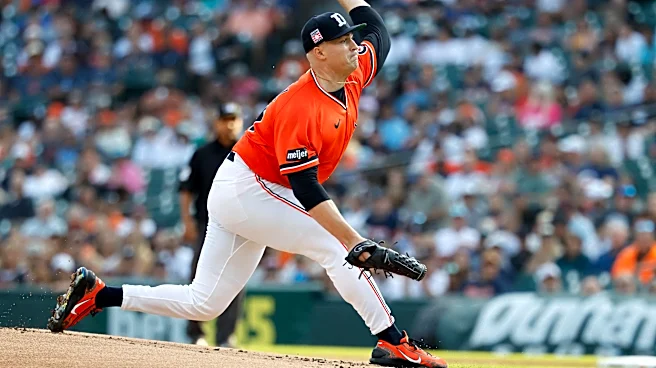




Should the Detroit Tigers decide to keep Tarik Skubal through the August 3 trade deadline without signing him to a contract extension, they will still face one of the most complicated roster decisions of the Scott Harris era. As discussed previously, should Skubal decline a qualifying offer and sign elsewhere this winter, the Tigers would receive very different compensation depending upon one critical factor: whether they finish the 2026 season above or below the first Competitive Balance Tax threshold.
For a revenue-sharing recipient like Detroit, remaining below the threshold means receiving a supplemental first-round draft pick. Finishing above it drops that compensation all the way to a pick after the fourth round. That makes every dollar matter.
Based on the best publicly available payroll tracking, the Tigers currently project to finish the season with a Competitive Balance Tax payroll between approximately $245.6 million and $246 million. That puts them roughly $2 million above the $244 million threshold. This is according to Cot’s contracts, and MLBR’s payroll tracker. (Note: Roster Resource and Spotrac do not exactly track each roster move during the season).
The luxury tax itself is almost insignificant. The Tigers would owe only about $300,000.
The real penalty is losing one of the most valuable draft picks available under the current Collective Bargaining Agreement.
With only 58 days remaining in the regular season, Detroit doesn’t need to eliminate $2 million in annual salary. It needs to remove approximately $6.3 million in annual salary from its books for the remainder of the season to net the prorated salary of $2 million. Any salary acquired before the deadline increases that number.
That’s where the problem begins.
Only eight players besides Skubal earn enough this season to accomplish the task by themselves:
- Javier Baez
- Gleyber Torres
- Framber Valdez
- Jack Flaherty
- Kenley Jansen
- Kyle Finnegan
- Justin Verlander
- Drew Anderson
Even trading Casey Mize would fall just short, despite his $6.15 million salary, because they’d only be clearing his salary over the final 54 days of the season. Trading Anderson who receives $7 million for the season, would clear enough salary, as long as they don’t add any salary back for the rest of the season. As erratic as he’s been, the Tigers do not have any notable relief options in Toledo other than possibly Beau Brieske if he can get it going.
Unfortunately for Scott Harris, identifying contracts isn’t the difficult part.
Finding one he can move without damaging the team and taking them completely out of the wild card and divisional hunts is the problem.
No one is trading for Justin Verlander and he’s currently still injured. Javier Baez is not worth his contract much less any surplus value. Jack Flaherty is really the ideal candidate for a move like this and trading him could both clear enough payroll and return a decent prospect as well. Unfortunately, he too is currently on the injured list. Kenley Jansen and Kyle Finnegan have both experienced uneven stretches this season, but the Tigers also need reliable late-inning relief if they hope to make a deep October run.
That leaves Gleyber Torres.
From a payroll standpoint, Torres is the cleanest solution. His $6.8 million salary would move Detroit comfortably below the CBT threshold, assuming little salary comes back in return. As an impending free agent, he also represents one of the club’s few veterans with meaningful trade value.
The baseball decision is much more difficult.
Torres has been one of Detroit’s best hitters this season, posting a 128 wRC+, one of only four Tigers above league average offensively. The Tigers could replace him internally with a combination of Javier Baez, Colt Keith and Zack McKinstry, but the numbers suggest that would be a downgrade in the lineup during a pennant race.
That’s the Catch-22.
If the Tigers keep Tarik Skubal, they are signaling that 2026 is about winning a championship, not maximizing long-term assets. Yet preserving the supplemental first-round compensation pick for a potential Skubal departure may require subtracting from the very roster they believe can win that championship.
The irony is that Scott Harris may have to act as both buyer and seller.
The ideal trade wouldn’t simply reduce payroll. It would reduce payroll while returning a player capable of helping Detroit win now. Every dollar of salary taken back, however, chips away at the payroll savings, making the balancing act even more difficult.
A supplemental first-round draft pick is hardly insignificant. Kevin McGonigle and Nick Castellanos both entered the organization through compensation selections. If both Skubal and Casey Mize ultimately declined qualifying offers and signed contracts exceeding $50 million elsewhere, Detroit could receive two supplemental first-round picks—but only if it finishes below the CBT threshold.
Payroll calculations themselves remain an inexact science. Cot’s Contracts attempts to track individual player obligations throughout the season and currently places Detroit around $246 million. MLB Trade Rumors maintains a tracker that estimates approximately $245.6 million. Major League Baseball’s official CBT accounting won’t be finalized until after the season and includes estimates for player benefits, bonuses, and other adjustments that aren’t publicly available. That uncertainty alone gives Detroit every reason to create a cushion rather than trying to finish a few thousand dollars below the line.
Payroll for CBT purposes differs from current MLB payroll in three main respects:
CBT payroll uses average annual value of multi year contracts, as well as all the salaries of players on the 40 man roster and those who were on the roster but have since been removed, and the calculation includes an estimated $18 million for the club’s share of player benefits plus their $1.6 million share of the pre arbitration bonus pool.
In case you’re wondering about the impact of the pending lockout of the players as MLB owners or sue a salary cap, don’t expect any changes to this year’s free agent class in the new Collective Bargaining Agreement. Even the proposals that both sides have made thus far would leave the current system in place for this winter.
For that reason, don’t be surprised if the Tigers make a move that seems puzzling at first glance. A trade motivated in part by payroll management may not bring back a headline prospect or even equal on-field value. The goal may simply be to thread the needle: stay below the Competitive Balance Tax threshold, preserve a supplemental first-round draft pick, and still field the strongest possible team for what they hope will be a long October. Or, they could make the obvious move and trade Tarik Skubal for pitching help, opening enough payroll space in order to make a trade to fill other needs and try to sneak into the playoffs anyway without their ace.