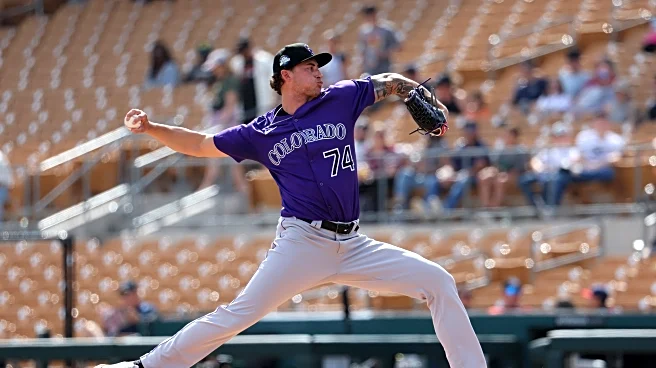

Kyle Freeland will take the ball for the Rockies on Opening Day in 2026 — the fifth Opening Day nod for a pitcher who has quietly built one of the most unique résumés in franchise history. By Baseball-Reference, he is already the Rockies’ all-time leader in WAR among starting pitchers (19.2), a reflection of both longevity and effectiveness in baseball’s most difficult pitching environment.
And yet, that same metric — WAR — is part of why Freeland is so often misunderstood.
Because here’s the reality:
WAR doesn’t always evaluate pitchers at Coors Field particularly well. And Freeland is one of the clearest case studies of that disconnect.
His 2018 season is the most extreme example. FanGraphs credited him with 4.1 WAR. Baseball-Reference credited him with 8.4 WAR. Same performance, radically different value depending on the model.
That season stands out — an outlier peak — but it doesn’t stand alone. Freeland has put together multiple solid seasons in Colorado, just not always at that elite level.
Why Coors breaks clean metrics
Most public pitcher WAR (Wins Above Replacement) models rely on two approaches:
- FIP-based WAR (FanGraphs) — built from strikeouts, walks, and home runs.
- RA9-based WAR (Baseball-Reference) — based on actual runs allowed.
Both work well in most environments. At Coors, they don’t.
At altitude, air density is roughly 15–20% lower than at sea level. Pitch-tracking research shows fastballs can lose roughly 2–3 inches of movement in Denver.
Movement isn’t just reduced: It’s altered. That makes generating swing-and-miss more difficult and increases reliance on contact.
So pitchers adapt.
Freeland doesn’t overpower hitters — and that’s exactly what WAR tends to undervalue.
2018 shows the disconnect
Freeland’s 2018 line:
- 202.1 innings
- 2.85 ERA
- 3.67 FIP
- 4.1 fWAR
- 8.4 rWAR
That gap between fWAR and rWAR isn’t small — it’s philosophical.
One model saw a pitcher without dominant strikeout numbers. The other saw elite run prevention.
At Coors, Freeland threw 93.2 innings with a 2.40 ERA — not just surviving, but thriving.

Coors isn’t just hitter-friendly
Coors is often called “hitter-friendly,” but that undersells it.
Park factors are averages — one adjustment applied broadly.
It interacts with pitch shape, contact quality, and decision-making in ways that don’t scale cleanly. Two identical pitches can produce completely different outcomes depending on where they’re thrown. Even the humidor reduced but didn’t eliminate these effects.
In Colorado, the numbers rarely tell the whole story.
The skill that gets missed
Freeland’s profile won’t jump off the page:
- Modest strikeout rates
- Solid command
- Heavy reliance on contact
But his value shows up differently:
- Weak contact
- Ground balls
- Avoiding letting one inning break everything
At Coors, that last skill might be the most valuable.
WAR rewards outcomes that translate cleanly across environments. Freeland’s value comes from handling one that doesn’t.
The Coors credibility tax
There’s also a perception gap — call it the Coors credibility tax.
A 4.30 ERA in a neutral environment looks like back-end production. At Coors, that same performance can resemble mid-rotation value or higher.
If the Rockies are building around pitchers like Freeland, the question isn’t just whether they’re good enough: it’s whether we’re measuring them correctly.
So what is he actually worth?
On paper, a ~2 WAR pitcher looks replaceable.
In reality, it’s not that simple.
Freeland is owed $16 million in 2026, with a vesting option tied to innings in 2027. That reflects something the numbers struggle to capture: reliability in a uniquely difficult environment. A pitcher with similar “true talent” elsewhere might not translate to Coors at all. Freeland already has.
Kyle Freeland isn’t an ace in the traditional sense.
He’s something more specific:
A pitcher built to survive — and occasionally thrive — in baseball’s most difficult pitching environment.
Until metrics better capture environmental context and contact management at altitude, pitchers like Freeland will continue to look ordinary on paper and essential in reality.
So the next time you see a WAR total next to a Rockies pitcher, ask:
Is that number telling the whole story — or just the part that survives outside of Coors Field?
What We Got Right and Wrong About the Rockies in Spring Training | SI.com
The Rockies’ spring training offered a mix of optimism and reality — some encouraging performances, but familiar concerns still lingering. A few players showed growth, especially on the offensive side, yet questions about pitching depth and consistency remain. In the end, the biggest takeaway is that spring can hint at progress, but proving it in the regular season is a different challenge entirely.
Ezequiel Tovar returned to the Rockies fresh off helping Venezuela capture a World Baseball Classic title, bringing both momentum and confidence back to Colorado. The young shortstop embraced the emotional weight of the moment, calling the experience meaningful not just for himself but for his country. Now back with the Rockies, the question becomes whether that energy — and his strong international performance — can carry over into a bounce-back season at Coors.
Rockies see top prospects Condon, Carrigg take next steps in solid spring | MLB.com
The Rockies reassigned top prospects Charlie Condon and Cole Carrigg to minor league camp, a move framed less as a setback and more as the next step in their development. Both impressed during spring training, with the organization emphasizing their strong performances and long-term upside. Ultimately, the decision reflects timing rather than talent — and reinforces that both remain firmly in the Rockies’ plans for 2026, even if their debuts will have to wait.
Please keep in mind our Purple Row Community Guidelines when you’re commenting. Thanks!