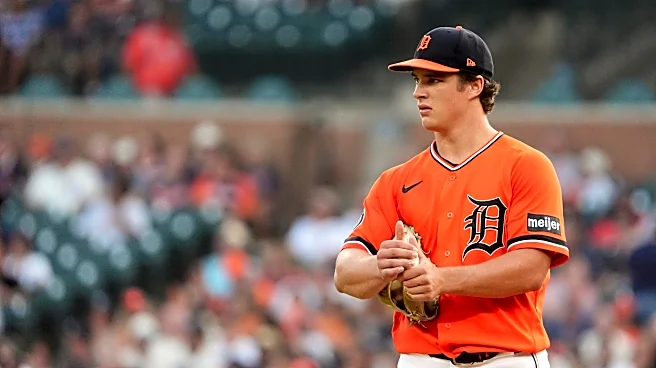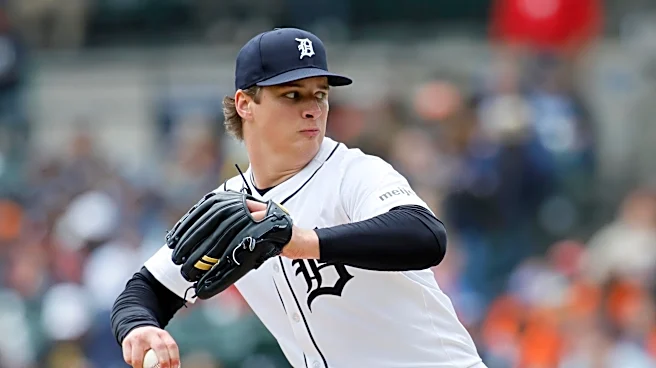

After over a year of rehab and recovery, Jackson Jobe made his triumphant return to the mound on Saturday, August 8 against the Giants. Then he got lit up by the White Sox on August 14. His outing against the Pittsburgh Pirates on the 19th, went much better as he allowed just one earned run over 5.1 innings. Truthfully, this all feels like the young right-hander is picking up right where he left off. He’s a very talented young pitcher, but there is still developmental work ahead to finally become
more consistent and start racking up the level of swing and miss that his raw ability says he should be able to produce. That is exactly where things stood at the end of May 2025, when the Tigers announced that Jobe would undergo Tommy John surgery.
That first start back showed what Jobe can do, and was impressive after nearly 15 months on the shelf. The second showed off the issues he still needs to work on, as the White Sox handled his fourseamer without too much trouble and weren’t chasing his power slider-curveball combo. The third saw him pivot more to his sinker against the Pirates, with better results.
This is all still a work in progress, as right now Jobe is still just knocking the rust off. There was plenty of work ahead of him when he was first called up in September of 2024 after skipping through Triple-A in only two starts, and while he’s made progress in the interim, the same issues with fourseam swing and miss and the ineffectiveness of his high spin breaking stuff remain intact. Ultimately, hitters are the testing ground, and improving his pitch mix will be the focus as the now 24-year-old Jobe looks to fulfill his potential and develop into a frontline starter.
On Tuesday, Jobe faced his toughest test yet against a dominant Rays lineup that strikes out less than any team in the league. Their only weakness is a minor lack of home run power, but they’re still generally middle of the pack in that department, and it may just be a trade-off they’re happy to make to put the ball in play more often. Things went reasonably well as Jobe tossed 4.1 quite inefficient innings of one-run ball. He showcased why he’s still very much a young and inexperienced work in progress who just needs steady major league time in which to work with Chris Fetter and Robin Lund and figure things out, but he also illustrated why he’s not easy to hit either.
One thing we noticed in his Jobe’s rehab work in the minors was a nice post-TJ velocity bump. That’s carried through to the major leagues so far, as Jobe is averaging 98 mph with his fourseamer, a full 1.5 mph more than in 2025. The other obvious element is a distinct drop in Jobe’s arm angle. In 2024-2025, Jobe’s arm angle was 43-44 degrees. So far this season he’s generally around 39 degrees. With a path that is a little less over the top, typically, though certainly not always, the result is less riding action and more horizontal movement. We’re seeing the former, as Jobe is down from 17.8 inches of induced vertical break to 16.5 inches. He isn’t actually getting more run on the fourseamer in concert with that change, however.
That may have precipitated the move to using his sinker more instead, or maybe lowering his arm slot was part of the plan. Mixing the two fastball types is always a good idea to help keep hitters uncomfortable. It’s probably still a little too early to tell, but for one reason or another, the fourseamer just doesn’t get many whiffs in the zone. Jobe’s clean, rhythmic mechanics don’t give him any deception, his extension is somewhat below average, and despite his high spin rate, he doesn’t often get the type of high spin efficiency ride that say, Justin Verlander always did. Using the sinker much more in the zone, and saving the fourseamer mainly to try and induce chase above the zone may be the way to go here, but one way or another, mixing the two types is usually a positive, as it’s been for Troy Melton.
Jobe’s lower arm slot may be great for his breaking stuff, however. In 2025, Jobe’s best secondary pitch was clearly his changeup, and he’s still got that pitch in his pocket for left-handers especially. Where he’s struggled, even in the minor leagues, is with his breaking stuff. Jobe has always had very high spin rates, to such a degree that his slider and curveball needed to start at the top or even above the zone, just to end up close to the bottom of the zone rather than practically in the dirt. That much break and those high sightlines gave both pitches a distinctive “pop” out of his hand that made them too easy to pick up. They move too much, too early, instead of tunneling off his two fastball types and then producing that late snap at the plate. With the lower arm slot and more velocity, Jobe may have started to crack the code finally.
On Tuesday, he was pumping curveballs in at 85 and even 87 mph, which is elite velocity even for a knuckle curve. Entering the game, Jobe had averaged 81.1 mph, 2858 rpms of spin, and 56.3 inches of drop through his first three starts. Against the Rays, he averaged 85.1 mph and 49 inches of drop after tinkering with his grip and release a bit. Typically, if you can throw your breaking balls harder, they’re going to be nastier for hitters to handle with all else being equal. And coming from a lower arm slot, with less drop, they may be less obvious out of hand.
Of course, you still have to locate them consistently, but this is a really interesting development to track. Notably his slider was also up a mile per hour. Whether this sticks or not, we’ll have to wait and see, but it’s pretty indicative of both the talent level and the fact that Jobe is still a work in progress, making adjustments and seeing what works best for him.
We’ll have to see how well this velocity surge holds up over time. Jobe knows they aren’t going to push his pitch counts right now. He can just air it out freely with minimal conservation of energy. Some of this may naturally change as Jobe fatigues during a longer start or over the course of the whole season, but there’s reason to think he’ll keep some of these gains, too.
For another change, Jobe is on the record saying he shifted from the 3B side of the mound more to the center during his rehab, which helped keep him more streamlined to the plate. Some pitchers really like the cross-bodied deception, but for a power pitcher like Jobe, an efficient, linear drive towards the batter is probably best for maximizing velocity, though it wouldn’t hurt him to have a little more of a pause or hitch in his motion to help throw hitters’ timing off a bit. It’s also possible that this more straightforward delivery helps keep him in the zone a bit more than 2025, when he was in the bottom 20 starting pitchers in ‘zone percent’. That’s not automatically a death sentence, but it does require hitters chasing, and they haven’t done that too much yet.
Still, just watching his start against the Rays, it’s easy to see why he wasn’t getting as many whiffs as he could, and it doesn’t have that much to do with the quality of his pitches. He only threw 49 of 86 pitches for strikes. The issue is still more command than raw stuff. When ahead early in a count, he struggled to spot his breaking stuff close enough to the zone to consistently force hitters to chase. There are too many pure waste pitches that let hitters back into counts rather than forcing them into swing mode against pitches they don’t really want to swing at. Jobe often got ahead and had hitters set up, only to let them back into counts. Suddenly he’s in a situation where he has to turn to the fourseamer or sinker in swing counts while needing to throw a strike. Not a great recipe for success. He has the raw stuff, and there are tweaks they can make to the movement patterns, but the far bigger element to develop is the ability to work in and out, up and down, with more precision than we’ve seen so far. For a starting pitcher, just about everything else follows from fastball command.
Most of these points were true in 2025 as well, and it’s well worth remembering that the Tigers basically skipped him through Triple-A quickly in 2024 to get him on the postseason roster. He had barely turned 22 years old at the time, and while he was certainly talented enough, he had a lot of work ahead of him to refine his stuff and approach against major league hitters. Only in 2025 did he get a normal spring training camp and then a spot in the Opening Day rotation. Jobe made some nice progress in May of 2025 after a shaky start. He’s really just now picking up where he left off, but doing so in the wake of major arm surgery and a long grueling rehab over the past year.
The potential here is outstanding, and the new curveball is exciting, but some patience is going to be required. In the wake of losing Tarik Skubal, it’s just great to have Jobe back on the mound to continue his development. The Tigers are going to need him if they’re going to get back into contention in 2027 and beyond. The explosive bump in velocity, particularly on Tuesday with his curveball, the changes to his arm slot and position on the rubber, as well as the ongoing tweaks between fourseam and sinker-based approaches, all speak to the constant tinkering still going on. There is an awful lot to like in Jackson Jobe as he finally embarks fully on his major league career. He’s just getting started.