





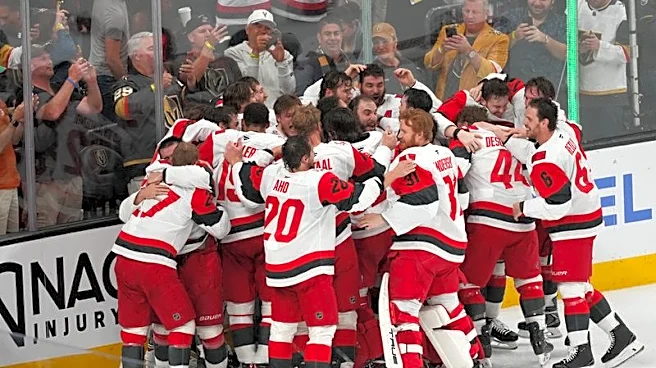


Every time a new champion is crowned in professional sports, the rest of the league looks for ways to copy or model them.
It could be an attempt to model more objective things like playing styles and strategies, to more philosophical ideas like an overall approach to the roster construction. I want to focus on the latter point as it relates to what the Pittsburgh Penguins can learn from the Carolina Hurricanes, and what takeaways we could have when it comes to continuing to rebuild the organization.
The one thing that tends to get lost in these discussions is there is always more than one way for a successful team to win, and there is more than one way to build (and rebuild) an organization. The Penguins are in a situation right now where they are clearly going through some sort of a rebuild, but are also not tearing it all down to the ground as part of a full-scale rebuild the way it was previously expected. That is putting them into a position where they are not really going to be picking at the top of the draft or dealing with the highest lottery odds.
There is a segment of the fan-base (and the hockey world in general) that sees that as a tough proposition. Maybe even a long-term losing proposition.
- You typically need superstars to win.
- The best and easiest way to get superstars is by picking at the top of the draft.
If you are not picking at the top of the draft, and you are not going deep into the playoffs, you tend to be stuck in a mushy-middle no-man’s land that is tough to get out of.
But there is also no guarantee the full-scale rebuilds work, and a lot of the recent ones that we have seen have either 1) completely failed, or 2) taken close to a decade to find success.
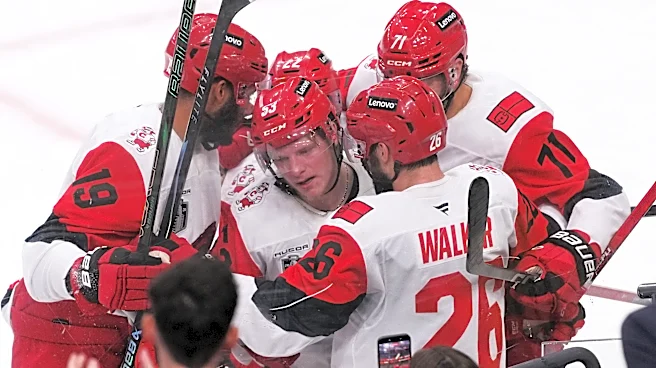
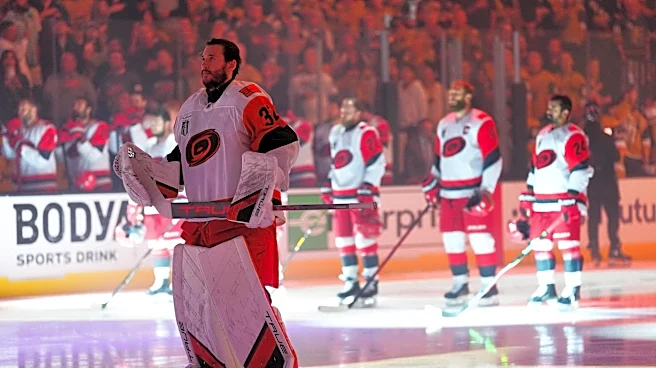
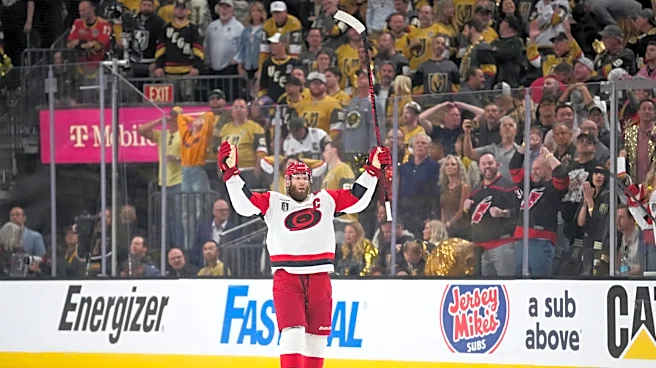
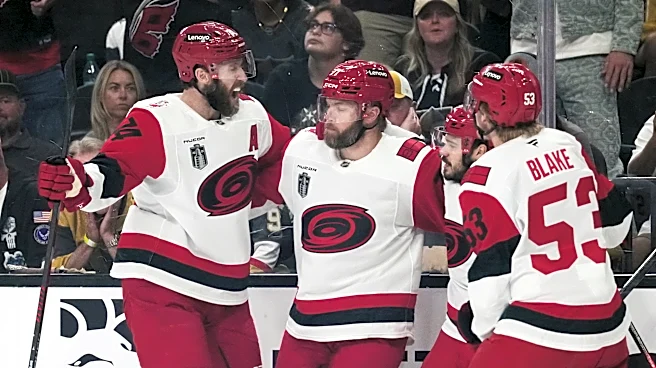
What is most interesting about the 2025-26 Hurricanes is they won without 1) a true superstar on their roster, and 2) without going through a full-scale, multiple-year tank to get to where they are.
Their roster is incredibly talented, but there is no Sidney Crosby or Connor McDavid level player on it. It is a roster that is highlighted by a lot of really good players, and incredible depth with no weaknesses. Its depth is its biggest strength. And that was always true even before this season.
And they still got there without having to routinely pick at the top of the draft.
While they had a nine-year playoff drought prior to reaching the playoffs in 2018-19 and starting this recent run of success, they never really truly bottomed out, and weren’t really at the bottom of the league.
Over at my Substack this week I dug into the Hurricanes roster construction a little bit and focused heavily on the Mikko Rantanen sequence, but also looked into the overall roster and how each player was acquired (here is the link, and maybe consider a subscription if you are interested — shameless plug, I know) .
I had been following the roster construction of the playoff teams through each round and how they were built, and the two teams in the Stanley Cup Final were largely pieced together through trades, free agent signings and non-lottery picks. While Vegas had a number of players that were picked in the top-five by other teams, they themselves didn’t actually pick them. They traded for them.
Carolina was similar.
The only top-five pick on the Hurricanes roster that the Hurricanes made was Andrei Svechnikov, the No. 2 overall pick in 2018. But Carolina did not end up with that pick by being the second-worst team in the league. They were the 11th-worst team in the league and won one of the league’s draft lotteries that year.
Seth Jarvis was the only other first-round pick Carolina made on the roster.
Everybody else was either a second-round pick or later, or an outside addition.

I mentioned above how they ended up with the Svechnikov pick, but prior to that the only other top-10 picks they had during that nine-year playoff drought came between 2013 and 2015 when Haydn Fleury, Elias Lindholm and Noah Hanifin were picked No. 5, No. 7 and No. 5.
But here’s the thing: None of them played a major role in the resurgence that followed, either directly or indirectly as part of an ensuing trade tree.
Fleury was simply a bust.
Lindholm and Hanifin were eventually traded to Calgary for Dougie Hamilton, Adam Fox and Michael Ferland. Hamilton played on three playoff teams in 2018-19, 2019-20 and 2020-21 before leaving as a free agent. Ferland played one season there before leaving as a free agent. Fox never signed and was traded for two draft picks that never panned out.
Their path to success was forged on great player development beyond the first-round, and by making shrewd moves in other areas.
A lot of their best internal players were second-round picks or later (Sebastian Aho, Jaccob Slavin, Jackson Blake).
The most impactful series of trades was the Rantanen sequence that saw them trade Marcin Necas and Jack Drury for Rantanen and Hall, and then almost immediately flip Rantanen for Logan Stankoven and two first-round picks. One of those picks was used as part of a trade with Scott Morrow (another second-round pick) to acquire K’Andre Miller.
But even the original Rantanen trade didn’t require unattainable assets. Necas was a No. 12 overall pick and a good, but not yet great player. It wasn’t until after he got to Colorado that his offense really eurpted. Drury was another second-round pick-level talent.
An overall package of Necas, Drury, Scott Morrow (whose career and value is rapidly plummeting) and an additional second-round pick eventually turned into Stankoven, Hall, Miller and another future first-round pick.
The only other player acquired through a trade that involved significant assets was Jordan Staal who was acquired for Brandon Sutter and a top-10 pick —- nearly 15 years ago.
Even with all of this being said, this is still an incredibly difficult thing to pull off because it requires not only a lot of great player development, but also at least some of the luck that resulted in the Svechnikov pick.
But here’s what I take away from this from a Penguins perspective.
- They are loaded with the type of second-and third-round assets that Carolina used to piece its team together. In Kyle Dubas’ first three years they have already made seven picks in the top-50 of the NHL Draft, and have two more coming this season (No. 22 and No. 39). That will be nine top-50 picks over a four-year stretch. Between the 2026 and 2029 drafts they already have accumulated 12 picks in the first two rounds of those draft classes.
- Will all of those picks, both the ones already made and the ones still to come, pan out? Absolutely not. I can not emphasize that enough. If you get three or four really good NHL players out of that group you should be ecstatic. Ben Kindel looks like he is on track to be one. Harrison Brunicke, Bill Zonnon and Will Horcoff are intriguing, as is Rutger McGroarty (acquired for Brayden Yager). There are some chances there. One of the best ways to give yourself a chance to find players in those spots is to simply give yourself as many swings as you can get. It’s one of the instances where quantity sometimes means just as much, if not more, than quality.
- But those picks, both in terms of prospects already in the system and picks still to be made, can also be used as trade chips. The Penguins already capitalized on some of that draft pick capital to acquire players like Egor Chinakhov and Elmer Soderblom.
- All of that is a big part of Carolina’s success with its player development and ability to make trades. Between the five-year stretch of 2017 and 2021 they made 14 picks in the first two rounds of the draft. They made 29 picks in the first four rounds of the draft. Only one of those picks was higher than 12th. Those picks produced Stanley Cup contributors in Jarvis (No. 13 overall), Alexander Nikishin (No. 69 overall), and Blake (No. 109 overall), and also players like Morrow, Necas, Drury, Ville Koivunen and Vasilly Ponomarov that were used to acquire players like Jake Guentzel and Rantanen (and everybody that followed after him).
Dubas has done an outstanding job giving them a LARGE collection of picks in that same range. He’s bought picks by weaponizing salary cap space. He’s moved up and down the draft board to collect more picks. He sold some veterans at the right time (specifically Marcus Pettersson and Drew O’Connor).
They have options.
If they move a Bryan Rust or Rickard Rakell this offseason, they could give themselves even more options.
More lessons to take here:
- Do not be afraid to be aggressive. If you have a chance to acquire big-time talent, no matter the situation, go for it. Even it doesn’t work out, you can still recoup something back from that and put yourself in a position to reset yourself. If you can move Rust or Rakell, you don’t necessarily need to do so with the mindset of hoping the return for them pans out in Pittsburgh. You can get assets that can be pieced together with the assets you already have to go for an even bigger fish.
- If you are going to dive into free agency, be smart about it. Carolina doesn’t really have any bad contracts on roster that come from bad free agent investments. Nikolaj Ehlers is the one big free agent contract on the roster, but he was one of the rare UFA’s that was still in his mid-20s and in the prime of his career.
- Depth is important. Carolina doesn’t have a major weakness on its roster with four lines that can score, three defense pairings they can rely on, and multiple goalies they are not afraid to play.
- I honestly think the Penguins are somewhat close to that sort of depth, for now, at forward. The defense is not close. The goalies are still a mystery and big-time wild-card.
- Have multiple goalies you can trust. That is important. They do not need to be great. Just give yourself options.
Carolina definitely built its roster in a different way than some other recent Stanley Cup winners, and it took a lot of playoff failures before they finally found the right mix. But even before this season they were still a team worth looking at and trying to model in their construction. The championship only validates it even more.
The Penguins are still quite a bit away from reaching the level Carolina is at.
But I do think they have some of the foundation, some of the assets, and some of the approach that could eventually get there if they continue on this path.
It’s not the rebuild everybody anticipated.
It’s not the type of rebuild they went through in the early-mid 2000s.
But not every rebuild needs to look the same.
And based on what we have seen over the past decade, not every rebuild SHOULD look the same.
It does require you to thread a very thin needle, and it requires almost as much luck as it does vision and action, but full-scale rebuilds sometimes require even more luck. It can be done without that. Carolina is the proof. Maybe the Penguins can follow in those footsteps.