
After the Mets lost out on Kyle Tucker, with the outfielder signing a mammoth contract with the Dodgers, the main question was where would the Mets turn next? The Mets, through trades and free agency,
lost many lineup mainstays, and while they still had Francisco Lindor and Juan Soto, they were looking for another major addition to their offense. And with Tucker off the board, their options became that much more limited.
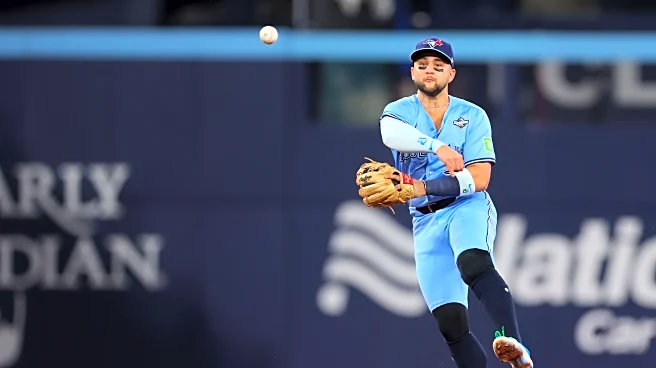
Turns out, that question did not go unanswered for long. Less than 24 hours after missing on Kyle Tucker the Mets signed free agent infielder Bo Bichette for a three year contract worth $126 million. And while there are opt-outs that could lead to an early exit from Queens, the fact of the matter is that, at least for 2026, Bo Bichette will be a New York Met.
Bo Bichette has spent the entirety of his career playing for the Toronto Blue Jays. He was drafted in the second round of the 2016 MLB draft, and made his debut in July of 2019, forming a formidable homegrown duo with Vladimir Guerrero Jr. In his seven seasons in Toronto, he hit .294/.337/.469 with 111 home runs, 437 runs batted in, and a career 122 wRC+. He accumulated 20 fWAR in his time in Toronto.
In his last season in Toronto Bichette hit .311/.357/.483, hitting 18 home runs and driving in 94 runs. He had a 134 wRC+, his second-best career mark, just after his abbreviated 2019 after his call-up. He accumulated 3.8 fWAR, which was short of what he probably could’ve gotten given a late season knee sprain that cost him the final month of the season and most of the playoffs. He was able to make a miraculous return in time for the World Series, where he had an incredible showing. In seven games he hit .348/.444/.478, with one home run and six runs batted in, adding up to an incredible 165 wRC+.
Now before last season’s excellence, he had the worst campaign of his career in 2024. He hit an abysmal .225/.277/.322 in 81 games, with just four home runs and 31 runs batted in. He was 30% worse than league average with a 70 wRC+, and was worth just 0.3 fWAR. But he also had two separate stints on the injured list that year, including one that cost him multiple months of the season, so he might not have been able to get his footing underneath him with all the injury issues.
He’s not a flawless player. He has never been a player who draws a lot of walks, with a career BB% of 5.7%, and last year had the second highest mark of his career with 6.4%. Over his seven seasons he’s struck out 19.4% of the time, though last season he brought that down to a career low 14.5%. And he’s getting progressively slower each year, only being in the 21st percentile of sprint speed last season.
He’s also never been a great fielder. He’s spent almost his entire career at short with the exception of last year’s World Series when he played second base. His high marks as a fielder were in 2020 and 2024, when he was worth 1 OAA in both seasons (both abbreviated seasons for Bichette as well). Last season he was worth -13 OAA, with all his games at shortstop.
But now he’s going to be playing third base, with Lindor to his left. And his major issue has been his range, not his arm, since he’s had a 0 run value for his arm over his career (which is better than the extreme negative of his range). So if he has to focus less on covering a ton of ground and has Lindor to help him (and Marcus Semien to help cover up the other side of Lindor), he might just be alright at his new position.
After missing out on Kyle Tucker, the Mets quickly pivoted and brought in Bichette to play third and help solidify their lineup. While on paper he’s yet another middle infielder on a team chock full of them, his impending move to third makes the team more flexible and stronger at the plate. There are some concerns to be had about his defense and potential to turn out a clunker of a season, money’s on Bichette being a welcome addition to a Mets team looking for a new identity in the wake of the dismantling of their core.