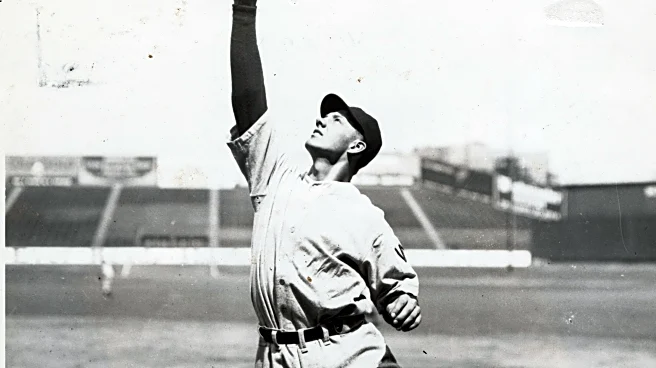

1901 After two seasons with Boston in the National League and ready to take on a bigger role at catcher, Billy Sullivan joined the exodus of players moving from the Senior Circuit to Junior by signing with the White Sox. Sullivan would play with the White Sox for the rest of his career, spanning 13 seasons. The first 12 was as a regular on the roster, with a 13th coming with a one-game cameo in 1914 after sitting out for a year. His career with the White Sox remained the longest in team history for a player until
1925, when fellow catcher Ray Schalk played his 14th (of 17) seasons with the team. Interestingly, it was Schalk, a teammate of Sullivan, who supplanted the senior player as Chicago’s starting catcher. And like his mentor, who managed the team in 1909, Schalk would eventually manage the White Sox as well.
1938
It was a challenge trade of first basemen that ended up as a win for the White Sox.
Chicago sent 29-year-old Zeke Bonura to Washington for 31-year-old Joe Kuhel. Bonura’s first four MLB seasons, all on the South Side, earned MVP votes in 1935 and 1936 and amassed 15.5 WAR and a slash of .317/.396/.487. Kuhel earned MVP votes in 1933 and 1936, but had suffered some pitfall seasons as well.
Neither player was any good in 1938, and both bounced back in 1939 (Bonura having moved on to the New York Giants and a 3.5 WAR, Kuhel a 3.2 WAR and 21st in MVP voting), but Kuhel also was a start in 1940 (3.7 WAR, 13th in MVP voting). Bonura continued to slump and was out of the majors by 1941, while Kuhel (flip-flopping once more to Washington and the White Sox again) would play until age 41. Over 18 seasons in the game, Kuhel put up 30.5 WAR and is regarded by JAWS as the 84th-best first baseman ever.
1942
White Sox manager Jimmy Dykes granted Black players Jackie Robinson and Nate Moreland a tryout with the White Sox, while the Pale Hose conducted spring training in Pasadena, Calif. Neither player made the cut.
After also failing to make the Boston Red Sox after a tryout, Robinson was signed to play for the Kansas City Monarchs three years later, becoming an All-Star as a rookie and breaking the color barrier in MLB in 1947. Moreland had pitched in 15 games for the Baltimore Elite Giants of the Negro Leagues in 1940, but would pitch in just one more Negro League game after his tryout with Chicago.
Interestingly, the White Sox were on the brink of a trade to bring Robinson to the White Sox in 1955, but the Cincinnati Reds claimed him on trade waivers, nixing the deal.
1964
The White Sox purchased the contract of veteran pitcher Don Mossi from the Tigers for $20,000. Mossi would have a spectacular season for the White Sox — who lost the pennant by one game — going 3-1 with seven saves and an ERA of 2.92. Mossi teamed up with Hoyt Wilhelm and Eddie Fisher to give the club the best bullpen in the league.
At the end of the year, however, Mossi was released.
1981
Carlton Fisk officially and finally signed a free agent deal with the White Sox, beginning the process of turning a purse-string organization into a competitive major league franchise. The All-Star catcher and future Hall-of-Famer got his free agency after the Red Sox did not tender him a contract by the CBA’s required date. Immediately, White Sox co-owner Eddie Einhorn and GM Roland Hemond jumped at the chance to get a player of Fisk’s caliber on to the team. For more than a week Fisk’s five-year, $2.9 million contract went unsigned, as minor tweaks to the deal continued.
Fisk would play 13 years on the South Side, make four All-Star teams as a member of the White Sox, and have his No. 72 retired in 1997. At the time he retired, he also held the team record for most home runs, as well as most home runs in MLB history hit by a catcher. His two best seasons were in 1983 (when he rebounded from a very slow start to hit .289 with 26 home runs and 89 RBIs for the Western Division champions, finishing third in the MVP voting) and 1985, his career season (Fisk hit only .238, but blasted 37 home runs with 107 RBIs).
2016
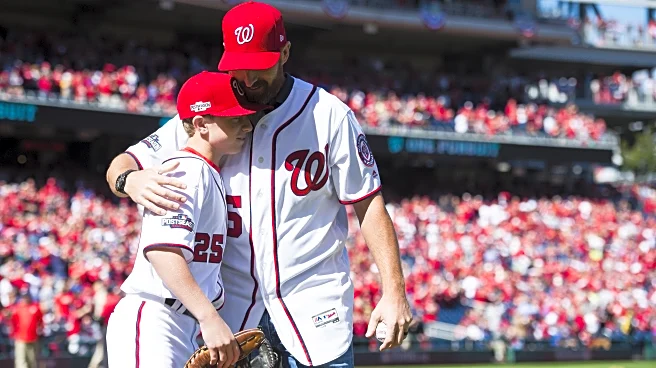
The ongoing embarrassment that surrounded the retirement of Adam LaRoche ended, at least officially, with a statement released by the player explaining his side of the story.
Just hours earlier, Chris Sale had kicked off what would be an utterly bizarre year for him by speaking out in support of LaRoche — and against his own GM, Ken Williams. As South Side Sox’s Josh Nelson wrote in his story on Sale, collectively “the White Sox unlocked a new level of awkwardness by making a dumb situation even dumber.”
The crux of the biscuit came down to LaRoche claiming that, contrary to what was promised when he signed with the White Sox, his son Drake recently had been completely banned from spring training — on-field, in locker room, full stop. Williams proffered that he’d spoken to Adam about lessening Drake’s constant presence with the team (as prompted by players like Jimmy Rollins, who talked to the GM about this strange, unprofessional and intrusive arrangement), lost his cool when after that he saw Drake on the pitcher’s mound during infield practice and issued a complete ban, then subsequently walked that back somewhat.
The 2016 season would end up fairly tainted by the incident, as White Sox stars Sale and Adam Eaton lined up in loony support of the LaRoches. Sale saved his greatest embarrassment for later in the year, however, when on July 23 he shredded 1976 throwback jerseys in the clubhouse with a knife before his scheduled start.