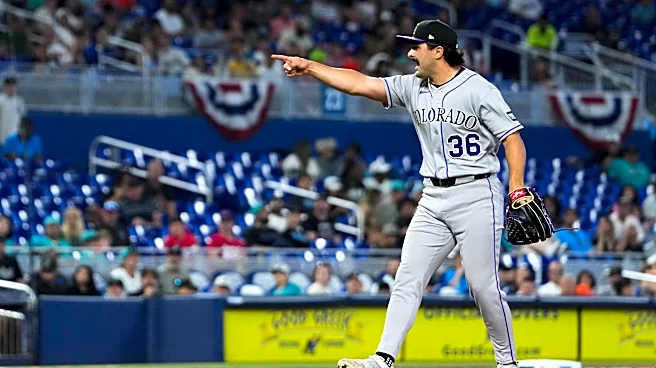






Welcome to the 2026 edition of Ranking the Rockies, where we take a look back at every player to log playing time for the Rockies in 2026. The purpose of this list is to provide a snapshot of the player in context. The “Ranking” is an organizing principle that’s drawn from Baseball Reference’s WAR (rWAR). It’s not something the staff debated. We’ll begin with the player with the lowest rWAR and end up with the player with the highest.
No. 32, Zach Agnos (0.1 rWAR)
No Rockies pitcher had a more unusual collection of assignments
in 2026 than Zach Agnos.
He made three starts, earned two saves, regularly worked multiple innings out of the bullpen and pitched in just about every game situation imaginable. By season’s end, he’d logged 91 innings, nearly 39 more than his previous professional high.
He also finished with a 5.93 ERA.
Agnos was more useful than good, but there were stretches of effective pitching and some encouraging developments in his arsenal that suggest he might have more to offer.
2026 statistics
Source: Baseball Reference.
A little bit of everything
Agnos entered 26 of his 38 relief appearances with Colorado trailing, including 13 when the Rockies were behind by at least four runs. For a team that lost 104 games, pitching from behind was hardly unusual.
The Rockies generally weren’t asking him to escape inherited jams, either. He began 31 of his relief appearances with a clean inning and was often left to cover two or three.
There were opportunities to finish victories, too. On April 8 against Houston, Agnos worked 3.1 innings to earn his first save of the season. He added another on April 26 against the Mets.
On May 21 against Arizona, Agnos made his first start since high school.
He retired the first six Diamondbacks he faced. He ran into trouble in the third, walking Adrian Del Castillo and allowing a single to Ketel Marte, but got Corbin Carroll to line out to center to end the inning.
He then retired all six hitters he faced in the fourth and fifth, finishing with five scoreless innings, one hit, one walk and four strikeouts.
Colorado lost 2-1, but Agnos had done his part.
Five days later, he allowed seven earned runs in two innings against the Dodgers, including a home run by Mookie Betts.
Five days after that, the Giants scored seven earned runs against him in one inning.
Fourteen earned runs in three innings, immediately following five scoreless innings against Arizona.
Two months of genuinely good pitching
In July and August, Agnos allowed just six earned runs over 27.1 innings, posting a 1.98 ERA. He walked four batters, struck out 17 and continued working primarily in multi-inning appearances.
All six earned runs came in two appearances.
On July 22 against Washington, Agnos entered with two outs in the seventh and the Rockies trailing 5-0. He allowed three consecutive singles and two earned runs before recording the third out. He stayed in the game long enough to cover 2.1 innings, allowing seven hits and three total runs.
On August 21 against Cleveland, Patrick Bailey hit a three-run homer off Agnos, who eventually allowed four earned runs in 2.1 innings.
Those were the only two appearances in July and August in which Agnos allowed an earned run.
Every other outing was scoreless.
On July 6 against the Dodgers, he threw three scoreless innings, allowing one hit. On August 5 against Tampa Bay, he worked two hitless innings.
For two months, Agnos wasn’t just effective. He was excellent. But that performance was a dramatic departure from his struggles earlier in the season, and he couldn’t sustain it through September.
The difference between those three stretches is striking:
Source: Baseball Reference.
Agnos allowed multiple earned runs in each of his final five appearances.
It’s fair to wonder whether the workload caught up with him. His 91 innings were well beyond the 52.1 he’d previously thrown in a professional season. His velocity was also down across all six pitches in his final appearance on September 22, although it had remained largely normal earlier in the month.
Something different in the arsenal
Agnos didn’t just take on different assignments in 2026. He also changed what he was throwing.
After relying on four pitches in 2025, Agnos added a slider and sinker to his repertoire. The slider was particularly interesting against left-handed hitters, producing a positive five-run value. Overall, opponents hit just .161 against it.
Agnos threw his splitter less frequently than he had in 2025, but opponents hit just .194 against it in 2026. It also generated a 41.9% whiff rate, easily the highest of his six pitches.
His sweeper also showed promise, holding opponents to a .220 average while generating a 34.6% whiff rate.
The results weren’t nearly as encouraging across his entire arsenal. Baseball Savant’s run value data highlights some significant differences depending on which side of the plate hitters stood:
2026 pitch run value by batter handedness. Positive values favor the pitcher; negative values favor the hitter. Source: Baseball Savant.
Agnos threw his four-seam fastball and cutter more than any other offerings, accounting for nearly half his pitches. Opponents hit .306 against the four-seamer and .359 against the cutter.
Agnos struck out just 14.3% of opposing hitters, placing him in the second percentile among major-league pitchers. He did lower his walk rate from 12.3% in 2025 to 8.6% in 2026, while also improving his hard-hit and barrel rates.
The individual results from his secondary pitches suggest Agnos has something to work with. The challenge is finding a way to turn those pitches into more strikeouts and better overall results, particularly when his most frequently used offerings have been so hittable.
Where does Agnos stand heading into 2027?
Agnos made three starts, posting a 1.69 ERA over 10.2 innings, compared to a 6.50 ERA in 80.1 innings as a reliever. That’s a considerable difference, although three starts are not enough to establish him as a rotation candidate. His more likely role remains that of a multi-inning reliever, something the Rockies leaned on him heavily for in 2026.
But he’s hardly the only pitcher capable of filling that role. Colorado has other young pitchers who could benefit from those opportunities, and as the organization works to improve its pitching staff, there should be more competition for those innings.
At 26, Agnos is still under team control and won’t be arbitration-eligible until 2028. He also has minor-league options remaining, giving Colorado some flexibility to keep him around without committing to a permanent spot in the major-league bullpen.
That works in his favor, but only to a point. His versatility helped him accumulate 91 innings in 2026, but a 5.93 ERA isn’t going to do much to protect his opportunities as better pitching becomes available.
Whether Agnos can turn the promise of his secondary pitches into more consistent results may determine how much longer that versatility remains valuable to Colorado.
Join the conversation!
Sign up for a user account and get:
- Fewer ads
- Create community posts
- Comment on articles, community posts
- Rec comments, community posts
- New, improved notifications system!
Download the SB Nation app on iOS or Android.
Please keep in mind ourPurple Row Community Guidelines when you’re commenting. Thanks!