





Looking back, it was my first chapter as a Sunderland supporter… the years from 1972 until I left home for Manchester in the autumn of 1978. The years when football became more than a game, when Sunderland became more than a club. The years when heroes were discovered and Saturdays were built around a trip to Roker Park on the Roberts coach. Bovril, pies and James Alexander Gordon.
The glow of the 1973 FA Cup Final victory shone on. I was lucky. I had been to that glorious day at Wembley, a nervous
teenager at one of the greatest moments in the club’s history. But as a schoolboy, I was learning something important about football. A cup run is a sprint. A league season is a marathon.
The following season was an early lesson in following Sunderland. It brought me straight back down to Earth. Every other team and its supporters wanted to beat the FA Cup holders. The Second Division didn’t care about nostalgia. Surely, though, the FA Cup triumph would be the springboard to First Division football? Well, not immediately.
The seasons that followed were less glamorous. The magic of Wembley remained, but the league campaign demanded something different. Consistency, resilience and the ability to grind out results over a long season. In 1973/74 Sunderland finished sixth in the old Second Division. A respectable finish, but well short of expectation. The following campaign saw some progress, but again promotion proved just beyond reach, with Sunderland finishing fourth. By the summer of 1976, though, Sunderland had finally turned promise into achievement. Under Jimmy Adamson, the club rebuilt and promotion was won.
It was in this period that Melville George Holden arrived.
Football tends to remember the winners. The players who lift trophies. The players who score iconic goals. The players whose careers last long enough for legend to blossom. Then again, football history also belongs to those whose stories were interrupted. Mel Holden belongs in that category.
Born in Dundee, Mel’s talent was spotted by Preston North End, where he joined their youth system and progressed through the traditional route of the era – youth football, reserve team football and eventually the first team. This was before academies, performance centres and carefully managed development pathways. Young players learned their trade by playing.

Mel had made his Preston debut as an 18 year old and quickly established himself as one of their brightest attacking prospects. He scored 22 goals in 72 appearances before Sunderland came calling. Jimmy Adamson saw something. In 1975, Sunderland paid £120,000 to bring the young lad to Roker Park.
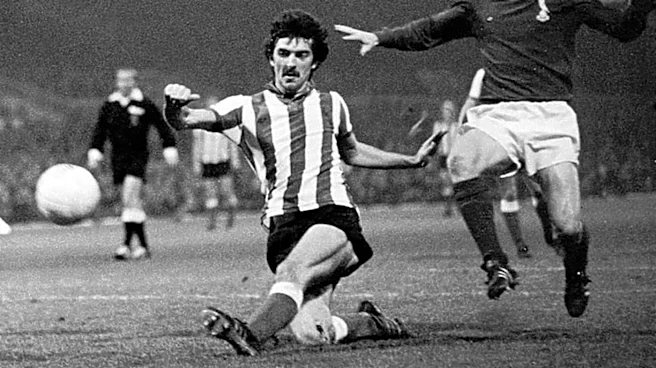
Mel arrived as exactly the type of player Sunderland needed. Young, hungry and with the potential to be a key figure in the next chapter of the Club’s story. He wasn’t simply a traditional target man. Lean and strong, brave in the challenge and dangerous in the air, he had intelligence and movement. He understood space. He could link play. Most importantly, he knew where the goal was.
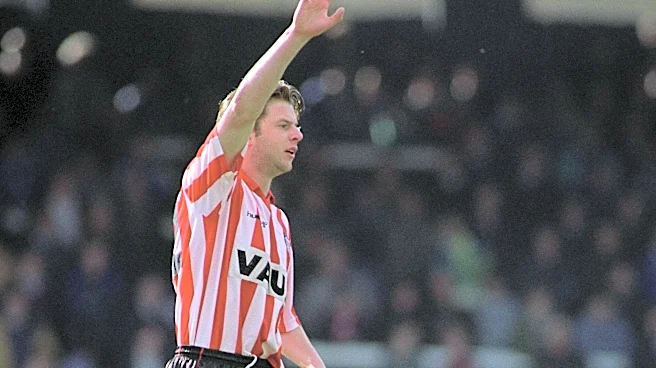
For most Sunderland fans, it didn’t take long to recognise that this was a player who could become really important. For me and my school mates, Super Mel became our favourite. We liked our forwards, and here was a new one to cheer. He wasn’t perfect. Sometimes he’d look a bit awkward. Sometimes he seemed to make football harder than it needed to be. For us that was part of his appeal. He felt like one of us. And then, suddenly, he’d produce a moment of magic. “Rising like a salmon” was the phrase we often used as we watched from a packed Fulwell End. Get in! Great days.
Mel was part of the promotion winning team of 1976 and the relegation side of 1977. He finished his Sunderland league career in 1978 with 23 goals in 73 appearances, a decent return.
1978 was to be a time of real change. Jimmy Adamson departed, Billy Elliott took charge and the squad was evolving. For me, change was coming too. I was leaving home and heading north-west to Manchester. The first chapter of my Sunderland-supporting journey was ending. And, so was the era of Mel Holden at Roker Park.
Mel moved on from Sunderland, joining Blackpool briefly, before continuing his career in the Netherlands with PEC Zwolle. At the time, nobody knew that the football future he was chasing was about to be cruelly taken away. Mel was diagnosed with motor neurone disease. This was at a time when the understanding of the condition was far less advanced than today. The diagnosis brought a devastating end to his football career. He was still only in his early twenties. Instead of more football, more memories and more goals, Mel faced a battle against a cruel illness. He died on 31 January 1981, aged just 26.
For me, my school friends and perhaps many Sunderland supporters, the sadness was not simply losing an ex player. It was losing a favourite. It was losing someone who had been part of our story. That’s why Mel Holden has a special place in my heart.
Because football is not only about the players who become legends. It is also about the players who travel with us through important moments in our own lives. Mel Holden was there during my first chapter as a Sunderland supporter. The chapter of school friends, Roberts’ Coaches, Roker Park Saturdays and swaying in the Fulwell End. Ups and downs. Now many years later, I look back and remember that those moments were precious. Mel Holden was not just a Sunderland player, he’s part of my, my friends and many others’ Sunderland story.
Some players never leave do they? They stay exactly where we found them… rising above defenders in front of The Fulwell End, a flash of red and white, flicking the ball in the top corner. Super Mel Holden.